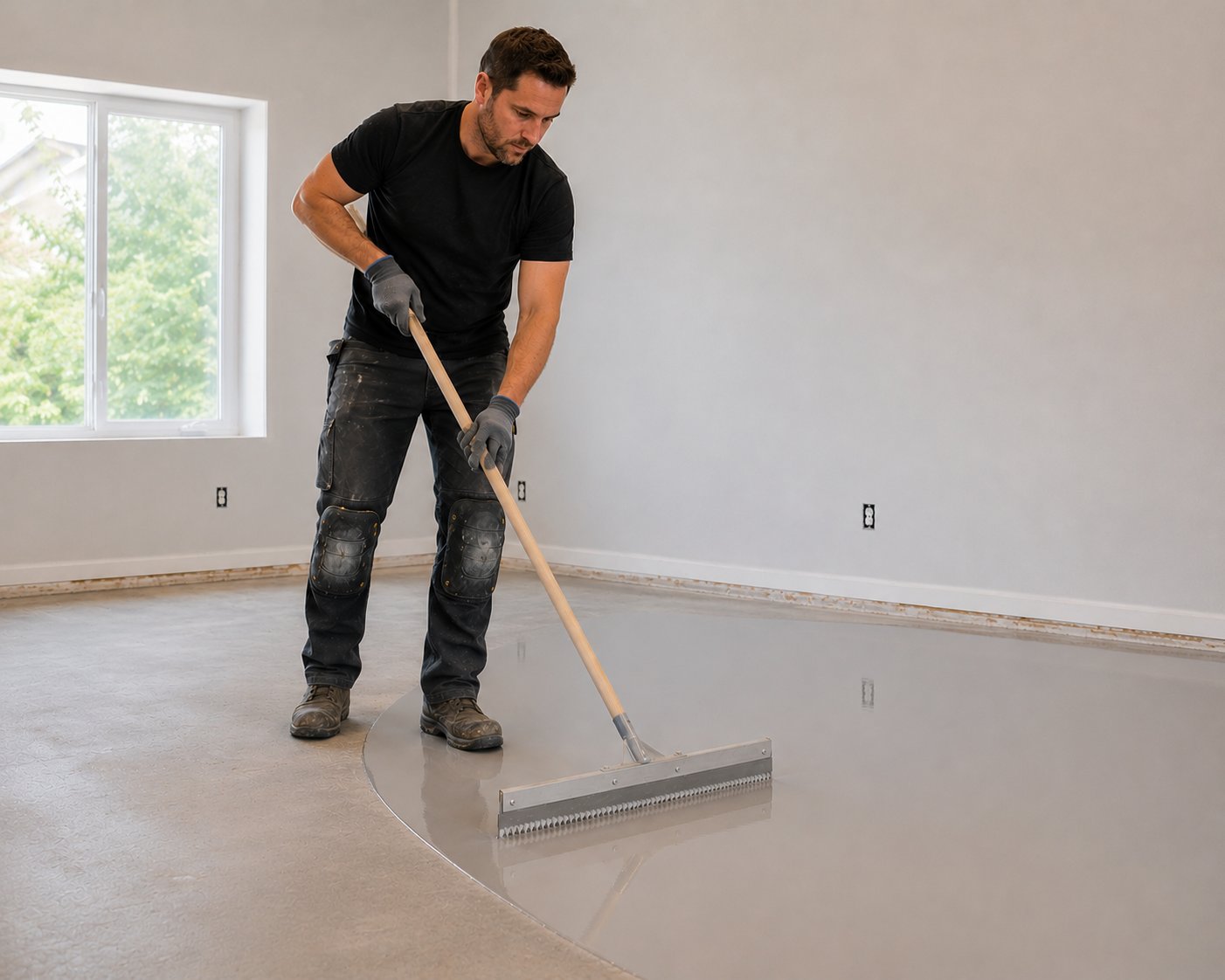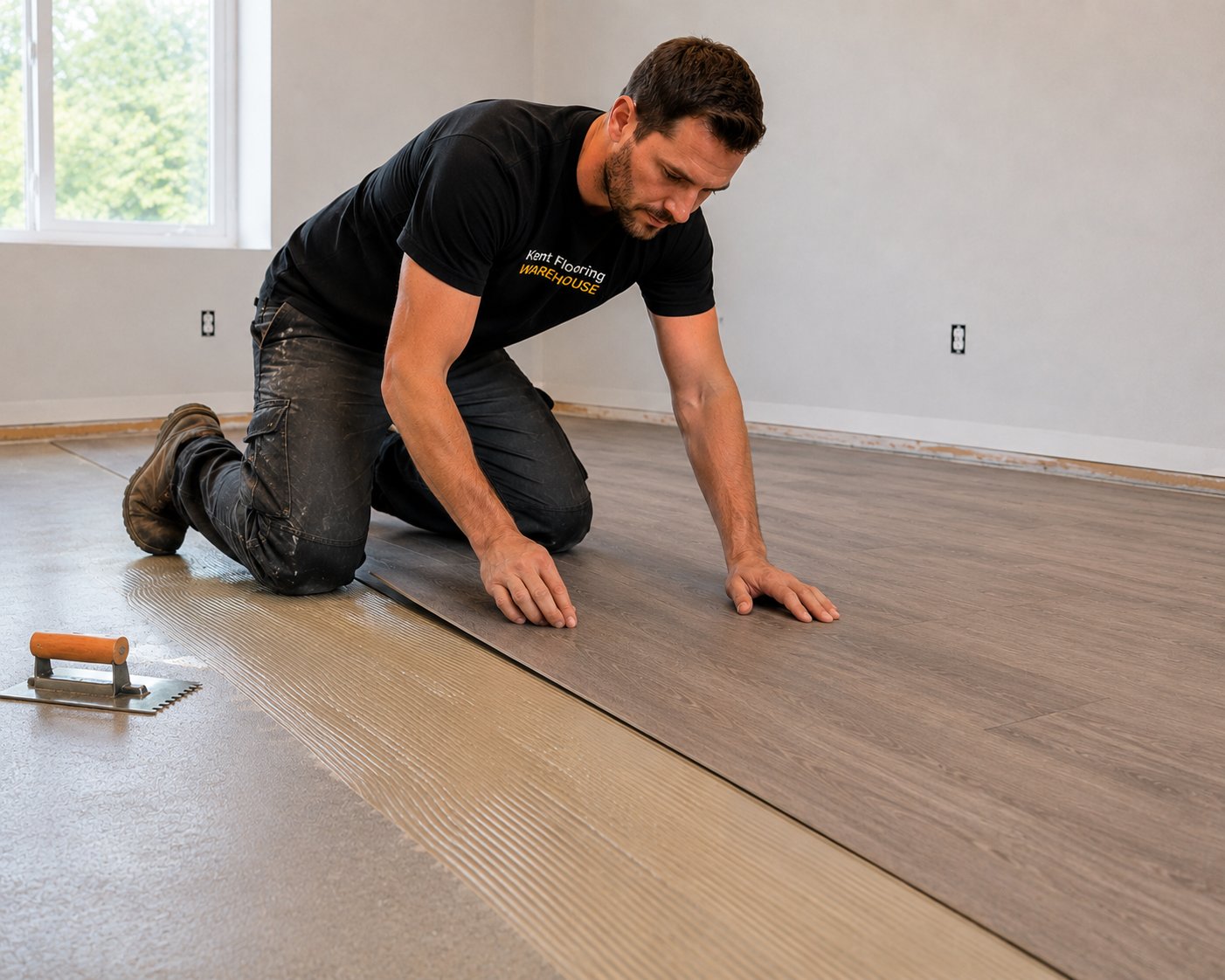
A Dartford floor after latex screeding (low angle)

Subfloor preparation · Dartford, DA1

Latex Self-Levelling Screed Before New Flooring — Dartford

Latex self-levelling compound before carpet, LVT or vinyl in Dartford. Primers, depths and cure times explained by our fitters.

Subfloor preparation page — Explains when a latex self-levelling screed is needed before flooring in Dartford and how it is applied correctly.

Ex-council stock in Dartford can include concrete floors poured to a standard spec, which helps prediction, though individual repairs over the years still need checking.

Most uneven or patchy concrete and sand-cement floors need a latex self-levelling compound poured over them before new flooring goes down. Skipping this step leaves lumps and hollows that telegraph straight through vinyl, LVT and thin-backed carpet, so it is one of the most common preparation jobs on any refit in Dartford.

Depths, mixing and application

Latex is mixed to the manufacturer's water ratio and poured in a continuous run where possible to avoid cold joints. It is worked with a trowel or spike roller to release trapped air and settle to a flat plane, using a laser or straight edge as a guide on larger areas.

SituationTypical depthCompound type
Minor unevenness before LVT/vinyl1-3mmStandard latex
General smoothing before carpet or laminate underlay2-5mmStandard latex
Uneven old tiles or dips over 5mm5-10mm+Fibre-reinforced latex
Feather edges at doorways or thresholdsDown to 0mmStandard latex, trowel finish

Absorbent vs non-absorbent substrates

The substrate underneath dictates the primer. Absorbent bases such as sand-cement screed, concrete or sound plywood need a diluted acrylic primer that soaks in and seals the surface, stopping the latex drying too fast and cracking. Non-absorbent bases such as old ceramic tiles, terrazzo or well-bonded epoxy need a different bonding primer, sometimes with a fine sand broadcast into it while wet, to give the latex something to grip.

  • Sand-cement screed: dilute acrylic primer, one or two coats depending on porosity
  • Concrete slabs: primer plus a moisture check before committing to latex
  • Old ceramic or quarry tiles: bonding primer with sand broadcast for mechanical key
  • Plywood: primer suited to timber, never latex direct onto bare ply
  • Painted or sealed floors: existing coating usually needs mechanical removal first

Subfloors we meet in Dartford

Ex-council stock in Dartford can include concrete floors poured to a standard spec, which helps prediction, though individual repairs over the years still need checking.

Ex-council stock in Dartford can include concrete floors poured to a standard spec, which helps prediction, though individual repairs over the years still need checking.

Our day-to-day working area

Where we fit

  • Greenhithe
  • Crayford
  • Temple Hill
  • Joydens Wood
  • Stone

Approach roads

  • M25 Junction 1A/2
  • A2
  • A282 Dartford Crossing

Postcode district DA1, Dartford Borough Council.

Commercial sites

  • Bluewater
  • Crossways Business Park
  • The Bridge

Fibre-reinforced vs standard compound

Standard latex compound is fine for thin fills and general smoothing up to a few millimetres. Where the floor needs building up more, or where there is slight movement in the base such as over old tiles or timber, a fibre-reinforced compound is used instead. The fibres hold the pour together and resist cracking under load, which matters in hallways, commercial areas and anywhere with heavy foot traffic.

  • Standard latex: thin smoothing coats, typically 1-3mm
  • Fibre-reinforced latex: deeper fills and higher-traffic or slightly flexible bases
  • Pumped latex: large open areas, faster application, consistent depth
  • Hand-applied latex: smaller rooms, cut-in areas, repairs to existing pours

How we handle your home or premises

  • Samples brought to you so the choice is made in the room itself.
  • Fitted by our own team — we do not subcontract the installation.
  • Subfloor preparation written into the quote rather than added later.
  • Supplied direct from our own warehouse stock.
  • One point of contact from survey through to the finished floor.
Where we are

Unit 9, Matilda Close, Gillingham Business Park, Gillingham

We reach Dartford via the M25 Junction 1A/2, and cover the wider DA1 district as part of our normal round.

What we check before quoting latex screeding in Dartford

  • Confirm which primer is needed for the existing subfloor before latex is ordered
  • Check whether the base is absorbent or non-absorbent before priming
  • Ask whether standard or fibre-reinforced latex is right for the depth involved
Latex Screeding detail photographed on a Dartford project (pattern detail)

Get your subfloor checked in Dartford

Book a free survey and we will tell you honestly whether latex screeding is needed before your new floor goes down.

07702 737267

Free latex screeding quote

Free site survey · No obligation · Response within 1 working hour

Recent latex screeding in and around Dartford

Latex Screeding detail photographed on a Dartford project (pattern detail)
Materials acclimatising on site in the DA1 area (on arrival)
Final sweep and inspection on a Dartford floor (signed off)

Our own photographs, used to show construction detail and finish. They are illustrative rather than tied to a specific property.

What happens, in order

  1. Step 1

    Assess and prime

    Inspect the substrate, remove loose material, and apply the correct primer for an absorbent or non-absorbent base.

  2. Step 2

    Mix to spec

    Mix standard or fibre-reinforced latex to the manufacturer's ratio, matching the compound to the depth and use of the room.

  3. Step 3

    Pour and level

    Pour in a continuous run, spread with a trowel or spike roller, and check the surface against a straight edge or laser line.

Points worth clearing up

Does every floor need latex screeding before new flooring?

No, a sound, flat and clean subfloor may not need it. It is used where the existing base is uneven, patchy, or made of a material such as old tiles that needs a smoothing layer for the new floorcovering to sit correctly.

Can latex go straight onto old ceramic tiles?

Only with the correct bonding primer and usually a sand key. Loose, cracked or hollow-sounding tiles need to be addressed first, as latex will not stabilise a failing tiled surface underneath it.

How thick can a latex pour be?

Standard latex suits thin smoothing coats, while fibre-reinforced compound is used for deeper fills. Very large discrepancies in level are better addressed with a proper screed rather than a thick latex pour alone.

Will latex screeding delay my fitting day in Dartford?

It adds a preparation visit and a curing period before flooring can be fitted, which we build into the schedule when we quote your job in Dartford so fitting day still goes ahead as planned.

Bottom line

Latex self-levelling screed gives new flooring a flat, sound base to sit on. Getting the primer, depth and cure time right in Dartford avoids problems appearing months down the line.

Get your subfloor checked in Dartford

Book a free survey and we will tell you honestly whether latex screeding is needed before your new floor goes down.

Free quote