Click LVT vs Glue-Down LVT
Click LVT or glue-down LVT? Compare stability, feel, subfloor needs and cost before choosing your fitting method.
Once you've settled on LVT, there's a second decision that gets far less attention than it deserves: click (floating) or glue-down (fully bonded). It affects the feel, longevity and subfloor requirements of the finished floor.
Both are genuinely good options — this isn't a case of one being the 'proper' way and the other a shortcut, and we fit both regularly depending on the room and subfloor.
Noise and heat transfer both come into the decision too: click systems typically perform slightly better acoustically thanks to their underlay, while glue-down systems usually win on heat transfer where underfloor heating is a priority in the room.
How each system actually works
Click LVT planks or tiles interlock along their edges and float above the subfloor on a separate underlay, similar in principle to laminate.
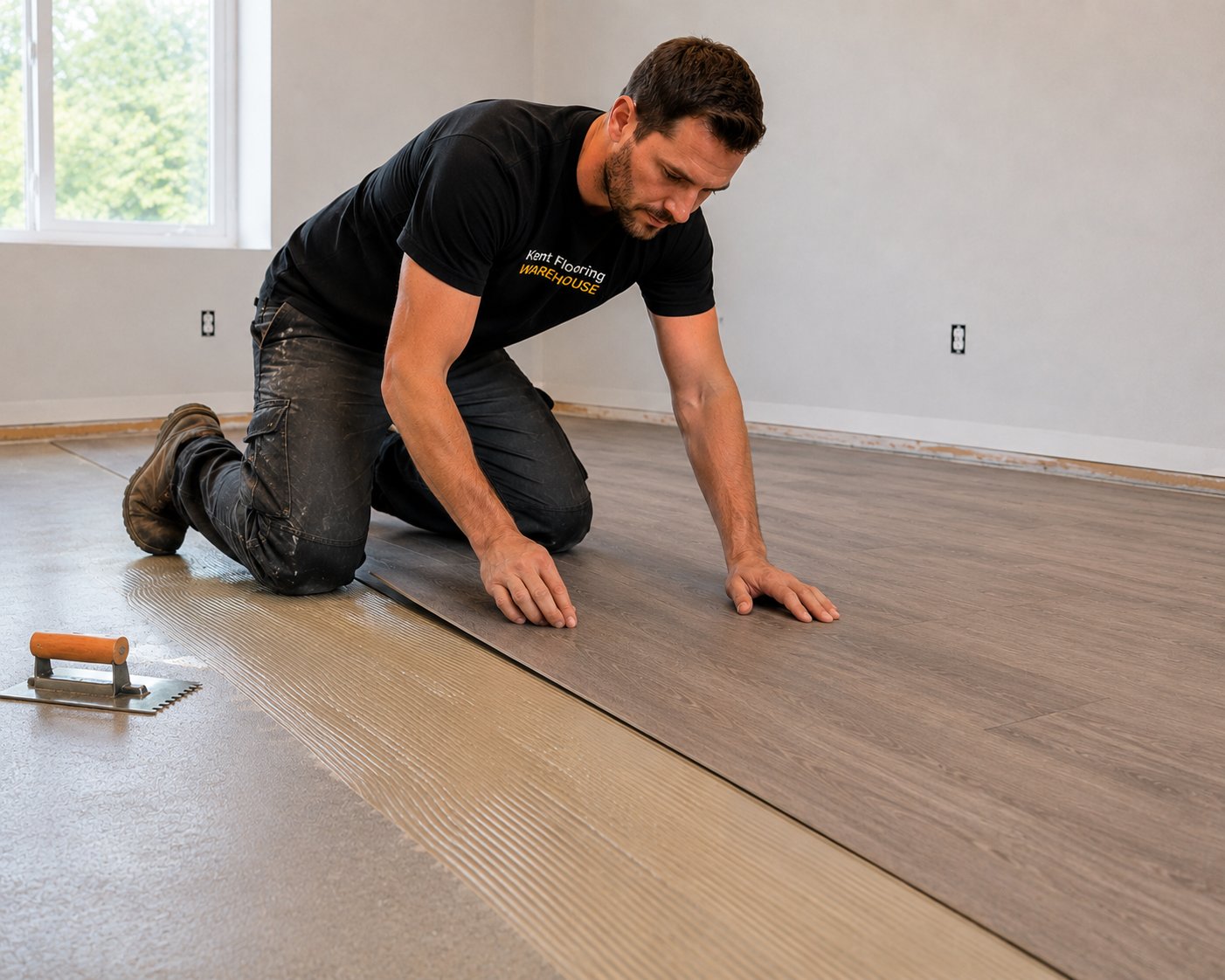
Glue-down LVT is bonded directly to the subfloor with adhesive across its full surface, so there's no floating layer and no click joints to maintain.
Stability and feel underfoot
- Glue-down LVT sits completely flat and solid, with no give or movement, which many customers prefer for a premium, substantial feel.
- Click LVT has a very slight amount of give from the underlay and can occasionally develop minor joint movement over a very long time in busy areas.
- Both feel very similar to walk on when correctly fitted; the difference is more noticeable to a trained eye or under close inspection.
Subfloor requirements
Glue-down LVT demands a very flat, sound, properly prepared subfloor since every imperfection can telegraph through the thin bonded layer over time.
Click LVT is somewhat more forgiving of minor subfloor imperfections because the underlay and floating action absorb small irregularities.
Comparing the two fitting methods
| Attribute | Click LVT | Glue-Down LVT |
|---|---|---|
| Subfloor tolerance | More forgiving of minor imperfections | Needs a very flat, sound subfloor |
| Feel underfoot | Slight give from underlay | Completely flat and solid |
| Suitability for large commercial areas | Less common at scale | Preferred for large/commercial floors |
| Guide cost band (supplied & fitted) | ££ to £££ | ££ to £££, plus subfloor prep if needed |
Which rooms and jobs favour each method
Click LVT works well in most domestic rooms and is the quicker of the two to fit, which can suit tighter timeframes.
Glue-down is our usual recommendation for larger open-plan areas, commercial spaces, and rooms with underfloor heating where full contact with the subfloor improves heat transfer.
Repairs and future changes
A damaged click plank can sometimes be lifted from an edge and replaced relatively easily, particularly nearer the perimeter of a room.
A glue-down plank is more involved to remove since it's bonded, though it's still a manageable, targeted repair rather than a full floor replacement.
Cost implications beyond the product price
Click LVT's guide cost is often similar to glue-down for the product itself, but the overall job cost can differ once you factor in underlay for click systems versus adhesive and, frequently, more extensive subfloor preparation for glue-down.
Glue-down jobs can also cost more in labour where the subfloor needs additional levelling first, since any dip or high spot will show through a bonded floor far more readily than a floating one.
It's also worth considering how each performs if you ever move house and want to take the flooring with you: click LVT can, in principle, be lifted and relaid elsewhere if handled carefully, whereas glue-down LVT is permanently bonded and effectively becomes part of the property rather than a removable asset.
Frequently asked questions
- Is glue-down LVT better for underfloor heating?
- Yes, generally — full contact with the subfloor via adhesive transfers heat more efficiently than a floating floor with an underlay layer, though many click products are still rated for UFH use.
- Can I fit click LVT myself and have you do glue-down later?
- We'd always recommend having the subfloor properly assessed first regardless of method, since preparation is often the deciding factor in how either system performs long-term.
- Does glue-down LVT take longer to fit?
- It typically takes a little longer due to adhesive application and cure times, and often requires more extensive subfloor preparation beforehand.
- Which is quieter underfoot?
- Click LVT with underlay tends to be slightly quieter and warmer underfoot than glue-down, which sits in more direct contact with the subfloor.
Keep reading
LVT or laminate? Compare water resistance, feel underfoot, durability and guide costs to pick the right floor for your room.
Sheet vinyl or LVT — which suits a wet room, kitchen or busy hallway best? Compare seams, looks and cost.
Herringbone or straight plank LVT? Compare visual impact, waste, fitting time and cost for your layout.
LVT explained for first-time buyers: how luxury vinyl tile is built, click versus glue-down fitting, wear layers, and which rooms it suits best in a home.
See how we survey, prepare and fit LVT across Kent.
Talk it through with a fitter, not a call centre
Our fitters will recommend the right method for your subfloor at a free survey — call 07702 737267.