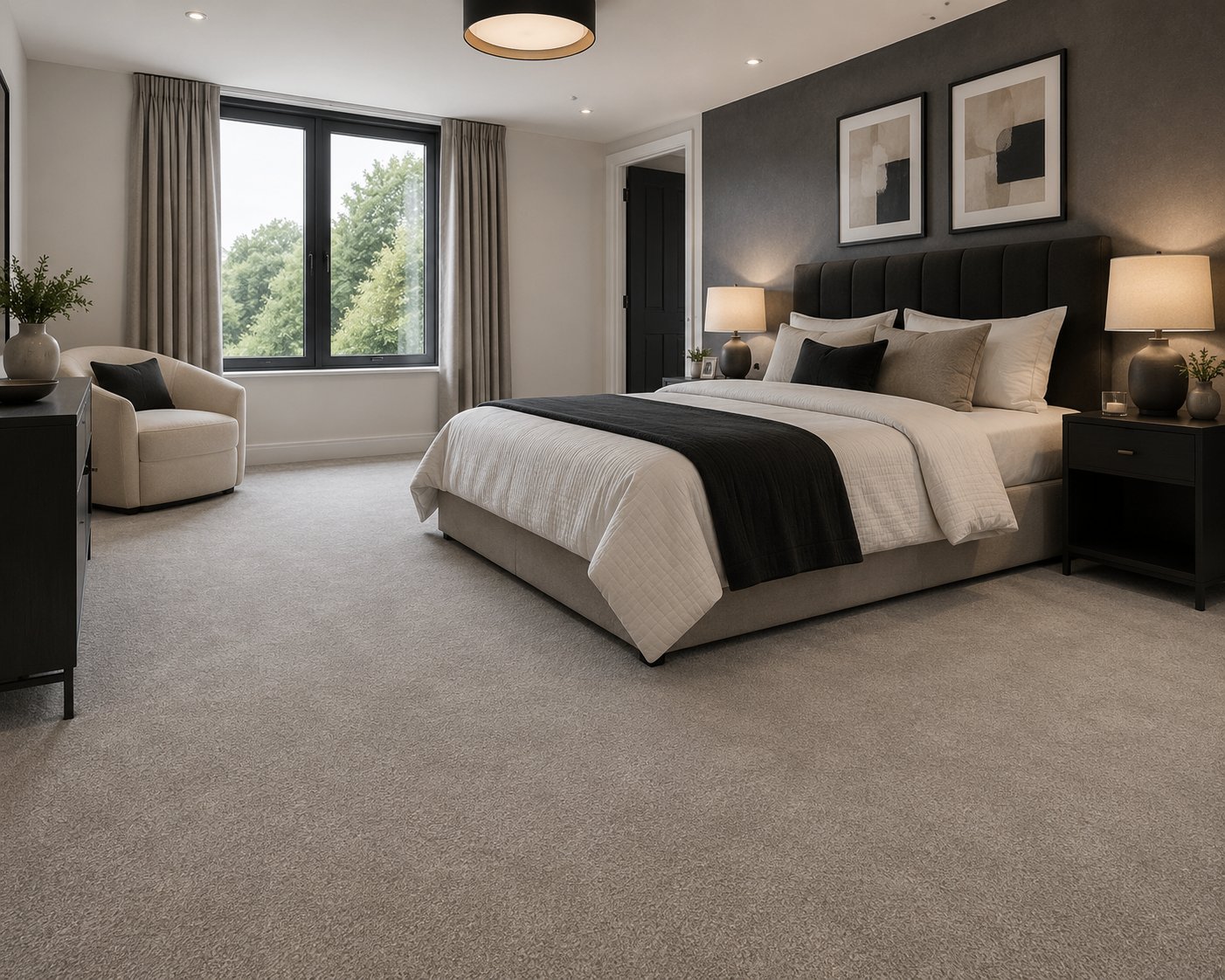
Carpet vs LVT for Bedrooms
Deciding between carpet and LVT for a bedroom? Compare warmth, comfort, allergies and upkeep before you commit.
Bedrooms are one of the few rooms where the 'best' floor genuinely comes down to personal preference rather than practicality alone — there's no dishwasher or muddy back door to force the decision.
We get asked about this most often from customers with allergies, pets that sleep upstairs, or a wood-effect scheme running through the rest of the house that they'd like to continue.
Budget shapes this decision too, though perhaps less than people expect: a good-quality carpet and a mid-range LVT can land in a similar guide price bracket once underlay and fitting are included, so it's rarely the deciding factor on its own.
Warmth and comfort underfoot
Carpet is hard to beat first thing in the morning — it retains warmth well and has genuine cushioning underfoot, especially with a good underlay.
LVT feels cooler to the touch than carpet even with underfloor heating, though a rug beside the bed closes much of that gap.
Allergies and indoor air quality
- Carpet fibres can trap dust, pet dander and pollen, which is a genuine consideration for allergy sufferers, though regular vacuuming manages this well.
- LVT has a smooth, sealed surface that doesn't hold dust the same way and is easier to keep clear of allergens with a simple wipe or vacuum.
- Neither choice is 'wrong' for allergies — it's about ongoing cleaning habits as much as the material itself.
Durability and everyday wear
Bedrooms see relatively light foot traffic compared with hallways or kitchens, so both carpet and LVT tend to last well here regardless of grade.
Carpet can show wear paths near doorways and beds over years, while LVT holds its appearance longer under light domestic use.
Cost and maintenance comparison
| Attribute | Carpet | LVT |
|---|---|---|
| Warmth underfoot | Warm, insulating | Cooler, warms with UFH |
| Allergy-friendliness | Traps dust, needs regular vacuuming | Smooth surface, easy to wipe clean |
| Water resistance | Poor — stains and soaks in | Waterproof surface |
| Guide cost band (supplied & fitted) | £ to ££ | ££ to £££, guide only |
Noise and shared walls or floors
In a flat or a bedroom above a living room, carpet's natural sound absorption is a genuine practical advantage for reducing footstep noise.
LVT can be paired with an acoustic underlay to significantly improve sound performance if a continuous LVT look is preferred throughout the home.
Resale and future flexibility
Carpet is generally the easier and cheaper floor to refresh if tastes change or a room is being redecorated for a new occupant, since re-carpeting a single bedroom is a relatively contained job.
LVT in a bedroom tends to be chosen as part of a wider whole-home look, and while it lasts well, replacing it purely for a style change is a bigger undertaking than swapping out carpet, so it's worth being confident in the design before committing.
Fitting speed also differs slightly: a bedroom carpet with underlay and gripper can usually be completed within a few hours, while LVT in a bedroom, especially if it's glue-down or being tied into a wider whole-floor scheme, can take a little longer to lay and, in some cases, needs time to bond before furniture goes back in.
What the subfloor decides for you
Carpet is the more forgiving of the two over an imperfect base. A thick underlay disguises small undulations, minor board movement and slightly proud fixings that would telegraph straight through a hard floor, so an older upstairs bedroom with springy floorboards can often be carpeted with little more than a check for loose boards and protruding nails.
LVT asks more of the same room. Plank edges sit directly on whatever is beneath them, so board joints, dips and flex all show up in the finished floor as ridges, hollow spots or clicking underfoot. On timber upstairs bedrooms that usually means a plywood overlay screwed down across the boards first; over concrete it can mean a levelling compound.
That preparation is a real part of the comparison rather than an afterthought. Two bedrooms of identical size can produce quite different LVT quotes purely because one needed overlay boarding and the other didn't, which is why we look under the existing floor covering during the survey wherever it can be lifted safely.
Pets, children and the practical stuff
- Claws and carpet loops don't mix well — a cut-pile or twist carpet copes with pets far better than a looped construction, which can snag and pull.
- LVT shrugs off accidents that would mark carpet permanently, which is why it appears more often in bedrooms used by young children or older pets.
- Nursery and toddler rooms often end up as a hybrid: LVT for cleanability with a large washable rug for floor play, giving both properties in one room.
- Bed castors and heavy wardrobe feet can indent both surfaces, so felt pads or cups are worth using regardless of which you pick.
- Radiator pipes, awkward alcoves and fitted wardrobes are quicker and neater to work around in carpet; in LVT they need careful scribing, which adds fitting time.
How to decide in a single afternoon
A short, practical test settles most bedroom debates. Take samples of both home, put them in the room, and look at them in the evening light you actually use the room in rather than under showroom lighting, then stand on each in bare feet.
If warmth, softness and quietness come first, carpet will almost certainly be the floor you're happier with for years. If cleanability, allergy management or continuing one floor finish through the whole upstairs matters more, LVT earns its place — with a rug taking care of the comfort side.
Where a household is genuinely split, the cost of doing both is worth checking rather than assuming: many customers carpet the main bedrooms and use LVT in a box room, spare room or nursery, which keeps each room suited to how it is used instead of forcing one compromise across the whole floor.
Frequently asked questions
- Is carpet still the most popular bedroom floor?
- Yes, carpet remains the most commonly requested bedroom floor because of its warmth and comfort, though we're fitting more LVT in bedrooms for customers with allergies or a whole-home wood-look scheme.
- Can I put a rug on LVT for warmth?
- Yes, a rug works well on LVT and is a simple way to add warmth and softness by the bed without losing the practicality of the hard floor elsewhere in the room.
- Does LVT feel cold at night?
- It's cooler than carpet to bare feet, particularly in winter, though it's not uncomfortably cold and underfloor heating or a bedside rug largely resolves this for most households.
- Which is easier to clean after illness or spills?
- LVT is considerably easier to clean and disinfect after a spill or illness since liquid sits on the surface rather than soaking into fibres, which some households find reassuring.
Keep reading
Wool or polypropylene carpet — compare feel, stain resistance, price and durability before you choose.
Foam, rubber, fibre or PU underlay: which feels softest, which quietens a flat, which lasts on stairs, and which one suits underfloor heating in your home.
LVT or laminate? Compare water resistance, feel underfoot, durability and guide costs to pick the right floor for your room.
See how we survey, prepare and fit carpet across Kent.
See how we survey, prepare and fit LVT across Kent.
Talk it through with a fitter, not a call centre
Whichever way you're leaning, our free survey lets you feel real samples underfoot before you decide — call 07702 737267.