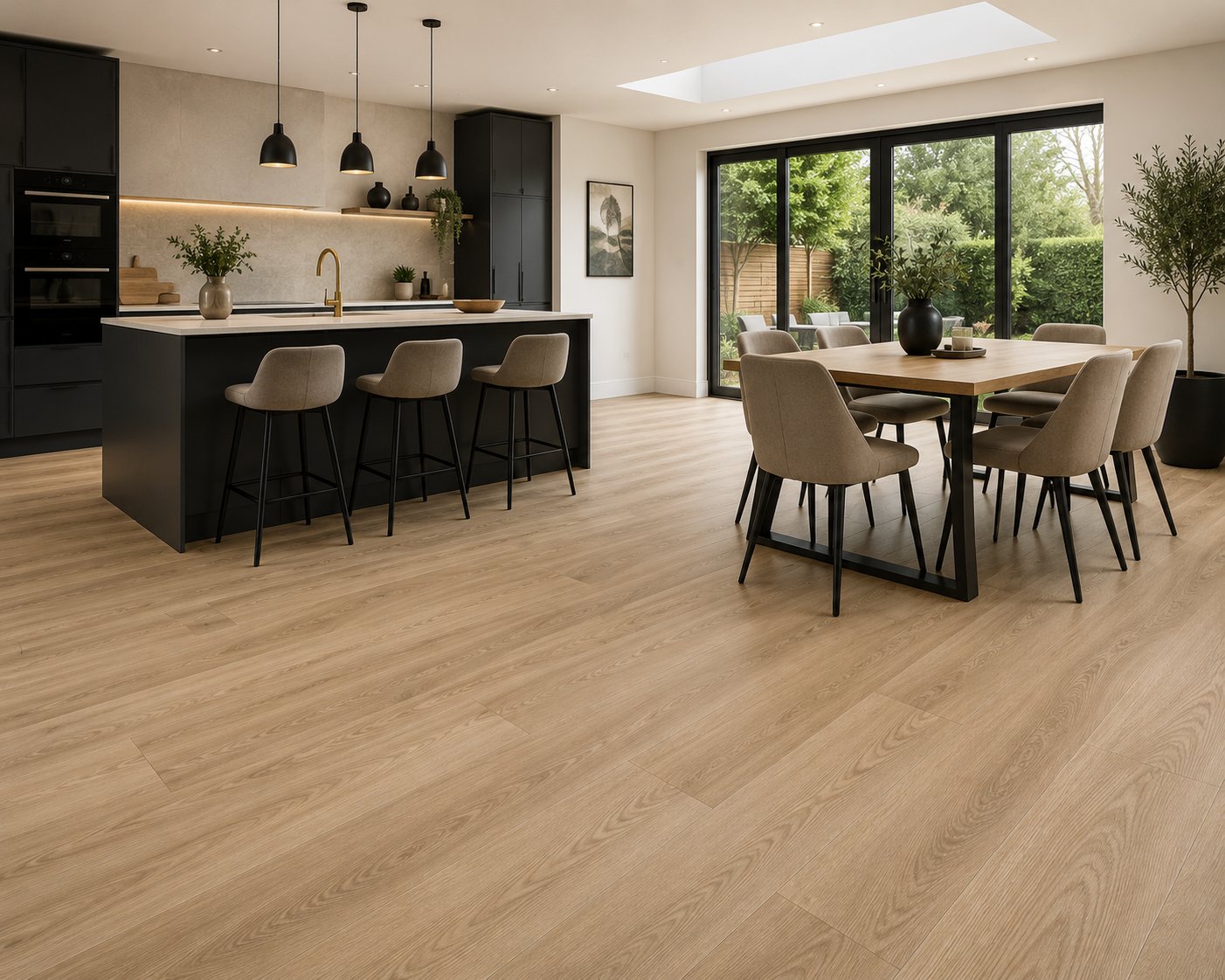
Herringbone Flooring vs Straight Plank LVT
Herringbone or straight plank LVT? Compare visual impact, waste, fitting time and cost for your layout.
Herringbone flooring is a zigzag pattern where short blocks meet at right angles, while plank LVT runs in straight, staggered rows. Herringbone gives a room more character and a sense of craft; plank is calmer, quicker to lay and produces less offcut waste, so it usually costs less to fit.
Once the LVT product is chosen, the laying pattern is what really shapes the character of the finished room. Herringbone and straight plank are the two most requested layouts we fit, and they create noticeably different impressions in the same space.
This decision is largely aesthetic, but it does have real practical implications for fitting time, waste and cost that are worth understanding before you commit.
Chevron, a close cousin of herringbone with planks cut at an angle to form a continuous 'V' rather than a stepped zig-zag, is worth mentioning too, since it creates an even more precise, formal look but generally costs more again due to the additional angled cutting required on every piece.
The visual effect of each layout
Herringbone creates a zig-zag pattern of short planks set at right angles to each other, giving a distinctive, characterful, almost woven appearance that draws the eye and adds a sense of craftsmanship to a room.
Straight plank layouts run boards in parallel rows, either along or across the room, giving a calmer, more contemporary look that can visually lengthen or widen a space depending on the direction chosen.
Fitting time and labour
- Herringbone takes considerably longer to fit than straight plank because each piece must be precisely cut and aligned at 90-degree angles to its neighbours.
- Straight plank fitting is quicker and more straightforward, particularly in regularly shaped rooms with few obstacles.
- Rooms with lots of doorways, alcoves or fitted units add complexity and time to herringbone in particular, since the pattern must be maintained around obstacles.
Material waste and cost implications
Herringbone typically generates more offcut waste than straight plank, since angled cuts don't always yield a usable piece for reuse elsewhere in the room.
This, combined with longer labour time, means herringbone generally costs more to fit than straight plank even using the same LVT product.
Comparing the two layouts
| Attribute | Herringbone | Straight Plank |
|---|---|---|
| Fitting time | Longer, more intricate cutting | Quicker, straightforward |
| Material waste | Higher due to angled cuts | Lower, more efficient use |
| Visual effect | Distinctive, characterful | Clean, contemporary |
| Guide cost band (fitting labour) | ££ to £££ higher labour cost | £ to ££, guide only |
Which rooms suit which pattern
Herringbone tends to suit hallways, living rooms and feature areas where the floor itself is meant to be part of the visual impact of the room.
Straight plank suits larger open-plan spaces, kitchens and bedrooms where a calmer backdrop lets furniture and decor take centre stage.
Planning the layout around doorways and features
Herringbone needs careful planning from a chosen starting point, often the centre of a room or a key sightline from the main entrance, so the pattern reads correctly and doesn't end awkwardly at a doorway or chimney breast.
Straight plank layouts are more forgiving of room shape changes and can usually be adjusted on site with less impact on the overall look, which is one reason it remains the faster, lower-risk choice for irregularly shaped rooms.
Mixed-width plank layouts sit as a middle option worth mentioning too, combining two or three plank widths in a random repeating pattern to add visual interest without the labour cost of a full herringbone lay, which some customers choose as a compromise between the two extremes.
Frequently asked questions
- What does herringbone mean in flooring?
- It describes the laying pattern, not the material. Short rectangular blocks are set at right angles to each other so the floor forms a repeating zigzag, similar to the bones of a fish. The same pattern can be laid in LVT, engineered wood or laminate made for it.
- Is herringbone LVT harder to fit than plank?
- Yes. Every block has to be set out from a centre line and cut accurately at the edges, so it takes longer and creates more offcuts than straight planks. The subfloor also needs to be flat, because pattern floors show any dip or ridge more clearly.
- Is herringbone LVT much more expensive than straight plank?
- The material cost can be similar depending on the product range, but labour costs are generally higher for herringbone due to the additional cutting and alignment time involved.
- Can herringbone be fitted in a small room?
- Yes, and it can actually make a small room feel more considered and characterful, though tighter spaces do mean proportionally more cutting relative to the floor area.
- Does herringbone work with glue-down LVT only?
- It's most commonly fitted as glue-down for maximum stability given the number of joints involved, though some click LVT ranges do offer herringbone-specific plank shapes.
- Which layout is easier to repair if damaged?
- Straight plank is generally easier to repair since replacement planks slot back into a simple grid, whereas herringbone repairs require careful realignment of the angled pattern around the damaged piece.
Keep reading
Click LVT or glue-down LVT? Compare stability, feel, subfloor needs and cost before choosing your fitting method.
Choosing between LVT and engineered wood? Compare looks, water tolerance, refinishing and lifespan before you buy.
LVT or laminate? Compare water resistance, feel underfoot, durability and guide costs to pick the right floor for your room.
See how we survey, prepare and fit LVT across Kent.
Talk it through with a fitter, not a call centre
Considering herringbone? Our fitters can talk through timescales and cost at a free, no-obligation survey — call 07702 737267.