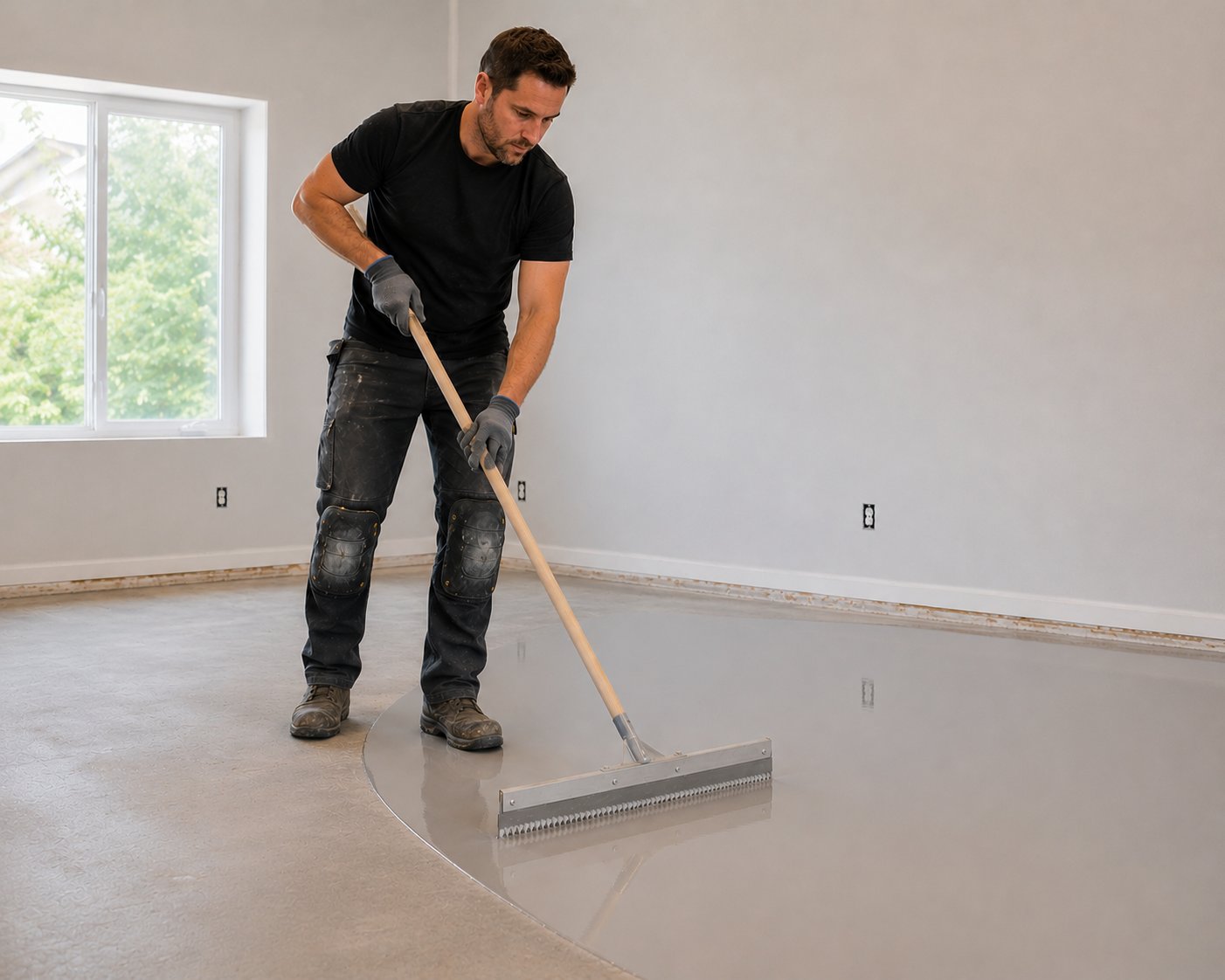
New Screed Still Drying Before Flooring
How to tell if a new screed is dry enough for flooring, and what happens if it isn't yet ready.
New screed looks and feels solid within a day or two, but that's a long way from being dry enough to take flooring safely. Screed dries slowly from the surface down, and fitting too early is one of the most common causes of flooring failure on new builds and renovations.
The rule of thumb often quoted — roughly a millimetre of depth per day, so a 65mm screed needing around 65 days — is a reasonable starting point, but it varies with screed type, thickness, ventilation and time of year, so we always test rather than guess.
It's also worth planning around screed drying times at the project scheduling stage rather than treating it as an afterthought, since a self-build or renovation timeline that assumes flooring can go in immediately after screeding is one of the most common causes of costly delays further down the project.
Why screed drying time gets underestimated
- Traditional sand and cement screeds dry much slower than modern flowing (anhydrite) screeds
- Cold, damp weather or poor site ventilation slows drying significantly
- Thicker screeds, common where underfloor heating is fitted, take proportionally longer
- Surface can feel dry and hard while the depth is still wet
How we test whether it's actually ready
We use a calibrated moisture meter, and for higher-risk jobs a hygrometer test, checked against the flooring manufacturer's maximum acceptable reading, which varies by flooring type. LVT and vinyl typically require a lower moisture reading than some engineered wood or carpet installations.
What happens if screed isn't ready but flooring is scheduled
- We'll re-test on a revised timeline rather than fit on an optimistic guess
- Ventilation, dehumidifiers or gentle heating can be used to accelerate drying where appropriate
- A damp-proof membrane can sometimes allow earlier fitting if the flooring type and screed allow it
- For underfloor heating, a commissioning process is needed before flooring regardless of moisture readings
Table: screed type and rough drying guide
| Screed type | Rough drying guide |
|---|---|
| Traditional sand/cement, 50-75mm | Roughly 1mm per day, often 50-75+ days |
| Flowing/anhydrite screed | Often faster, but manufacturer testing still required |
| With underfloor heating | Needs a controlled commissioning heat-up before flooring |
Why we won't fit flooring on an assumed timeline
Fitting onto screed that's still releasing moisture traps that moisture under the flooring, which can cause adhesive failure, cupping, mould, or lifting months later. We'd rather push a fitting date back by testing than hand over a floor that fails once the moisture has nowhere to go.
Coordinating with other trades during the drying period
The screed drying window is often a useful time to complete other trades that don't need to touch the floor, such as first-fix electrics, plastering upper walls, or fitting kitchen units that sit on legs rather than directly on the finished floor level.
We're happy to advise builders and self-builders on a realistic flooring start date early in the project so it can be built into the wider programme rather than becoming the trade that unexpectedly holds everything else up.
It's also worth noting that different areas of the same room can dry at different rates if ventilation or heating isn't even throughout the space, so a single moisture reading taken in one corner isn't necessarily representative of the whole floor, which is why we take multiple readings across a room rather than relying on just one.
Frequently asked questions
- How is screed moisture actually measured?
- We use a calibrated moisture meter on site, and for critical jobs a hygrometer test, comparing the reading against the specific flooring manufacturer's maximum acceptable level.
- Can screed drying time be sped up?
- To some extent — good ventilation, dehumidifiers and controlled gentle heat can help, but there's a limit, and rushing it risks fitting onto screed that isn't genuinely ready.
- Does underfloor heating change the drying process?
- Yes, screeds with underfloor heating need a specific commissioning heat-up cycle in addition to normal drying time before flooring can go down safely.
- What happens if flooring is fitted too early?
- Trapped moisture can cause adhesive failure, boards cupping, or mould developing under the floor, often not becoming obvious until weeks or months later — which is why testing beforehand matters.
Keep reading
What it means when our survey uncovers a damp or uneven subfloor, and how we prepare it properly.
Why engineered wood floors cup, crown or gap, and the humidity and subfloor fixes that resolve it.
How to assess vinyl or laminate after a leak or flood, and when repair versus full replacement makes sense.
See how we survey, prepare and fit LVT across Kent.
See how we survey, prepare and fit engineered wood across Kent.
Talk it through with a fitter, not a call centre
Book a free, no-obligation survey with Kent Flooring Warehouse's in-house fitting team — call 07702 737267 and we'll inspect the floor and give you a straight answer on the fix.