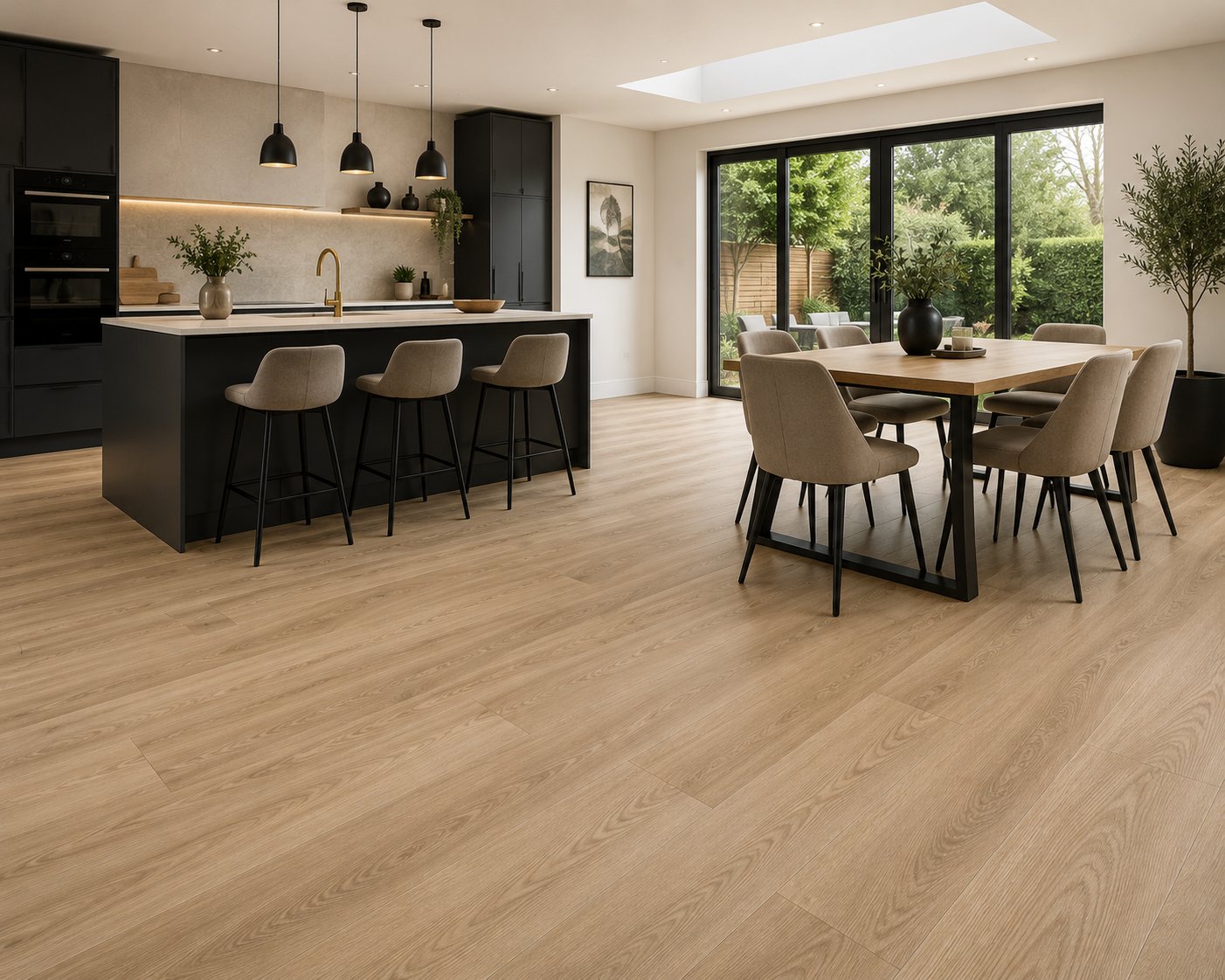
LVT vs Laminate Flooring
LVT or laminate? Compare water resistance, feel underfoot, durability and guide costs to pick the right floor for your room.
LVT and laminate are the two most-requested floors we quote in Kent, and customers often assume they're interchangeable. They're not — one is a real plastic composite that shrugs off water, the other is a printed wood-fibre board that looks similar but behaves very differently once moisture is involved.
The right choice depends less on budget and more on where the floor is going. A kitchen with a dishwasher and a hallway with wet dogs coming in from the garden have very different needs to a spare bedroom.
Budget also plays out differently than most customers expect: it's not simply that laminate is always cheaper, because a thick, rigid-core LVT can cost more than a mid-range laminate, while a basic 8mm laminate can undercut entry-level LVT. Getting both priced for the actual room, rather than assuming one category wins on cost, avoids paying over the odds for waterproofing you may not need, or under-specifying a wet area to save a few pounds.
How the two floors are actually built
Laminate is a fibreboard core (usually HDF) topped with a printed decorative layer and a wear-resistant overlay. It's rigid, clicks together quickly, and feels closer to a solid board underfoot. Most laminate ranges are also sold with matching scotia, beading and threshold trims, which keeps the finished look consistent from room to room without needing bespoke joinery.
LVT (luxury vinyl tile) is built from PVC layers — a dense core, printed vinyl film, and a clear wear layer. It's naturally waterproof at the material level, not just sealed at the joints, and it's more flexible so it copes better with minor subfloor movement.
Water and moisture performance
This is the single biggest differentiator. Laminate's fibreboard core will swell and delaminate if water sits on it, even with a 'water-resistant' rating — that term describes surface splashes wiped up quickly, not standing water.
LVT is genuinely unaffected by water reaching the surface, which is why it's our default recommendation for kitchens, utility rooms, bathrooms and conservatories.
Underfoot feel and acoustic performance
Laminate has a firmer, slightly hollow-sounding feel unless a good acoustic underlay is fitted beneath it, and some people simply prefer that more 'solid floor' sensation.
LVT feels warmer and slightly softer underfoot, and with the right underlay it's noticeably quieter — a point that matters in flats or rooms above living space.
Side-by-side comparison
| Attribute | LVT | Laminate |
|---|---|---|
| Water resistance | Waterproof core | Not waterproof — swells if wet |
| Underfloor heating | Suitable (check spec) | Suitable (check spec) |
| Subfloor tolerance | More forgiving of minor imperfections | Needs a flatter, drier subfloor |
| Typical use | Kitchens, bathrooms, hallways, whole-home | Living rooms, bedrooms, low-moisture areas |
| Guide cost band (supplied & fitted) | £££ mid-to-upper | ££ lower-to-mid, guide only |
Durability and repairability day to day
- LVT's wear layer resists scuffs and scratches well and individual planks can sometimes be replaced without lifting the whole floor.
- Laminate's overlay is very scratch-resistant but once the core is damaged by water or impact, that board usually needs full replacement.
- Both floors are sold in a wide range of wear-layer or AC-rating thicknesses — heavier households should ask us to spec accordingly.
Which rooms suit which floor
If we're fitting a single continuous floor through a kitchen-diner into a hallway, LVT is almost always the sensible call because it removes the weak point at doorways where laminate would otherwise meet a wet zone.
For a landing, bedroom or living room with no real moisture risk, laminate remains a genuinely good-value, attractive option and there's no need to pay for waterproofing you won't use.
Fitting timescales and disruption
Laminate is generally the quicker of the two to fit in a straightforward rectangular room, since click-lock boards go down fast once the subfloor and underlay are ready, and most domestic rooms are finished within a day.
LVT fitting time depends heavily on the format chosen: click LVT fits at a similar pace to laminate, while glue-down LVT takes longer because of adhesive spread rates, open times and, in some cases, a curing period before the room can be walked on normally. If you're on a tight moving-in deadline, it's worth flagging this at the survey stage so the right product and fitting method are chosen for your timeline.
Frequently asked questions
- Is LVT always more expensive than laminate?
- Entry-level LVT and mid-range laminate often sit in a similar guide price band, but premium rigid-core LVT costs more than most laminate. It's worth getting both quoted for your specific room so you're comparing like for like.
- Can I fit LVT over old laminate?
- Sometimes, if the laminate is flat, well-bonded and not moving underfoot, but we'll always check the subfloor and existing floor condition first rather than assume it's suitable — a quick survey settles this.
- Which is better for a home with pets?
- LVT generally copes better with claws, accidents and spilled water bowls, and scratches are less likely to show on textured LVT finishes than on some laminate designs.
- Do both work with underfloor heating?
- Many LVT and laminate products are rated for underfloor heating, but the maximum surface temperature and installation method differ by manufacturer, so we always check the exact product spec before fitting.
Keep reading
Choosing between LVT and engineered wood? Compare looks, water tolerance, refinishing and lifespan before you buy.
Sheet vinyl or LVT — which suits a wet room, kitchen or busy hallway best? Compare seams, looks and cost.
Laminate looks like wood but isn't — compare it against real engineered wood on feel, longevity and value.
LVT explained for first-time buyers: how luxury vinyl tile is built, click versus glue-down fitting, wear layers, and which rooms it suits best in a home.
How laminate flooring is installed, step by step: acclimatising boards, levelling, underlay, expansion gaps, doorways and finishing trims, plus common mistakes.
See how we survey, prepare and fit LVT across Kent.
See how we survey, prepare and fit laminate across Kent.
Talk it through with a fitter, not a call centre
Not sure which suits your room? Book a free, no-obligation survey with our in-house fitters on 07702 737267 and we'll bring samples of both.