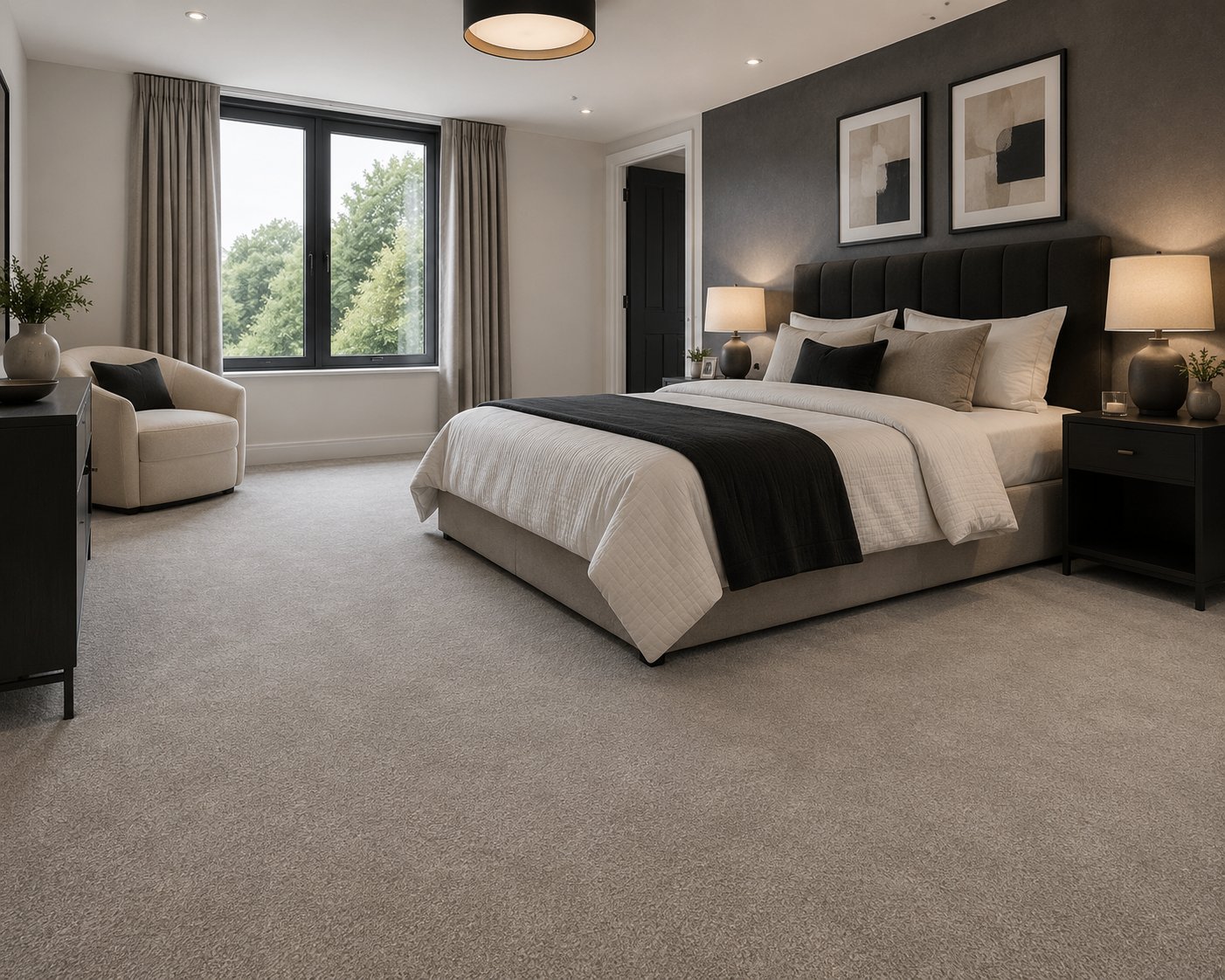
What Does Carpet Fitting Actually Cost?
Carpet, underlay, gripper, door bars and stairs: what each line on a carpet fitting quote covers, why stairs cost more, and where the money really goes.
Carpet quotes often list several line items — carpet, underlay, gripper, fitting labour, door bars — and it's not always obvious which ones are essential and which are optional upgrades. Understanding the breakdown helps you compare quotes fairly rather than just looking at the bottom line.
This guide walks through each component of a typical carpet job, with broad guide-only UK price bands, so you know what a fair quote should contain before work starts.
Because carpet fitting has several genuinely separate cost elements — product, underlay, gripper, labour and disposal — it's one of the easiest jobs to get an unfair-sounding quote for if a supplier bundles everything into one number with no breakdown. Asking for each line separately usually resolves any confusion quickly.
The core components of a carpet quote
- Carpet itself — priced per m², varying by fibre (wool, wool-blend, synthetic) and pile type
- Underlay — affects comfort, warmth and how long the carpet lasts
- Gripper rods and tackless strip — fixed around the room edge to hold carpet in place
- Door bars/trims — finish the join to hard flooring in doorways
- Labour — cutting, seaming, stretching (power-stretching) and fitting
- Uplift and disposal of old carpet, if needed
Guide-only cost bands
| Item | Guide price range |
|---|---|
| Carpet, mid-range synthetic | £10–£25 per m² |
| Carpet, wool/wool-blend | £25–£50 per m² |
| Standard underlay | £4–£10 per m² |
| Fitting labour (per room) | £80–£200 depending on size and access |
| Old carpet uplift and disposal | £2–£5 per m² |
| Stair carpet fitting (per stair flight, avg) | £150–£350 |
Why stairs cost more per metre than open rooms
Stairs take considerably longer to fit than flat rooms because each tread and riser needs to be measured, cut and tensioned individually, and pattern-matching on a striped or patterned carpet adds further time. This is reflected in a higher per-stair rate rather than a flat per-m² figure.
Underlay: where it's worth spending more
A better underlay extends carpet life, improves acoustic performance between floors, and adds comfort underfoot. It's often the cheapest way to noticeably upgrade how a room feels, and worth discussing at survey stage rather than defaulting to the cheapest option.
What can add cost once a fitter is on site
- Uneven subfloor needing boards refixed or levelling compound
- Doorways requiring new door bars or trimming of doors
- Furniture that wasn't cleared before the fitting date
- Awkward room shapes needing extra seams or waste allowance
Seaming and pattern-matching: the hidden labour cost
Wide rooms or awkward shapes sometimes need two widths of carpet joined with a seam, which takes skill to make invisible and adds fitting time. Striped, checked or patterned carpets add further time again, since the pattern has to line up across the seam and around obstacles rather than just being cut to fit.
How call-out minimums affect small jobs
A single small room, like a box bedroom or a hallway, can sometimes carry a higher effective per-m² rate than a whole-house job, because most fitting businesses have a practical minimum charge to cover travel and setup time regardless of room size. It's worth asking whether a minimum applies if you're only carpeting one small space.
Fibre choice and how it feeds into the quoted price
Wool and wool-blend carpets generally carry a higher material cost than synthetic fibres such as polypropylene or polyester, but they also tend to recover better from flattening under furniture and can hold their appearance longer in living rooms and hallways. A quote built around a synthetic carpet at a similar visual thickness will usually look cheaper on paper without necessarily being cheaper over the life of the floor.
Frequently asked questions
- Is underlay always included in a carpet fitting quote?
- A standard underlay is usually included in supply-and-fit quotes, but acoustic or premium underlays are often an optional upgrade priced separately. Ask your fitter to specify the underlay grade included in your quote.
- How much extra do stairs typically add to a job?
- Stairs are priced per flight rather than per m² because of the extra time needed for cutting and tensioning each tread, so expect a noticeably higher rate than an equivalent flat area of carpet. Exact cost depends on the number of stairs and whether there's a landing or winders.
- Does old carpet removal cost extra?
- Uplift and disposal of old carpet and underlay is sometimes included and sometimes charged separately, so it's worth confirming this explicitly when comparing quotes. It's usually a modest per-m² addition rather than a major cost.
- Why did my final invoice cost more than the online guide price?
- Online guide prices are broad averages; a final invoice reflects your specific room shape, subfloor condition and any extras agreed on the day. A written quote after survey avoids this gap by pricing your actual room.
Keep reading
A plain-English breakdown of what goes into a per-m² flooring price, with guide-only UK cost bands for materials, fitting and extras.
The real cost differences between buying flooring supply-only and using supply-and-fit, including risks, warranties and guide-only price bands.
The genuine reasons a flooring quote can move after a site survey — subfloor condition, access, room shape — and how to avoid nasty surprises.
How carpet is priced per square metre or square foot, how to convert between the two, and why the room size on your quote is bigger than the floor itself.
See how we survey, prepare and fit carpet across Kent.
See how we survey, prepare and fit stair runners across Kent.
Talk it through with a fitter, not a call centre
Request a measured written quote from Kent Flooring Warehouse after a free, no-obligation site survey — call 07702 737267 to book a visit from our Gillingham-based team of in-house fitters.