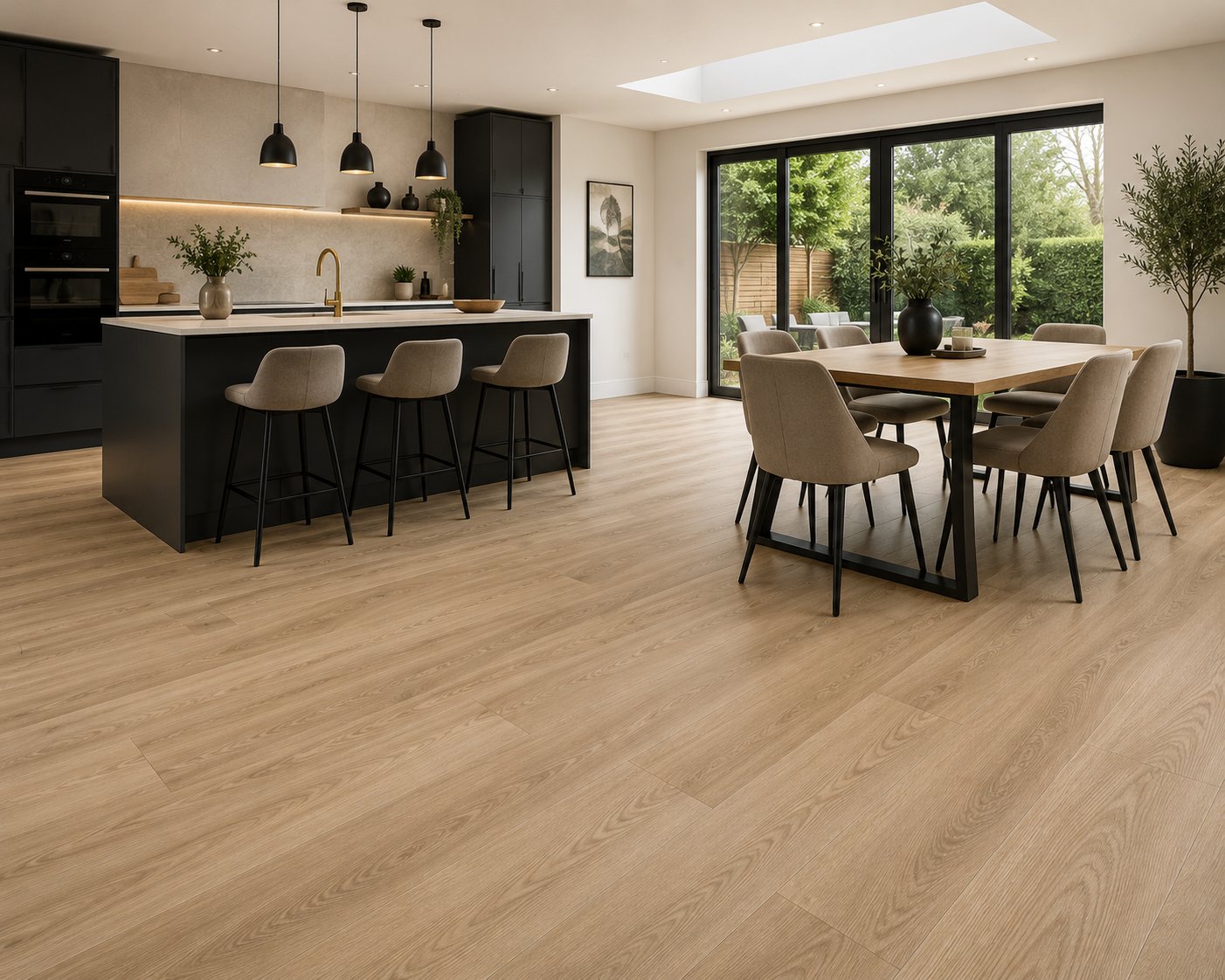
LVT Flooring in Kent
LVT flooring across Kent. Wear layer guidance, glue-down or click, herringbone setting out, underfloor heating and free measuring from Kent Flooring Warehouse.
LVT is built as a stack, not a single material. A UV-cured wear layer sits on top of a printed decorative film, which sits on a rigid or flexible core, backed by a stabilising layer. What that wear layer is made from and how thick it is decides whether the floor still looks new in three years or shows a grey path down the hallway by month eighteen. Everything else about the product, including the pattern and the click joint, is secondary to that one figure.
Two things separate a good LVT installation from a poor one that happens to use the same box of planks: the state of the subfloor underneath and whether the fitting method suits the room. LVT is thin and rigid enough that it will telegraph almost anything beneath it, from a ridge of old adhesive to a dip left by a badly patched pipe run. Get the subfloor flat and the floor disappears into the background. Skip that step and every defect reappears through the surface within weeks.
We supply and fit LVT across Kent, from single rooms to full commercial refits, using our own employed fitters. We measure on site, check the subfloor with a straightedge and moisture meter before quoting, and tell you honestly if a latex screed or plywood overlay needs adding to the job before any planks go down. LVT is usually the least expensive of the hard floors once you compare it fairly with engineered wood or solid wood, and it is priced by the square metre after that measure.
Wear layer thickness and what commercial ratings actually mean
The wear layer is the clear top skin that takes footfall, grit and chair legs. Domestic LVT typically carries a wear layer between 0.15mm and 0.3mm, fine for a bedroom or lounge with normal traffic. Anything used in a hallway, kitchen, or let as a rental should move up to 0.3mm to 0.5mm. Commercial products used in shops, offices and school corridors carry 0.5mm to 0.7mm or more, matched to an EN 685 commercial class rating rather than a marketing label.
The rating system that matters is EN 685, which grades a product by use (domestic, commercial, light industrial) and traffic intensity (moderate to heavy). A tile boasting a 'lifetime' domestic warranty can still be entirely wrong for a busy reception area, because the rating describes footfall category, not durability in the abstract. We match the class to the actual room before quoting, not to the nearest available box.
- 0.15mm to 0.2mm wear layer: light domestic use, bedrooms and low-traffic rooms
- 0.3mm wear layer: general domestic use, hallways, kitchens and let properties
- 0.5mm wear layer: light commercial, small retail and busy family homes
- 0.7mm plus: heavy commercial, schools, care settings and public circulation routes
- EN 685 class describes traffic intensity, not just wear layer depth
| Wear layer | Typical setting | Expected surface life before resurfacing |
|---|---|---|
| 0.15mm to 0.2mm | Bedroom, spare room | Shorter, shows scuffing sooner under regular use |
| 0.3mm | Hallway, kitchen, living room | Holds up to daily family traffic and pet claws |
| 0.5mm | Home office let commercially, small shop | Copes with trolley wheels and repeated foot traffic |
| 0.7mm plus | School corridor, care home, retail unit | Built for continuous heavy footfall over years |
Click LVT against glue-down LVT and why the choice is not cosmetic
Click LVT locks plank to plank with a tongue-and-groove edge and floats above the subfloor on a thin underlay, similar in principle to laminate. It fits faster, tolerates a slightly less than perfect subfloor, and can be lifted and relaid if a section is damaged. The trade-off is a hollower underfoot feel and, in large open areas, a greater need for expansion gaps at walls and doorways because the whole floor moves as one sheet.
Glue-down LVT is bonded tile by tile or plank by plank directly to the subfloor with a pressure-sensitive or hard-set adhesive. It sits lower, feels denser underfoot, handles heavier point loads such as hospital beds or shop fixtures, and is the standard choice for most commercial fit-outs and for rooms with underfloor heating. It demands a genuinely flat, primed, and often damp-proofed subfloor, because there is no floating layer to hide small imperfections.
Neither method is universally correct. We recommend glue-down for kitchens, commercial units, and any room with underfloor heating, and click for retrofits over an existing hard floor or where a fast turnaround matters more than the last word in acoustic feel.
- Click LVT: floats on underlay, faster to fit, easier to repair a single plank
- Glue-down LVT: bonded solid, lower profile, better for heavy point loads
- Glue-down suits underfloor heating better because the adhesive aids heat transfer
- Click needs a perimeter expansion gap because the whole floor moves together
- Commercial fit-outs default to glue-down for stability under trolleys and chairs
Subfloor flatness tolerance and why LVT telegraphs every defect
LVT is typically only 2mm to 5mm thick, with no cushioning layer to absorb an uneven base the way carpet does. The industry tolerance most manufacturers specify is a maximum deviation of 3mm under a 2 metre straightedge. Anything beyond that and the plank will rock, the joint will click audibly underfoot, or the surface will show a visible dip once the floor is walked on and settles slightly under load.
Old adhesive ridges left from a lifted carpet gripper or a previous vinyl sheet are one of the most common causes of failed LVT jobs we get called to inspect. A ridge as thin as a coin can print through the surface as a faint line within days, because the wear layer and decorative film have nothing to distribute the pressure over. We check every subfloor with a straightedge before quoting and price in any grinding or levelling that the survey shows is needed.
Latex screed and plywood overlay as preparation, not extras
Self-levelling latex screed is the standard fix for an uneven solid subfloor, poured across the room in a thin layer that finds its own level and cures to a smooth, hard surface within hours. It suits concrete and well-bonded old adhesive residue, and is our default recommendation ahead of LVT in older Kent properties where the original screed has settled unevenly over decades.
Timber subfloors, particularly older suspended floors with boards that have cupped or shrunk, usually need a plywood overlay screwed down across the whole area rather than latex, since latex will crack over a floor that flexes. A 6mm or 9mm structural ply layer, joints staggered and screwed at close centres, gives LVT the rigid, flat base it needs and stops individual boards moving independently under the new floor.
- Latex screed suits solid concrete subfloors and bonded adhesive residue
- Plywood overlay suits suspended timber floors and older board floors
- Both are priced as part of the job once the survey identifies the need
- Skipping preparation is the single most common cause of early LVT failure
Herringbone and pattern setting out before a single plank is cut
Herringbone LVT is set out from a chalked centre line running through the middle of the room, with a dry lay of the first few rows to confirm the pattern lands symmetrically at doorways and focal walls rather than finishing on an awkward sliver of plank at one edge. Getting this setting-out stage right before adhesive or click joints are committed is what separates a herringbone floor that looks intentional from one that visibly drifts across a long room.
Straight plank layouts are more forgiving but still benefit from planning the direction of light travel and door thresholds before starting, since LVT planks are almost always laid running away from the main window or light source to minimise visible joint lines. Mixed-pattern borders and feature strips need their setting-out agreed at quote stage, because they affect how much material is ordered and how much is wasted in cutting.
| Layout | Setting-out starting point | Main risk if skipped |
|---|---|---|
| Herringbone | Chalked centre line through room middle | Pattern drifts off true across the room length |
| Straight plank | Line parallel to main light source | Joint lines catch the eye under low-angle light |
| Feature border | Agreed at quote and measure stage | Wasted material and mismatched cut widths |
Underfloor heating compatibility and thermal expansion
Most quality LVT is rated for use over underfloor heating, provided the surface temperature at the floor stays below the manufacturer's stated limit, usually around 27 degrees Celsius. Glue-down LVT copes better than click, because full-surface adhesive bonding gives more even heat transfer and reduces the risk of joints opening as the floor cycles between warm and cool.
LVT expands and contracts more than most people expect as room temperature changes through the seasons, which is why expansion gaps at the perimeter and at doorway thresholds are not optional extras. A floor laid tight to the skirting on a cool fitting day can visibly bow or lift at a threshold once summer sun through a patio door raises the surface temperature by several degrees.
- Confirm the underfloor heating system is compatible before ordering LVT
- Keep floor surface temperature under the manufacturer's stated limit, typically 27C
- Bring the heating up and down gradually rather than switching abruptly
- Always leave a perimeter expansion gap, covered by skirting or trim
Cleaning routine and why the wrong products dull the surface early
LVT only needs a regular sweep or vacuum to lift grit before it scratches the wear layer, followed by a damp mop using a neutral pH cleaner formulated for vinyl. Standard household floor cleaners, steam mops and anything containing wax, bleach or ammonia will dull the factory finish, leave a cloudy film, or in the case of steam, force moisture into the joints and risk lifting the edges over time.
A doormat at every external entrance removes most of the grit that causes visible scratching, since it is the sharp mineral particles carried in on shoes, not general foot traffic, that abrade the wear layer. Furniture pads under chair and table legs prevent the small compression marks that otherwise build up in dining areas and home offices.
Where LVT fails: edge lifting and adhesive creep in conservatories
Edge lifting at joints and against skirting is the most common LVT failure we are called out to look at, usually traced back to one of three causes: insufficient expansion allowance, moisture rising through an unsealed concrete subfloor, or steam cleaning breaking down the adhesive bond at the plank edge. Once an edge lifts, grit and moisture get underneath and the problem spreads outward from that point.
Conservatories and garden rooms are a specific risk area because they swing through a much wider temperature range than the rest of the house, often from near freezing overnight to well over 30 degrees on a sunny afternoon. That range accelerates adhesive creep, where the bond softens repeatedly under heat and gradually loses grip, showing up as planks that shift slightly underfoot or curl at the edges within a couple of years rather than lasting the decade or more expected elsewhere in the house.
- Edge lifting usually traces to insufficient expansion gap or rising moisture
- Steam cleaners break down adhesive bonds and force moisture into joints
- Conservatories and garden rooms see wider temperature swings than the main house
- Adhesive creep in high-heat rooms shows as shifting or curling planks over time
- A damp-proof membrane or DPM primer is essential over solid ground floors
Frequently asked questions
- What wear layer thickness should I choose for a busy family kitchen?
- Aim for at least 0.3mm, and consider 0.5mm if you have large dogs, multiple children, or plan to let the property. A thin 0.15mm domestic wear layer will show scuffing and dulling in a kitchen far sooner than in a bedroom.
- Is click LVT or glue-down LVT better for my home?
- Glue-down suits kitchens, underfloor heating and heavy furniture. Click suits retrofits over existing hard floors, rented rooms, or where you want the option to lift and relay a damaged plank without disturbing the rest of the floor.
- How flat does my subfloor need to be for LVT?
- Most manufacturers specify a maximum deviation of 3mm under a 2 metre straightedge. Beyond that, planks rock, joints click underfoot, and imperfections telegraph through the thin wear layer, so levelling work is usually needed first.
- Can LVT go over underfloor heating?
- Yes, provided the product is rated for it and the surface temperature stays under the manufacturer's limit, usually around 27 degrees Celsius. Glue-down LVT generally performs better than click over underfloor heating.
- Why does my LVT floor show every dip in the concrete underneath?
- LVT is thin, rigid and has no cushioning layer, so it telegraphs any ridge or dip in the subfloor rather than absorbing it. A latex screed or plywood overlay before fitting removes this problem at the source.
- What causes LVT edges to lift after a year or two?
- The usual causes are an insufficient expansion gap, rising moisture through an unsealed concrete subfloor, or repeated steam cleaning breaking down the adhesive bond. Each lets grit and moisture work under the plank edge.
- Can I lay herringbone LVT myself or does it need a fitter?
- Herringbone demands accurate centre-line setting out and consistent cutting angles, and mistakes are expensive once several boxes are opened. Most homeowners get a straighter, more symmetrical result having it fitted professionally.
- What should I clean LVT with?
- A neutral pH cleaner formulated for vinyl floors, applied with a well-wrung damp mop. Avoid wax-based products, bleach, ammonia and steam mops, all of which dull the finish or risk forcing moisture into the joints.
Where to go next
Supplied and fitted across Gillingham and the ME7 area.
Supplied and fitted across Chatham and the ME4 area.
Supplied and fitted across Rochester and the ME1 area.
Supplied and fitted across Strood and the ME2 area.
Supplied and fitted across Rainham and the ME8 area.
Supplied and fitted across Maidstone and the ME14 area.
Supplied and fitted across Sittingbourne and the ME10 area.
Supplied and fitted across Faversham and the ME13 area.
Wide rolled sheet with a cushioned or felt-back core, welded seams and no grout lines, laid as a single waterproof skin across kitchens, bathrooms and hallways.
An HDF-cored floating floor with a printed decor layer under a hard AC-rated wear surface, usually the least expensive of the hard floors.
A real wood wear layer bonded onto cross-ply backing boards, giving the look and feel of solid wood with far more dimensional stability across the seasons.
How LVT wear layer thickness and AC/commercial use class ratings relate to durability, and which specification suits which room.
Click LVT or glue-down LVT? Compare stability, feel, subfloor needs and cost before choosing your fitting method.
Herringbone or straight plank LVT? Compare visual impact, waste, fitting time and cost for your layout.
Why LVT planks or tiles curl, peel or lift at the joints, and how our fitters diagnose and put it right.
Why plywood overlay boarding is used over timber subfloors before fitting vinyl or LVT, and how it differs from screeding.
Free measure, free written quote
Book a free LVT measure and quote with Kent Flooring Warehouse
Showroom and warehouse: Unit 9, Matilda Close, Gillingham Business Park, Gillingham, Kent, ME8 0PY