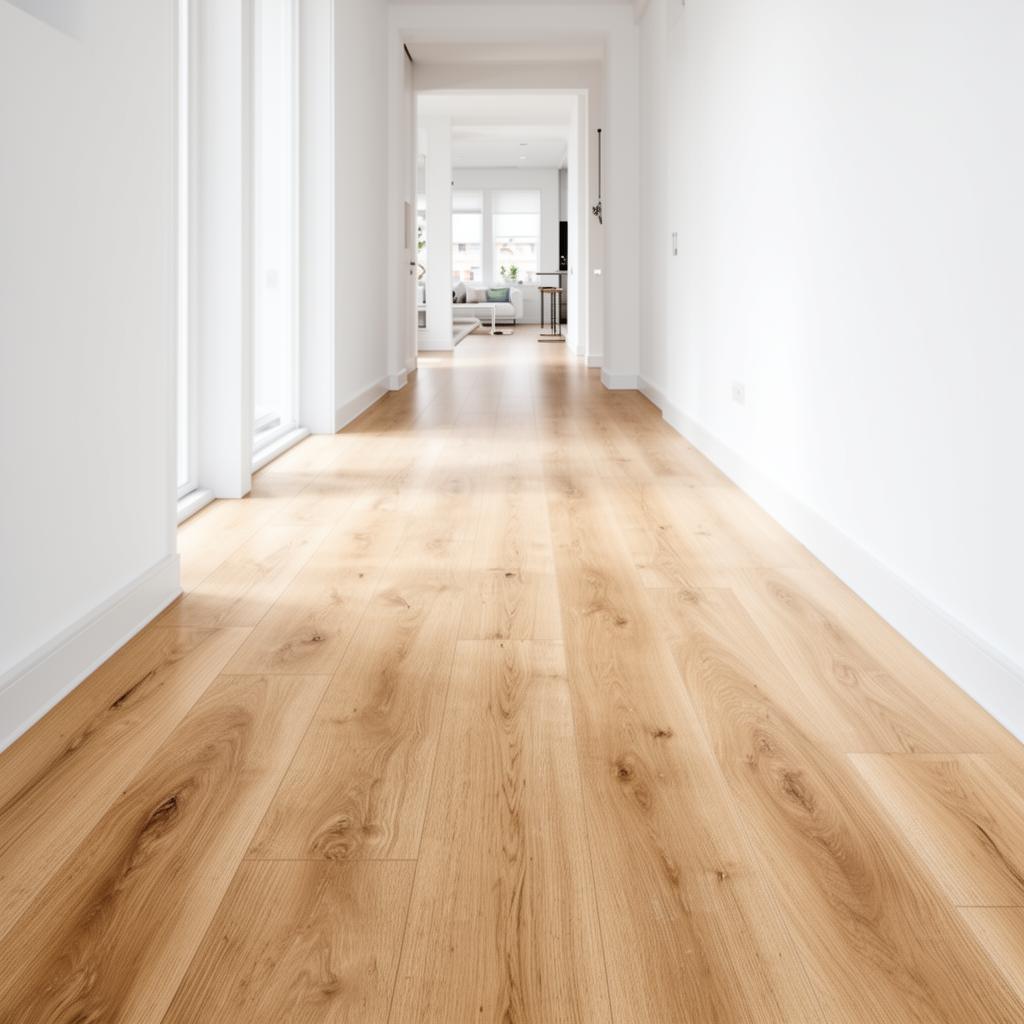
Laminate flooring, supplied and fitted across Kent
Laminate flooring supplied and fitted across Kent. AC-rated wear layers, click locking, floating installation over proper underlay. Free measuring and quotes.
Laminate flooring is built from a high density fibreboard (HDF) core, a printed decor paper that carries the wood or stone image, and a hard resin-impregnated overlay that takes the abrasion. It is not a solid material with grain running through it. It is a manufactured sandwich, and every fitting decision we make is about respecting that sandwich rather than fighting it. Get the gaps, the underlay and the subfloor moisture right and it behaves well for years. Get any of those wrong and the HDF core tells you quickly.
The core is timber fibre bonded under heat and pressure, which makes it dense, flat and cheap to produce compared with a solid or engineered board, but it is also the part most sensitive to standing water. HDF swells when it takes on moisture and, unlike solid wood, it does not really shrink back to its original dimension once it has swollen. That single fact drives most of our advice on where laminate suits a room and where we would steer a customer towards LVT or engineered wood instead.
This page covers what the AC rating actually tells you, how click locking systems hold a floor together without glue, why the underlay matters as much as the board, and the specific ways laminate fails when it is fitted badly or asked to do a job it is not built for. If you already know laminate is right for the room, our fitters supply and fit it across Kent with proper expansion gaps and manufacturer-approved underlay as standard.
What the AC abrasion rating is actually measuring
The AC rating on a laminate box, usually AC3 to AC5, comes from a European test that drags an abrasive wheel across the wear layer until the printed pattern starts to show through. It tells you about surface abrasion resistance, meaning how long the floor keeps its printed finish under foot traffic and grit. It tells you nothing about impact resistance, moisture tolerance or joint strength, which is why an AC5 board can still be dented by a dropped pan or swell at a leaking dishwasher joint.
For most Kent homes an AC4 board is the sensible middle ground, giving commercial-grade wear resistance in a domestic pack at a domestic price. AC3 suits bedrooms and low-traffic rooms where the floor sees socks and slippers rather than boots and paws. We would not fit AC3 in a hallway or kitchen regardless of how the room looks on the day, because the rating is the one number on the box that genuinely predicts how the surface will look in five years.
- AC3: light domestic use, bedrooms and occasional rooms
- AC4: general domestic use, living rooms, hallways, kitchens
- AC5: heavy domestic or light commercial, high footfall areas
- Higher AC number does not mean better water resistance
- Rating tests the printed wear layer, not the HDF core or joints
Click locking systems and why the floor has to float
Almost all laminate now uses an angle-tap or fold-down click profile milled into the long and short edges of each board. Boards lock mechanically along a tongue and groove shaped to pull the joint tight and hold it under tension, with no glue and no fixings into the subfloor. The floor is not attached to anything beneath it. It is a floating panel that relies entirely on the click joints holding hands across the whole room to stay flat and stable.
Because the floor floats, it needs room to move as temperature and humidity shift through the seasons, which is why we leave an expansion gap at every wall, doorway and fixed obstruction, covered later by skirting, scotia or a transition profile. Skip that gap and the floor has nowhere to expand into. It pushes against the wall instead, and the pressure transfers straight into the click joints, which is one of the most common causes of boards lifting or joints opening months after a fit.
Floating installation, expansion gaps and perimeter movement
A floating laminate floor needs a continuous expansion gap of around ten to fifteen millimetres around every fixed edge, larger in bigger open-plan rooms and at doorways between rooms so the floor is not locked into one enormous rigid sheet. In rooms wider than about eight to ten metres in any direction we build in an expansion joint or transition strip partway across, because a single unbroken run that size will generate more movement than the perimeter gap alone can absorb.
Perimeter movement is normal and expected. What is not normal is a floor that bows, cups at the edges or develops a visible ridge, which usually means the gap was closed off by skirting fitted too tight, a door threshold packed hard against the boards, or furniture legs pinning the floor to the subfloor. We check every perimeter detail on handover, because a floor that looked perfect on fitting day can telegraph a closed gap weeks later once the seasons turn.
- 10 to 15mm expansion gap at all walls and fixed objects
- Extra allowance in large or long, unbroken open-plan runs
- Transition strips at doorways to break up large floor areas
- Skirting and scotia fitted to cover the gap, never to close it
- Furniture and appliances should not pin the boards to the subfloor
Underlay with an integrated damp proof membrane
The underlay beneath a laminate floor is not just comfort and sound deadening, it is doing structural moisture and flatness work that the click joints depend on. Most laminate underlays combine a foam or fibreboard layer with an integrated damp proof membrane (DPM), which stops residual moisture vapour rising from a concrete subfloor into the HDF core from below. Over a timber subfloor the DPM matters less, but the flatness tolerance the underlay provides still matters just as much.
We always check the subfloor moisture reading before choosing underlay, because a standard combination underlay is not a substitute for a proper liquid or sheet DPM on a subfloor reading outside the range the board manufacturer allows. Skimping on underlay to save a little on the job is one of the more expensive false economies in flooring, because a failed DPM shows up as swelling and click joint failure that only a full lift and relay will fix.
Board thickness, hollow sound and how they connect
Laminate boards typically run from about seven to twelve millimetres thick, and thickness affects two things a customer actually notices day to day: how forgiving the floor is over a slightly imperfect subfloor, and how the floor sounds underfoot. Thinner boards flex more over minor dips and can develop a faint hollow or clicking sound where the underlay has not filled a low spot completely. Thicker boards, generally ten millimetres and above, feel more substantial and transmit less of that hollow floating-floor sound.
The hollow sound itself is not a fault, it is a characteristic of any floating floor over an air gap created by the underlay, and no laminate will ever sound quite like a floor fixed directly to the subfloor. What we do control is subfloor preparation, because a genuinely flat subfloor within manufacturer tolerance, checked with a straight edge before the underlay goes down, removes most of the drumminess customers associate with a cheap-feeling laminate fit.
Water at the joints and how swelling actually happens
Laminate does not fail from ambient humidity in a normally used room, it fails from standing water sitting at a joint long enough to wick into the exposed HDF edge. The click profile is milled from the same fibreboard as the core, and the raw edge inside that profile has far less moisture resistance than the sealed top surface, even on boards described as water resistant. A spilt glass of water wiped up promptly does no harm. The same spill left under a fridge or behind a washing machine for days will find its way into a joint.
Once water reaches the HDF at a joint, the fibre swells and the swelling is largely permanent, showing as a raised, darkened ridge along the affected boards that will not flatten out again once dry. This is the single biggest reason we steer customers away from laminate in wet rooms, utility rooms with plumbed appliances, and conservatories with high condensation, and towards LVT or a genuinely waterproof floor in those specific rooms instead.
Scratch behaviour versus dent behaviour
Scratching and denting are different failure modes and laminate handles them very differently. The resin overlay resists surface scratching well, which is exactly what the AC rating is testing, so laminate generally shrugs off the fine scuffing that would mark a lacquered wood floor. Grit dragged under shoes or dog claws over years will eventually dull the surface sheen, but a genuinely deep scratch through to the decor paper is uncommon on a correctly rated board.
Denting is the opposite story. The HDF core is dense but not soft or resilient the way solid wood fibre is, so a sharp point load, a stiletto heel, a dropped tin, a dining chair leg without a felt pad, can leave a permanent compression mark that no amount of cleaning removes. Unlike a solid wood floor, a dented laminate board cannot be sanded back, because there is no wear layer depth below the printed pattern. A dented board has to be replaced.
Cleaning damp, not wet, and everyday care
Laminate is cleaned damp, never wet, and the distinction is not fussy advice, it is the practical consequence of everything above about joints and HDF swelling. A microfibre mop that has been well wrung out, or a spray mop that mists a fine amount of cleaner rather than flooding the surface, keeps standing moisture off the joints while still lifting grit and marks. Steam mops and any cleaning method that leaves visible pooled water are the fastest way to shorten a laminate floor's life.
Day to day, a soft brush or vacuum on a hard floor setting to lift grit before it scratches the surface, felt pads under furniture legs, and doormats at external doors do more for a laminate floor's long-term look than any cleaning product. We talk customers through this at handover because most laminate call-backs we see are cleaning and care issues rather than fitting faults.
| Task | Correct approach | Common mistake |
|---|---|---|
| Routine cleaning | Vacuum or dry mop, then a barely damp microfibre mop | Steam mop or a wet string mop that leaves pooled water |
| Spills | Wipe up immediately with a dry cloth | Leaving liquid to sit until it evaporates on its own |
| Furniture | Felt pads on every leg, lift rather than drag | Dragging chairs or dragging appliances across the joints |
| Appliances | Check behind washing machines and dishwashers regularly | Assuming a sealed edge means the joint is watertight |
Where laminate actually fails: gapping, peaking and standing water
The three failure patterns we get called out to most often are gapping, peaking and swelling from standing water, and each one has a distinct, identifiable cause rather than being random bad luck with the product. Gapping, visible dark lines opening up between boards, is almost always a humidity swing acting on a floor that had too tight an expansion gap to begin with, or a room that runs unusually dry in winter with heating on and no humidity buffer.
Peaking, where a joint lifts into a visible ridge, is the opposite problem, a floor with nowhere to expand into because the perimeter gap was closed by skirting, a threshold bar, or built-in furniture fitted after the floor with no allowance made. Standing water damage looks different again, a localised soft, swollen, darkened patch rather than a ridge running along a joint line, and it does not recover once dry the way gapping and peaking often do when conditions normalise.
- Gapping: joints opening, usually a dry winter or an undersized expansion gap
- Peaking: joints lifting, usually a closed or blocked perimeter gap
- Standing water swelling: localised, does not flatten out once dry
- Cupping across a whole run: subfloor moisture reaching the core from below
- Squeaking or clicking: a low spot in the subfloor not filled by underlay
Frequently asked questions
- How long does laminate flooring last?
- Well fitted AC4 laminate in a typical living room or hallway usually lasts a good number of years, driven mainly by how well the expansion gaps were left and whether the room stays dry. It is the joints and moisture exposure that end a laminate floor's life, not simple foot traffic wearing through the surface.
- Can laminate flooring go in a kitchen?
- It can, provided the AC rating is at least AC4 and every plumbed appliance and sink area is checked for water risk, but we generally recommend LVT or waterproof flooring instead in kitchens with a dishwasher or washing machine, since standing water at a laminate joint causes permanent swelling.
- Why is there a gap between my laminate boards?
- Gapping is usually seasonal, caused by a dry heating season shrinking the boards slightly at joints that had a tight expansion margin to begin with. Small seasonal gaps that close back up in summer are normal. Gaps that stay open all year suggest the expansion allowance was wrong at fitting.
- Does laminate flooring need an underlay?
- Yes, laminate is a floating floor and relies on underlay for flatness tolerance, sound deadening and, over concrete, moisture protection via an integrated damp proof membrane. Fitting laminate directly onto a subfloor without underlay voids most manufacturer warranties and invites early joint failure.
- Can a dented laminate board be repaired?
- Not really. Laminate has no meaningful wear layer depth below the printed pattern, unlike solid or engineered wood which can be sanded, so a genuine dent through to the core is permanent. The practical fix is replacing the affected board or boards, which is one advantage of the click system over glued floors.
- Is laminate flooring noisy or hollow sounding underfoot?
- Floating floors always sound slightly different to a floor fixed directly to the subfloor, because there is an underlay air gap beneath the boards. Thicker boards and a genuinely flat subfloor reduce the hollow or drummy feel, but some difference from a solid floor is a normal characteristic, not a fault.
- What AC rating do I need for a hallway?
- AC4 as a minimum for a hallway, since it is a high-traffic area that also picks up grit from outside. AC3 is fine for bedrooms and low-traffic rooms but will show surface wear noticeably faster in a hallway than an AC4 board rated for general domestic to light commercial use.
- How do I clean laminate flooring without damaging it?
- Vacuum or dry mop first to lift grit, then clean with a barely damp microfibre mop or a spray mop, never a steam mop or a soaking wet mop. Wipe spills up immediately. Standing or pooled water at the joints is the main cause of laminate swelling and shortened floor life.
Where to go next
Supplied and fitted across Gillingham and the ME7 area.
Supplied and fitted across Chatham and the ME4 area.
Supplied and fitted across Rochester and the ME1 area.
Supplied and fitted across Strood and the ME2 area.
Supplied and fitted across Rainham and the ME8 area.
Supplied and fitted across Maidstone and the ME14 area.
Supplied and fitted across Sittingbourne and the ME10 area.
Supplied and fitted across Faversham and the ME13 area.
Rigid, layered vinyl planks and tiles built around a wear layer and a printed decorative film, fitted glued or clicked over a properly prepared subfloor.
A real wood wear layer bonded onto cross-ply backing boards, giving the look and feel of solid wood with far more dimensional stability across the seasons.
Wide rolled sheet with a cushioned or felt-back core, welded seams and no grout lines, laid as a single waterproof skin across kitchens, bathrooms and hallways.
Why laminate boards separate over time and how we close the gaps or refit the floor correctly.
Laminate looks like wood but isn't — compare it against real engineered wood on feel, longevity and value.
LVT or laminate? Compare water resistance, feel underfoot, durability and guide costs to pick the right floor for your room.
Not all underlay is equal. Compare foam, rubber, fibre and PU underlays for comfort, sound and durability.
Free measure, free written quote
Book a free measure and quote for laminate flooring
Showroom and warehouse: Unit 9, Matilda Close, Gillingham Business Park, Gillingham, Kent, ME8 0PY