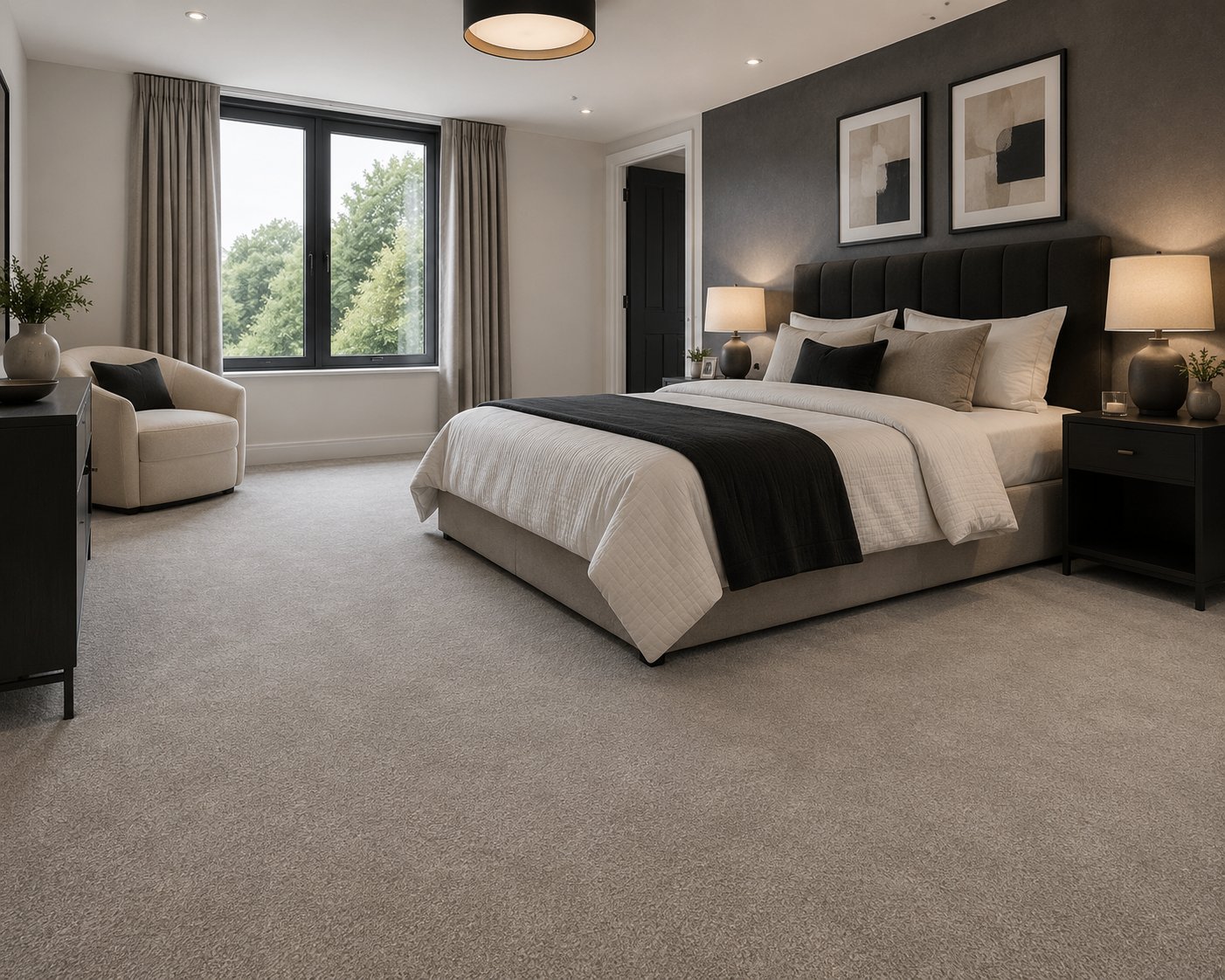
Carpet supply and fitting
Carpet supplied and fitted across Kent. Twist, loop, saxony and Berber piles, wool or synthetic fibre, gripper or double stick, stairs included.
Carpet is not one product, it is a pile construction sitting on a backing, laid over an underlay, held to the floor by gripper or adhesive. Change any one of those four layers and the floor behaves differently underfoot, wears differently in the traffic lanes, and cleans differently after a spill. A twist pile in polypropylene and a saxony in wool can look similar in a sample book and perform in completely different ways once furniture, footfall and daylight get to work on them.
Most of the calls we get are about one of two things: a carpet that has crushed and flattened in the doorway and hallway within a couple of years, or a carpet that has felt cold and thin from the day it went down. Both usually trace back to pile weight, fibre choice or underlay being wrong for the room rather than a poor fitting job. We match the construction to the traffic before we quote, not after.
Fitting itself is a stretching trade, not a cutting trade. Gripper rods pin the edges, the underlay floats free in the middle, and the carpet is powered onto the gripper with a knee kicker and stretcher so the pile stays taut and square for years rather than months. Get the stretch wrong and every seam, doorway and stair nosing will show it within a season.
Pile construction: twist, loop, saxony and Berber behave differently underfoot
Twist pile is the tufted, heat-set yarn found in most UK hallways and living rooms. The fibres are twisted and set so they spring back after being walked on, which is why twist hides footprints and vacuum marks better than a cut saxony. Loop pile, including Berber, is uncut, so the surface is denser and flatter, resists crushing well, but can snag on stiletto heels, dog claws or a dropped ring if a loop pulls.
Saxony has a longer, straight cut pile that shows every footprint and vacuum stripe, which suits a formal lounge or bedroom where the room is not walked through constantly. Berber loop, often with fleck colouring, hides dirt and wear better than any other construction we fit, which is why it turns up so often in hallways, stairs and family rooms with children or pets.
- Twist pile: heat-set, springs back, good all-rounder for living rooms and bedrooms
- Loop pile and Berber: uncut, dense, resists crushing, can snag on sharp points
- Saxony: cut pile, formal look, shows footprints and vacuum lines
- Cord or velvet pile: very short, hard wearing, common in contract settings
- Mixed pile height patterns: decorative but trap dirt in the lower loops
Fibre choice drives both feel and stain behaviour
Wool carpet is naturally springy, keeps its pile height longest, and resists soiling because the fibre surface repels dirt until it is worked in. It is also naturally flame resistant and takes dye well, but it is the fibre most at risk from moth larvae and can hold a spill longer if not blotted quickly, since wool absorbs liquid rather than shedding it.
Polypropylene is the fibre behind most budget and mid-range twist carpets. It does not absorb liquid, so spills sit on the surface long enough to blot up before they stain, and it will not attract moth. Its weakness is resilience: polypropylene pile does not spring back as well as wool or polyamide, so it flattens faster in traffic lanes and under furniture legs.
Polyamide, often sold as nylon, sits between the two. It takes stain treatment well, holds its twist longer than polypropylene under heavy footfall, and is the fibre most contract carpet is built from because it copes with repeated wear cycles without matting.
| Fibre | Resilience | Stain behaviour |
|---|---|---|
| Wool | Very good, slow to flatten | Absorbs liquid, blot fast |
| Polypropylene | Fair, flattens under heavy traffic | Repels liquid, easy to blot |
| Polyamide (nylon) | Good, holds twist well | Takes stain treatment, wipes clean |
Tog rating and underlay pairing set the feel and the lifespan
Tog measures thermal resistance, not comfort, though the two are related. A higher combined carpet and underlay tog keeps a room warmer, which matters over a solid or suspended floor with no other insulation, but too high a tog under a carpet with underfloor heating will choke the heat output. We check the heating type on survey before recommending underlay thickness.
Underlay does more work than most people credit it for. It absorbs footfall shock so the carpet backing is not doing that job, which is exactly what extends pile life in traffic lanes. A 9mm to 10mm PU foam or combination underlay suits most living rooms and bedrooms, while stairs and hallways need a firmer, thinner underlay so the carpet does not roll or shift on the tread.
Gripper and double stick fitting suit different rooms
Gripper fitting pins timber or plastic gripper strip around the room perimeter, spaced away from the skirting by roughly the thickness of the carpet, with underlay stapled or taped in the middle. The carpet is stretched onto the gripper pins with a knee kicker for small areas and a power stretcher across larger rooms, which is what keeps the pile flat and prevents rippling months later.
Double stick, where carpet is glued directly to the subfloor without gripper or a separate underlay, suits commercial areas, stairs with a runner, or rooms where a very low profile is needed at doorways. It gives a firmer, flatter feel underfoot than gripper and underlay, and it removes the risk of the carpet working loose from gripper over time, but it is much harder to lift and refit later.
- Gripper and underlay: softer feel, standard for living rooms and bedrooms
- Double stick: flatter, firmer, common on stairs and commercial floors
- Gripper spacing set to carpet thickness to avoid a visible gap at the wall
- Power stretcher used on runs over roughly 3.5 metres to hold the stretch
Stretching and seams determine how long the floor stays flat
A carpet that is not stretched hard enough on fitting will show every sign of use within weeks: rippling in doorways, a loose feel underfoot, and seams that gap open as the backing relaxes. Correct stretch takes the carpet slightly beyond its relaxed size before hooking it onto the gripper, which is why a power stretcher rather than a knee kicker is used on anything beyond a small room.
Seams are unavoidable on most rooms over 4 metres wide since broadloom carpet is usually 4m wide. A seam cut and taped with a heat bond iron, with pile direction matched on both sides, should be barely visible once brushed up. A seam running across the main traffic path rather than along it will wear and show first, so seam placement is planned on survey, not on the day.
Stairs need a different fitting approach to flat rooms
Stairs take more direct wear per square metre than any other part of a carpeted home because every step loads and twists the pile at the nosing. Waterfall fitting, where the carpet runs straight down each tread and riser, is the standard domestic method and is quicker and cheaper than cap and band, but it wears fastest at the nosing edge.
A denser, shorter pile such as cord, twist or a tight Berber loop copes with stair wear far better than a deep saxony, which will crush and bald at the nosing within a couple of years. Fitting a spare offcut as an underlay pad specifically at each nosing, or moving the carpet down periodically on long staircases, extends the wear point before it needs replacing.
- Waterfall fitting: standard, quicker, wears first at the nosing
- Cap and band: tailored to each tread edge, slower and more costly to fit
- Dense, short pile lasts longest on stairs, deep saxony wears fastest
- Stair rods as an alternative fixing where a runner rather than full width is wanted
Spillage, staining and how to react in the first minute
What happens in the first sixty seconds after a spill matters more than which cleaning product follows. Blot, do not rub, working from the outside of the spill inward so it does not spread. Rubbing pushes liquid deeper into the pile and can distort the twist or loop structure permanently, which shows as a dull patch even after the stain itself is gone.
Wool needs a wool-safe, low-alkali cleaner since strong alkaline products can strip the fibre's natural protective layer and leave it more prone to future staining. Polypropylene and stain-treated polyamide tolerate a wider range of household cleaners because the fibre itself does not absorb the liquid, but any stain treatment does wear off over years of vacuuming and foot traffic and is not permanent.
Vacuum routine and where carpet fails first
Grit sitting at the base of the pile is what actually wears carpet out, not footfall itself. Each grain acts like sandpaper against the fibre every time it is walked on, so a weekly vacuum with a beater bar on cut pile, or suction only on loop and Berber to avoid pulling loops, is the single biggest factor in how long a carpet lasts.
Failure shows first in three places: traffic lanes between doorways and seating, where pile crushes and loses its twist; south facing rooms, where UV fades colour unevenly against furniture that has shielded the pile beneath it; and wool carpet in unheated, undisturbed areas such as under a bed or behind a wardrobe, which is exactly where moth larvae prefer to feed undisturbed.
- Traffic lanes: pile crushes and loses twist definition first
- South facing rooms and bay windows: UV fade, most visible next to furniture
- Wool under static furniture: moth risk, check periodically by moving pieces
- Doorway thresholds: backing and seams take the most flexing and wear
Frequently asked questions
- How long does carpet last before it needs replacing?
- It depends on fibre, pile and traffic rather than a fixed number of years. A dense polyamide twist in a low traffic bedroom will outlast a light polypropylene saxony in a hallway by a wide margin. Traffic lane crushing, not the carpet's age, is usually what forces replacement.
- Is wool or polypropylene carpet better?
- Wool springs back better and stays looking newer for longer, but costs more and needs moth protection and gentler cleaning. Polypropylene resists staining and moth but flattens faster underfoot. We match the fibre to the room's traffic and your cleaning habits rather than naming one as universally better.
- What tog underlay do I need?
- It depends on the floor beneath and whether there is underfloor heating. A cold solid floor benefits from a higher combined tog for warmth, while underfloor heating needs a lower tog underlay so heat is not trapped below the carpet. We check this on survey before recommending a thickness.
- Should carpet be fitted with gripper or stuck down?
- Gripper and underlay is standard for living rooms, bedrooms and most domestic floors, giving a softer feel and easier future replacement. Double stick suits stairs, some commercial areas and rooms needing a very low profile at doorways, but is harder to lift later.
- Will carpet show seams?
- A well planned and correctly bonded seam, with pile direction matched and placed away from the main traffic path, is barely visible once the pile is brushed up. Poor seam placement across a doorway or walking line will show and wear faster than the rest of the floor.
- How do I stop carpet crushing in doorways?
- Crushing in traffic lanes cannot be fully prevented, only slowed, by choosing a denser pile and fibre suited to the footfall and vacuuming regularly to remove grit. Furniture rearranged periodically also spreads wear more evenly across a room.
- Does carpet need underlay?
- Yes for gripper fitted domestic carpet. Underlay absorbs footfall shock that would otherwise be taken by the carpet backing, extends pile life, adds warmth and improves the feel underfoot. Double stick fitting, used on stairs and some commercial floors, does not use a separate underlay.
- Is wool carpet at risk from moths?
- Yes, moth larvae feed on wool fibre, particularly in undisturbed areas such as under beds or behind wardrobes where carpet is rarely walked on or vacuumed. Regular vacuuming under furniture and prompt treatment if larvae are seen reduces the risk considerably.
Where to go next
Supplied and fitted across Gillingham and the ME7 area.
Supplied and fitted across Chatham and the ME4 area.
Supplied and fitted across Rochester and the ME1 area.
Supplied and fitted across Strood and the ME2 area.
Supplied and fitted across Rainham and the ME8 area.
Supplied and fitted across Maidstone and the ME14 area.
Supplied and fitted across Sittingbourne and the ME10 area.
Supplied and fitted across Faversham and the ME13 area.
Modular carpet tiles fixed with tackifier for offices and commercial floors, chosen for easy replacement, cable access and dye lot control rather than for looking like broadloom.
Crumb rubber, sponge, PU foam and felt underlays, acoustic layers for flats, gripper, door bars, scotia and stair nosings, specified to suit the floor above and the subfloor below.
Rigid, layered vinyl planks and tiles built around a wear layer and a printed decorative film, fitted glued or clicked over a properly prepared subfloor.
Wool or polypropylene carpet — compare feel, stain resistance, price and durability before you choose.
A plain-English guide to carpet fibre types, pile weight and underlay tog values, and how they affect feel and durability.
Not all underlay is equal. Compare foam, rubber, fibre and PU underlays for comfort, sound and durability.
How gripper-rod carpet fitting compares with fully bonded double-stick fitting, and which method suits which room or setting.
Free measure, free written quote
Book a free carpet measure and quote
Showroom and warehouse: Unit 9, Matilda Close, Gillingham Business Park, Gillingham, Kent, ME8 0PY