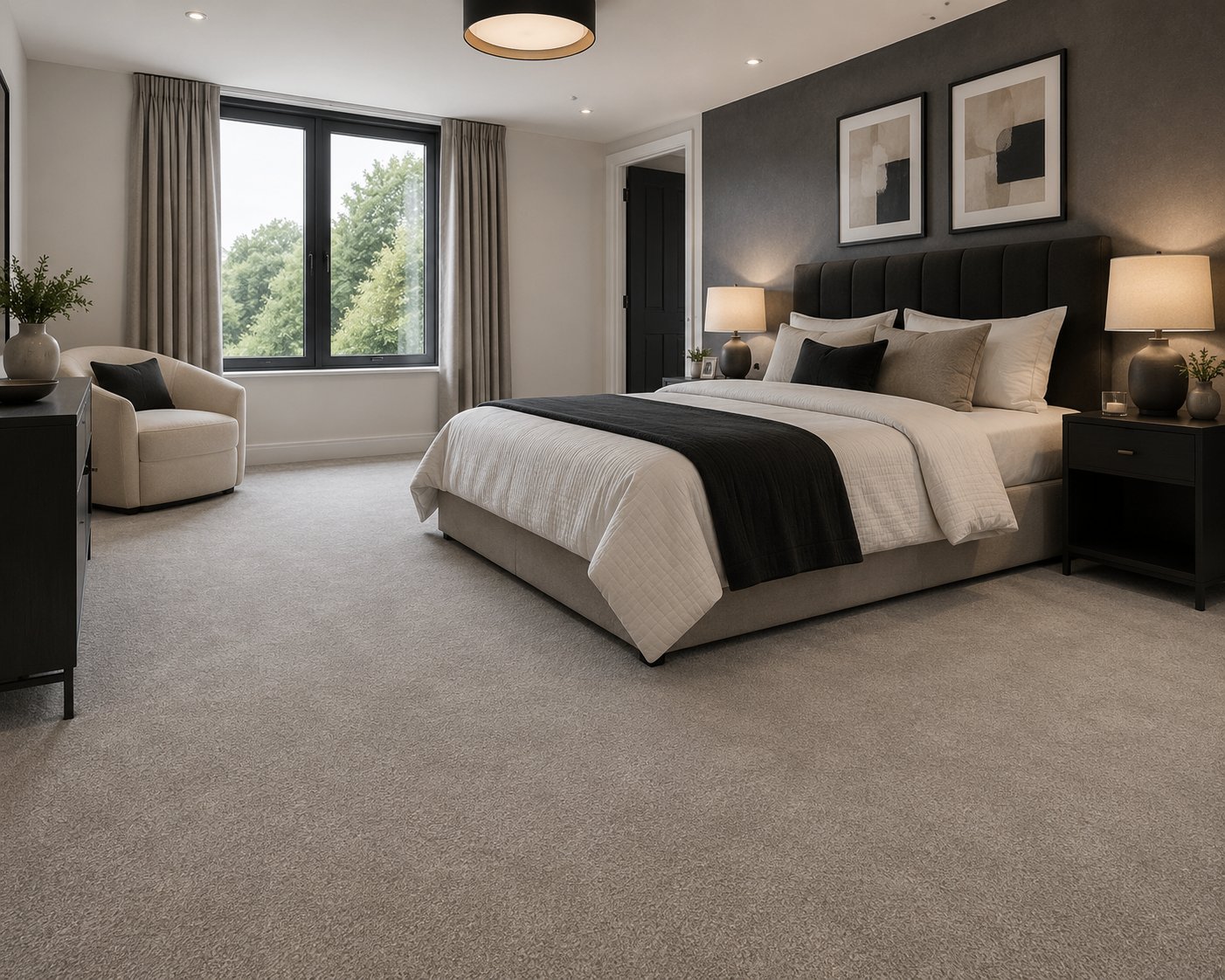
Can You Put Carpet Over Underfloor Heating?
Whether carpet can go over underfloor heating, the tog limits that matter, how underlay choice changes output, and when a hard floor is the better answer.
Yes, carpet can be fitted over underfloor heating, and it is done in Kent homes every week. The constraint is thermal resistance. Every layer between the heat source and the room resists heat, and once the total passes a threshold the system stops being able to warm the space at a sensible flow temperature.
The practical rule is that the combined tog value of carpet and underlay should not exceed 2.5, and lower is better. That figure sounds abstract until you realise most comfort underlays on their own are already 1.5 to 2.0.
The tog budget in practice
| Layer | Typical tog | Suitable over UFH |
|---|---|---|
| Standard 10mm PU foam underlay | 2.0 to 2.6 | No |
| 8mm crumb rubber underlay | 0.9 to 1.2 | Usually yes |
| Purpose-made low tog UFH underlay | 0.4 to 0.7 | Yes |
| Medium pile polypropylene carpet | 0.9 to 1.3 | Yes with a low tog underlay |
| Deep pile wool twist | 1.6 to 2.2 | Rarely, only with the thinnest underlay |
| Carpet tile, needlefelt backed | 0.4 to 0.7 | Yes |
How to choose the pairing
Start with the carpet you want and ask the supplier for its tog value, then work backwards to the underlay. A 1.0 tog carpet leaves you around 1.5 tog of underlay, which is comfortable. A 2.0 tog carpet leaves almost nothing, so you would be fitting onto a very thin underlay and the carpet will feel harder underfoot than you expect.
Where comfort matters more than heat output, and the room has radiators as well, the tog rule can be relaxed. Where underfloor heating is the only heat source, treat 2.5 as a hard ceiling.
Gripper, screed and the risk of hitting a pipe
Carpet gripper is nailed or pinned into the perimeter of the floor, and in a wet underfloor heating system the pipes usually run within the screed. Pipes are normally kept clear of the perimeter, but not always, and a nail through a pipe is an expensive afternoon.
The safe method is to bond gripper with adhesive rather than pin it, and to ask for the pipe layout drawing before starting. Where no drawing exists, a thermal camera run with the system warm shows exactly where the pipes are.
Commissioning the floor before fitting
- New screed must be fully dry, which for a traditional sand and cement screed can be a day per millimetre for the first 50mm
- The system should be commissioned and run up gradually before the floor covering goes down
- Turn the heating off, or down to around 18 degrees, for 48 hours before fitting and for 48 hours after
- Bring the temperature back up in small steps rather than in one jump
When a hard floor is simply better
If the underfloor heating is the primary heat source in a kitchen, open-plan area or extension, LVT or engineered wood will deliver far more of the heat you are paying for. Glue-down LVT in particular sits in direct contact with the screed and responds quickly.
Carpet remains the right answer in bedrooms and lounges where the underfloor heating supplements radiators, or where warmth underfoot and quiet matter more than raw output.
Electric mat systems have tighter limits
Electric mats sit much closer to the surface and have a lower total output than a wet system, so they are less forgiving of insulating layers. With an electric mat we would keep the combined tog under 1.5 and would usually steer the room towards a hard floor instead.
Getting the most heat out of a carpeted room
If you have committed to carpet over underfloor heating, a few decisions recover a surprising amount of the output. Choose a carpet with a shorter, denser pile rather than a deep one, because it is the trapped air in a long pile that insulates. Avoid a thick felt or hessian backing where an alternative exists.
Run the system continuously at a lower flow temperature rather than in short bursts. A carpeted floor is slow to respond, so an on-off schedule spends most of its time warming the floor rather than the room, whereas a steady low setting reaches equilibrium and stays there.
Finally, keep large rugs off the heated area. A rug on top of carpet on top of underfloor heating is three insulating layers, and it is the most common reason a customer tells us their heating has stopped working properly when nothing has actually failed.
Frequently asked questions
- What tog is too high for underfloor heating?
- Anything over 2.5 tog combined for carpet and underlay on a wet system, and over about 1.5 tog on an electric mat system.
- Will carpet damage the heating pipes?
- Only if gripper is pinned into a pipe. Bonding the gripper with adhesive removes the risk entirely.
- Does underfloor heating make carpet wear faster?
- No. It can dry the fibres slightly, which makes regular vacuuming more important, but it does not shorten the carpet's life.
- Can I keep my existing underlay?
- Almost never. Standard comfort underlay is well over the tog limit and is the usual reason a heated room never feels warm.
Keep reading
Which flooring types work well over underfloor heating, thermal considerations, and how commissioning affects fitting timescales.
Not all underlay is equal. Compare foam, rubber, fibre and PU underlays for comfort, sound and durability.
How wet and electric underfloor heating differ for flooring choice, build height, response time and which floor coverings suit each system.
See how we survey, prepare and fit carpet across Kent.
See how we survey, prepare and fit LVT across Kent.
Talk it through with a fitter, not a call centre
Book a free measure from our Gillingham warehouse and we will bring samples of the options discussed here, check the subfloor and leave you with a written quote you can hold us to.