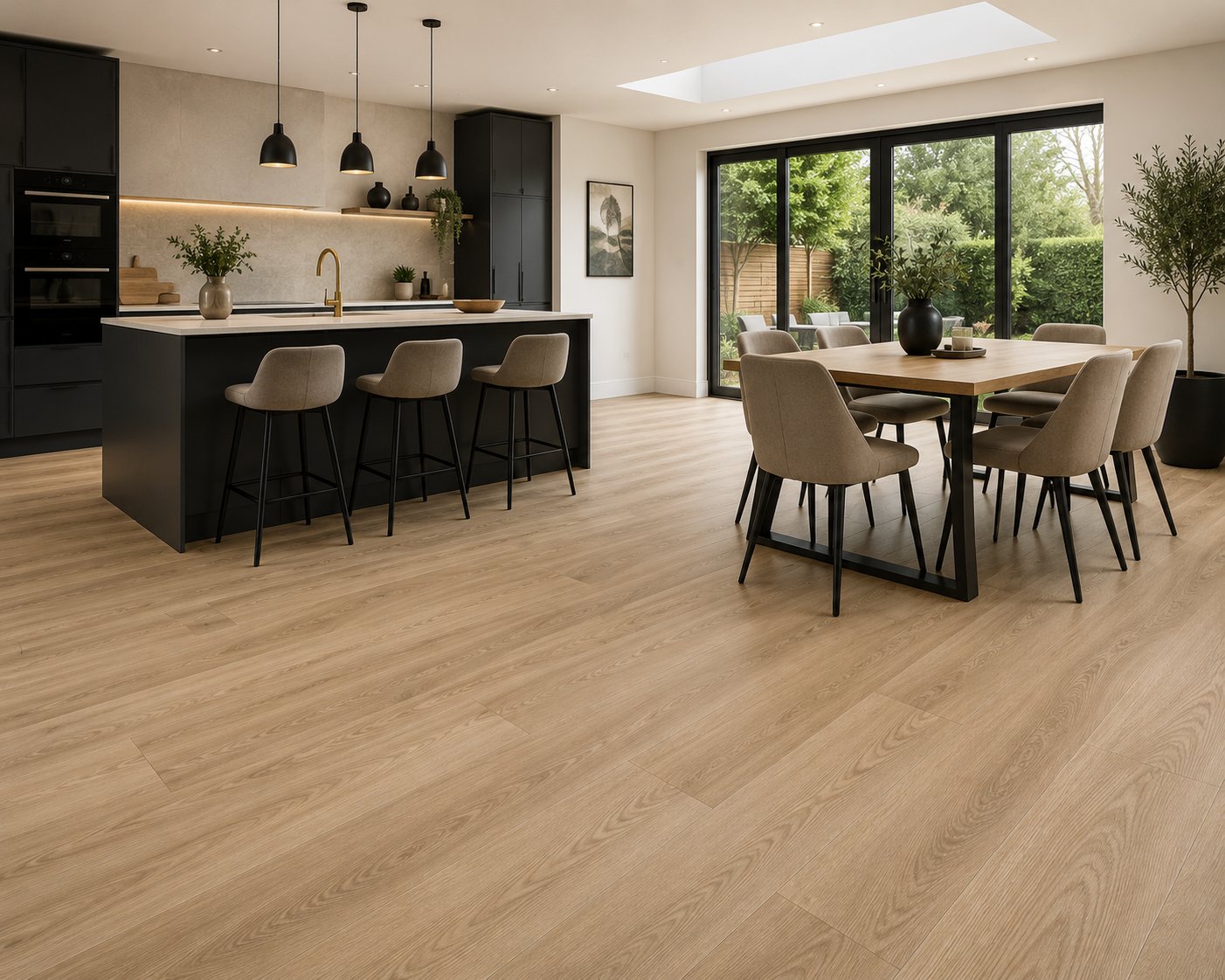
Luxury vinyl tile (LVT) in Dartford
LVT Flooring in Dartford
LVT supply and fit in Dartford. Subfloor checks, wear layer advice and free measuring from Kent Flooring Warehouse fitters covering Kent.
Conservatories and garden rooms are common additions on Modern Bridge developments properties around Dartford, and they are also where LVT sees the widest temperature swings of any room in the house. We talk through expansion allowance and adhesive choice specifically for these rooms before quoting.
Victorian terraces near Crayford often hide an original solid floor topped with several layers of old covering, and each layer has to be assessed before LVT can be quoted properly in Dartford.
New-build developments around Crossways Business Park in Dartford tend to have flatter, more consistent concrete subfloors straight from the builder, which usually keeps LVT preparation costs lower than in older Modern Bridge developments.


Ask about LVT in Dartford
Commercial LVT ratings for Crossways Business Park businesses
Shops, offices and hospitality units around Crossways Business Park in Dartford need an LVT product rated for the traffic they actually see, not a domestic tile stretched beyond its intended use. We check footfall patterns during the site visit and recommend a class that matches.
Glue-down fitting is the near-universal choice for commercial units, since the fixed floor plates and trolley traffic common in retail near A282 Dartford Crossing demand a stable, low-profile surface rather than a floating click floor.
| Setting | Recommended wear layer | Fitting method |
|---|---|---|
| Small office near {road} | 0.3mm to 0.5mm | Glue-down |
| Retail unit in {zone} | 0.5mm to 0.7mm | Glue-down |
| Hospitality area | 0.7mm plus | Glue-down with sealed joints |
Conservatories and garden rooms across Dartford
Conservatories on Modern Bridge developments properties around Dartford see far wider temperature swings than the main house, and this accelerates adhesive creep in glue-down LVT if the wrong adhesive is used. We select a formulation rated for these conditions and increase expansion allowance accordingly.
Click LVT is sometimes a better fit for a garden room extension near Crayford, since the floating installation tolerates seasonal movement without relying on an adhesive bond that has to withstand the full temperature range.
Cleaning and maintenance advice for Dartford customers
We leave every Dartford customer with the same simple routine: sweep or vacuum regularly, mop with a neutral pH vinyl cleaner, and keep steam mops and wax-based products away from the floor entirely.
A doormat at the entrance nearest A282 Dartford Crossing or the garden door removes most of the grit that causes visible scratching over time, which matters more to the floor's appearance long term than any cleaning product choice.
- Sweep or vacuum before mopping to remove grit
- Use a neutral pH cleaner made for vinyl floors
- Avoid steam mops, wax and ammonia-based products
- Fit furniture pads under chair and table legs
Repairs and edge lifting we see in Dartford
Edge lifting call-outs across Dartford usually trace back to one of the same three causes wherever they happen: too little expansion allowance, rising moisture through an unsealed concrete subfloor, or steam cleaning breaking down the adhesive bond.
Where we find lifting during a repair visit near Crayford, we assess whether the affected planks can be lifted and relaid individually, which is more often possible with click LVT than with a fully bonded glue-down floor.
What we check before quoting in Dartford
- Measure doorway thresholds and plan expansion gaps at every fixed obstruction.
- Check whether a damp-proof membrane or DPM primer is needed over a solid floor.
- Confirm whether click or glue-down suits the room's furniture loads and traffic.
- Check skirting boards or beading will fully cover the perimeter expansion gap.
- Assess conservatory or garden room temperature range before specifying adhesive type.
- Confirm batch numbers match across all boxes to avoid visible shade variation.
How the LVT job runs
- 1Survey and measure
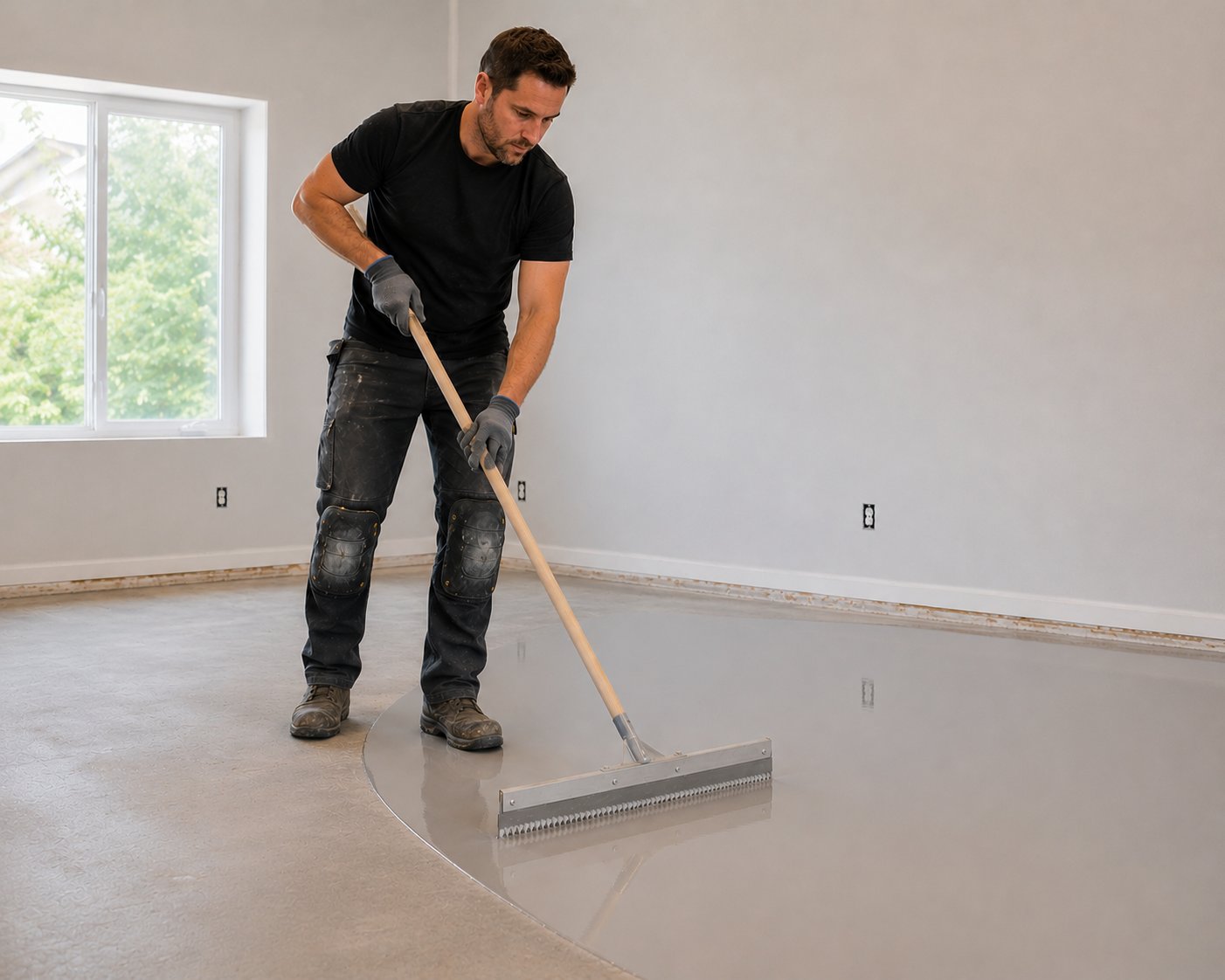
We visit to measure the room, check subfloor flatness with a straightedge, take moisture readings and identify whether latex screed or a plywood overlay will be needed before LVT can be fitted.
- 2Specify wear layer and fitting method
We match wear layer thickness and commercial rating to the room's actual traffic, and recommend glue-down or click based on subfloor type, underfloor heating and furniture loads expected in daily use.
- 3Prepare the subfloor
Latex screed is poured and left to cure on solid floors, or plywood overlay is screwed down across suspended timber floors, bringing the whole area within the flatness tolerance the LVT needs to perform properly.
- 4Set out the pattern
For herringbone or feature layouts, a centre line is chalked through the room and a dry lay confirms the pattern sits symmetrically at doorways and focal walls before any adhesive or click joint is committed.
- 5Fit the LVT
Planks or tiles are bonded with the correct adhesive or clicked together over underlay, with expansion gaps maintained at every wall, threshold and fixed obstruction throughout the room.
Luxury vinyl tile (LVT) questions from Dartford customers
- Do you check the subfloor before quoting LVT in Dartford?
- Yes, every Dartford measure includes a straightedge check for flatness and a moisture reading on solid floors. Any levelling work this reveals is priced into the quote before the job is confirmed.
- Can you fit herringbone LVT in a Dartford hallway?
- Yes, herringbone is one of our more requested layouts for hallways and open-plan areas across Dartford. We set out a centre line and dry lay the pattern before fitting to keep it symmetrical.
- Is glue-down or click LVT better for a Dartford kitchen?
- Glue-down usually suits kitchens better, particularly with underfloor heating, since it transfers heat more evenly and copes well with heavy appliances. We confirm the right choice during the Dartford site visit.
- Do you fit LVT over underfloor heating in Dartford new builds?
- Yes, provided the system is compatible and the surface temperature stays under the manufacturer's limit. We check this at the measure stage before recommending glue-down LVT for Dartford new-build projects.
- What wear layer do you recommend for a family home in Dartford?
- For most Dartford family homes we recommend 0.3mm to 0.5mm, which copes with children, pets and daily traffic better than a thinner domestic-grade wear layer aimed at low-use bedrooms.
- Can you fit LVT in a commercial unit near Crossways Business Park?
- Yes, we fit LVT rated to EN 685 commercial classes in shops, offices and hospitality units around Crossways Business Park, matching wear layer and fitting method to the traffic the floor will actually see.
Where we fit LVT around Dartford
We cover Crayford, Temple Hill, Joydens Wood, Stone, Greenhithe and the wider DA1 area, reaching Dartford via M25 Junction 1A/2, A2, A282 Dartford Crossing. Commercial work runs at Bluewater, Crossways Business Park, The Bridge.
Showroom and warehouse: Unit 9, Matilda Close, Gillingham Business Park, Gillingham, Kent, ME8 0PY
Every service we cover in Dartford.
Wide rolled sheet with a cushioned or felt-back core, welded seams and no grout lines, laid as a single waterproof skin across kitchens, bathrooms and hallways.
An HDF-cored floating floor with a printed decor layer under a hard AC-rated wear surface, usually the least expensive of the hard floors.
A real wood wear layer bonded onto cross-ply backing boards, giving the look and feel of solid wood with far more dimensional stability across the seasons.
How LVT wear layer thickness and AC/commercial use class ratings relate to durability, and which specification suits which room.
Click LVT or glue-down LVT? Compare stability, feel, subfloor needs and cost before choosing your fitting method.
Herringbone or straight plank LVT? Compare visual impact, waste, fitting time and cost for your layout.
Booking LVT in Dartford
LVT rewards attention to what happens before the planks arrive on site. Wear layer thickness, subfloor flatness and the right fitting method decide the outcome far more than the surface pattern does.