
Sheet vinyl in Strood
Sheet vinyl for Strood kitchens and bathrooms
Waterproof sheet vinyl fitted in Strood homes and let properties, seams welded and edges coved where needed. Free quotes.
In Strood ME2 properties with older bathrooms, sheet vinyl with coved edges is often the simplest way to stop water tracking behind the skirting into a timber subfloor without a full wet room conversion. We form the cove at the wall junction, cap the top edge, and weld the sheet seams so the whole floor behaves as one sealed unit rather than a series of joints that each need to be watched.
Timber subfloors in Strood ME2 homes need a full smoothing compound spread over sound plywood before sheet vinyl is laid, or board joints will eventually show through as ridges.
Doorway thresholds in Strood hallways are a common failure point for sheet vinyl, where a tight door bar or a poorly trimmed edge tears under repeated foot and trolley traffic.


Ask about sheet vinyl in Strood
Cushioned versus felt-back choice for Strood households
Families in Strood with young children often prefer cushioned sheet vinyl for the softer, quieter feel underfoot, accepting that heavy appliance and furniture feet will need load-spreading discs to avoid permanent dents over time. Households near Medway City Estate with heavier kitchen equipment or a busy let property often do better with felt-back or fully bonded sheet, which resists indentation far better at the cost of a firmer feel.
We bring both backing types as samples so Strood customers can feel the difference before choosing, rather than picking on appearance alone. The wrong backing for a heavily used Strood kitchen is one of the more avoidable disappointments we see reported after a few years.
| Household situation | Better backing | Why |
|---|---|---|
| Young family, standing at sink often | Cushioned | Softer, quieter underfoot over long periods |
| Heavy fixed kitchen appliances | Felt-back or fully bonded | Resists permanent indentation |
| Let property, high turnover of tenants | Felt-back | Firmer, more tolerant of harder daily use |
Cleaning advice we give every Strood customer after fitting
New sheet vinyl in Strood only needs a regular sweep and a damp mop with a neutral cleaner, and we always flag that strong solvent strippers and steam mops can soften seam welds and dull the wear layer over time. This is a simple habit to get right from day one and avoids the sticky residue and premature seam lifting that aggressive cleaning products cause.
We leave written aftercare guidance with every Strood job, because the floor's appearance and seam integrity several years on depends far more on cleaning routine than on the initial fit. A five minute conversation on handover saves most of the avoidable damage we get called back to look at.
Commercial sheet vinyl in Strood washrooms and kitchens
Commercial premises around Medway City Estate in Strood, including cafes, salons and small care settings, generally specify fully bonded or heavy-duty sheet vinyl with hot welded seams and coving throughout, meeting the hygiene standards expected in kitchens and washrooms under regular inspection. This is a different specification to a domestic kitchen job and is priced and quoted accordingly once the area and detailing are confirmed.
We have fitted this kind of sheet vinyl in commercial units across Strood and the wider Medway Council area, and the fitting sequence is more involved, with every seam welded and every wall junction coved rather than sealed with silicone alone.
- Fully bonded or heavy-duty sheet as standard for commercial floors
- Hot welded seams throughout, no unwelded joints
- Coving and capping at all wall junctions in wet areas
- Specification matched to the relevant hygiene requirements for the setting
Repairing and patching sheet vinyl in existing Strood properties
Older sheet vinyl in Strood homes, particularly near Higham, sometimes has a localised bubble, a torn threshold edge, or a lifted seam rather than damage across the whole floor, and this can often be cut out and patched rather than replacing the entire sheet. The patch is bonded and welded in to match, though an exact colour match on a faded older sheet is not always possible.
Where the damage is more widespread, or the backing has swollen from long-term moisture ingress, a full replacement is the more sensible option, and we would rather tell a Strood customer that plainly than patch a floor that is already failing structurally underneath.
What we check before quoting in Strood
- Identify existing appliance and furniture positions likely to need load-spreading feet.
- Choose cushioned, felt-back or fully bonded backing based on expected loads and use.
- Check existing floor coverings that need lifting and disposing of before the new lay.
- Confirm skirting condition and whether it needs lifting for a coved edge to be formed.
- Note any commercial hygiene specification that dictates fully bonded sheet and hot welding.
- Confirm whether the subfloor is solid concrete or suspended timber before specifying preparation.
How the sheet vinyl job runs
- 1Bonding the sheet
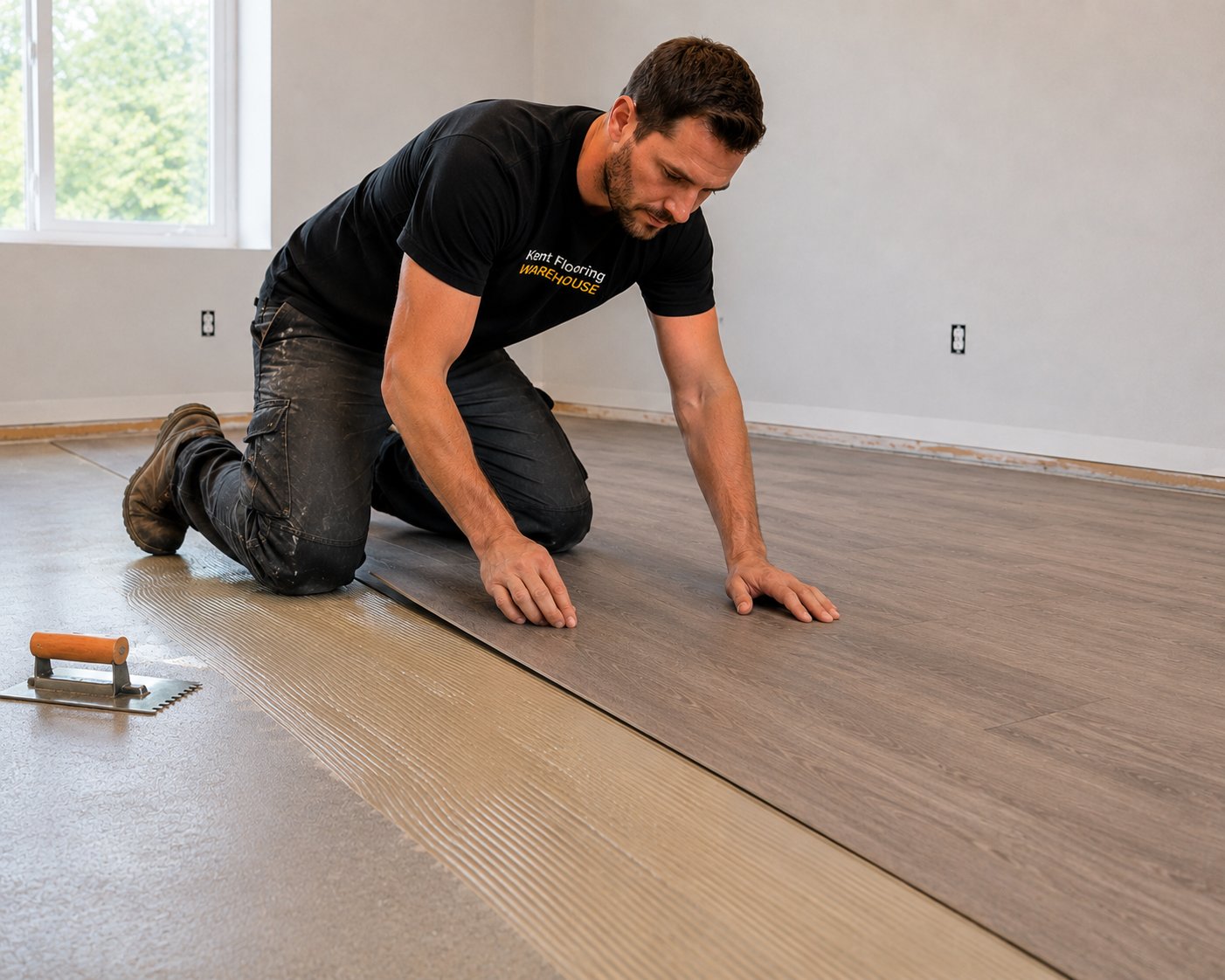
The sheet is bonded to the subfloor with the adhesive matched to the backing type, working out air pockets and debris as it goes down so no bubbles form under the finished surface.
- 2Seam welding
Seams are hot welded with a routed groove and matching weld rod, or cold welded with a chemical sealer for a domestic finish, then trimmed flush once fully cured.
- 3Coving, capping and finishing
Where specified, the sheet is dressed up the wall over a cove former and finished with a capping strip, then door bars, trims and thresholds are fitted to complete a sealed floor.
- 4Survey and measure
We measure the room precisely, check the subfloor type and condition, and work out roll width and orientation to minimise or avoid seams before anything is ordered or quoted.
- 5Subfloor preparation
Concrete is checked for moisture and levelled where needed, timber decks are checked for soundness and smoothed with compound over structural-grade ply so nothing telegraphs through the finished sheet.
Sheet vinyl questions from Strood customers
- Can a bubble in my Strood vinyl floor be fixed without replacing the whole floor?
- Often yes. A localised bubble or lifted seam can usually be cut out and patched, though if the backing has swollen more widely from moisture ingress a full replacement is the more honest recommendation.
- What is the difference between hot and cold welding for my Strood bathroom?
- Cold welding uses a chemical sealer for a near-invisible domestic seam and suits most Strood bathrooms, while hot welding with a routed weld rod is generally reserved for commercial-grade specifications.
- Will sheet vinyl dent under my fridge in my Strood kitchen?
- Cushioned sheet vinyl can dent permanently under sustained appliance loads over time. Using wide, load-spreading feet under the fridge, or choosing felt-back sheet instead, reduces this in Strood kitchens.
- Can you fit sheet vinyl over underfloor heating in Strood?
- Sheet vinyl can generally be fitted over underfloor heating in Strood properties provided the system is run up gradually and the manufacturer's maximum surface temperature is respected during and after fitting.
- How do I clean sheet vinyl in my Strood home?
- A regular sweep or vacuum and a damp mop with a neutral cleaner is all that is needed. We advise every Strood customer against solvent strippers and steam mops, which can soften seam welds over time.
- Do you offer free quotes for sheet vinyl in Strood?
- Yes, we measure the room, check the subfloor and confirm any coving or welding requirements on site, then provide a written quote for supply and fitting your Strood property before any work is booked.
Where we fit sheet vinyl around Strood
We cover Higham, Temple Marsh, Frindsbury, Cuxton, Wainscott and the wider ME2 area, reaching Strood via M2 Junction 2, A2, A228. Commercial work runs at Knight Road, Medway City Estate, Strood Retail Park.
Showroom and warehouse: Unit 9, Matilda Close, Gillingham Business Park, Gillingham, Kent, ME8 0PY
Every service we cover in Strood.
Rigid, layered vinyl planks and tiles built around a wear layer and a printed decorative film, fitted glued or clicked over a properly prepared subfloor.
Slip-resistant sheet vinyl with an aggregate wear layer, welded seams and coved edges for kitchens, clinical rooms, schools and anywhere wet feet or spilled fat meet hard floor.
An HDF-cored floating floor with a printed decor layer under a hard AC-rated wear surface, usually the least expensive of the hard floors.
Sheet vinyl or LVT — which suits a wet room, kitchen or busy hallway best? Compare seams, looks and cost.
What seam welding is, why it's used on sheet vinyl in wet areas and commercial settings, and how it differs from a standard seam.
Safety flooring or standard vinyl — know the difference in slip resistance, compliance and where each belongs.
Booking sheet vinyl in Strood
Coving and capping cost more in labour than a flat lay but remove the skirting joint entirely, which is worth having in any wet room where water reliably finds its way to the wall base over time.