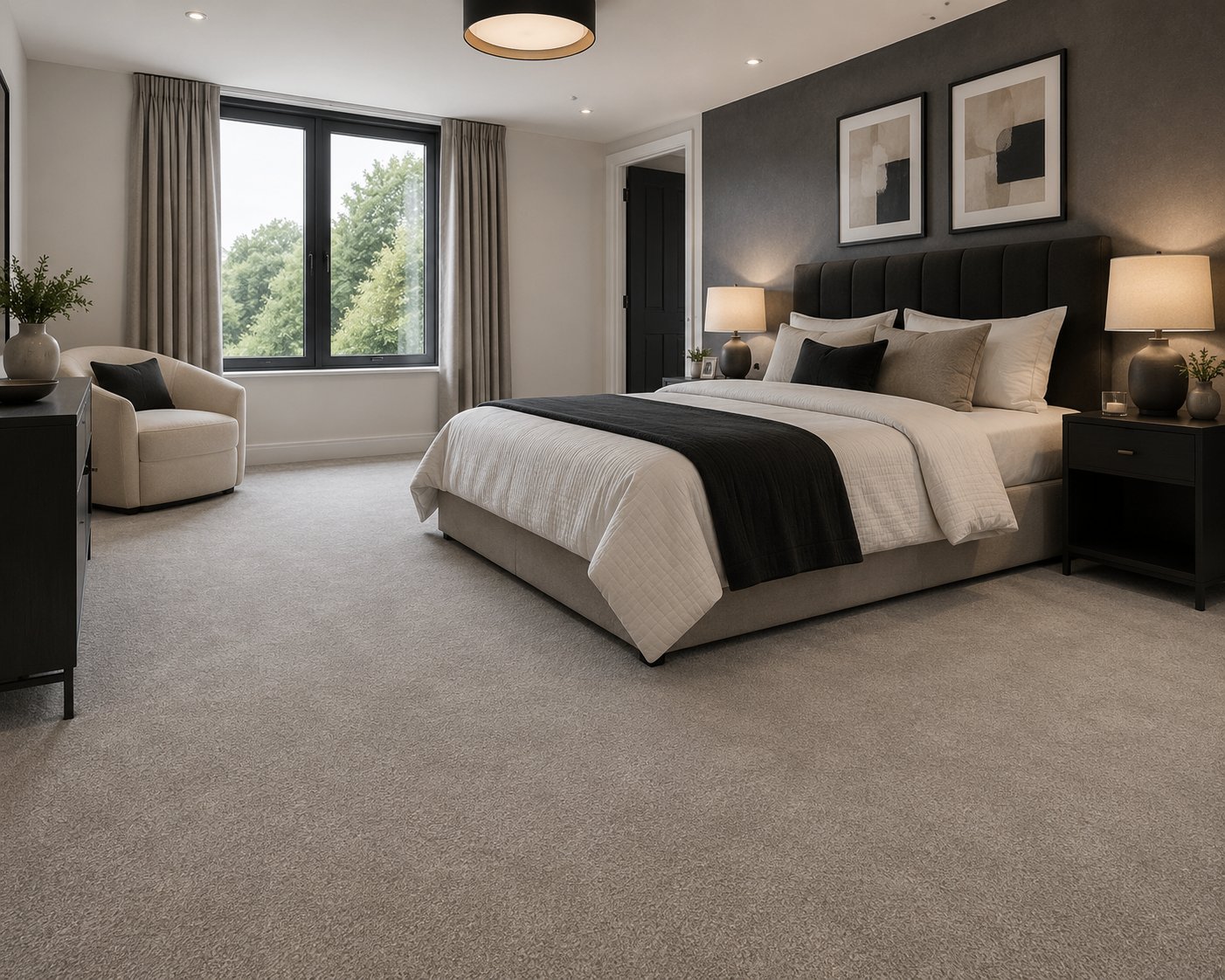
Carpet Fibres, Weight and Tog: What the Numbers Mean
A plain-English guide to carpet fibre types, pile weight and underlay tog values, and how they affect feel and durability.
Carpet labels can carry a fair amount of technical detail — fibre type, pile weight, twist level, underlay tog — and it's not always clear which of those actually matter for your room. Fibre type mostly determines durability and feel, pile weight relates to density and how luxurious it feels underfoot, and tog is specifically about underlay's thermal insulation, not the carpet itself.
Getting these matched to the room — a hard-wearing stair carpet versus a soft bedroom pile, for instance — makes a bigger practical difference than choosing on colour alone.
It's also worth reading past the headline fibre name, since two carpets both labelled 'nylon' or 'wool-blend' can perform quite differently depending on the percentage blend, the yarn's twist level, and how densely it's tufted. A sample that feels similar in the showroom can wear quite differently once it's down in a hallway seeing daily traffic, which is why it's worth asking what the specific construction is, not just the fibre name on the label.
Common carpet fibre types
| Fibre | Typical characteristics |
|---|---|
| Wool | Durable, natural feel, good resilience, higher price point |
| Wool-blend (e.g. wool/nylon) | Combines wool's look with added durability from synthetic fibre |
| Nylon (polyamide) | Very durable and resilient, good for high-traffic areas |
| Polypropylene | Budget-friendly, stain-resistant, less resilient underfoot over time |
| Polyester | Soft feel and good colour retention, softer wear performance |
Pile weight and what it tells you
Pile weight, usually given in grams per square metre, is a rough guide to how dense the carpet is — generally, a higher weight means a more substantial, longer-wearing carpet, though fibre type and construction also play a big part in actual durability.
Twist level is a related but separate figure, sometimes given as turns per inch, describing how tightly the yarn is spun before tufting. A tightly twisted pile tends to hold its shape better and resist matting and flattening in high-traffic areas, whereas a looser twist can feel plush initially but flatten more visibly over the first year or two of use.
How carpet is actually tested and graded by manufacturers
Reputable manufacturers grade domestic carpets against standard wear and appearance-retention tests, often shown on the label as a star rating or a specific traffic grade (light, medium, general or heavy domestic). This grading takes fibre, twist, weight and backing construction into account together, which is a more reliable guide to expected performance in a specific room than looking at pile weight in isolation.
Twist pile versus loop pile construction
- Twist pile — cut fibres twisted for a textured, hard-wearing finish, popular for living areas and stairs
- Loop pile (including berber styles) — uncut loops, durable and good for high-traffic zones, though snags can pull a loop if caught
- Saxony/plush — a smoother, softer cut pile finish, often chosen for bedrooms rather than heavy-traffic rooms
Underlay tog values explained
| Tog rating | Suitability |
|---|---|
| Up to 1.5 tog | Underfloor heating rooms — low thermal resistance needed |
| 1.5–2.5 tog | General living areas with good warmth and comfort |
| 2.5 tog+ | Bedrooms and rooms without underfloor heating, maximum warmth and cushioning |
Matching fibre and construction to the room
Stairs and hallways benefit from a durable, resilient fibre and construction such as twist or loop pile in nylon or wool-blend, since these areas see concentrated wear. Bedrooms can prioritise softness and warmth over sheer durability, since footfall is lighter.
Backing construction and how it affects fitting
The backing on the underside of the carpet — action backed, latex-coated, or a woven jute-style backing on some wool carpets — affects how well it grips gripper pins, how much it stretches during fitting, and how it behaves over time. A carpet with a stiffer, more dimensionally stable backing tends to hold its stretch better over a large room, while a softer-backed carpet can be easier to dress into awkward shapes such as bay windows or stair winders but needs a more careful hand when tensioning it.
Frequently asked questions
- Is a higher tog value always warmer and better?
- It's warmer, but 'better' depends on your floor — a high tog underlay over underfloor heating will insulate against the heat you're paying to generate, so lower tog is specified in those rooms instead.
- What's the most durable carpet fibre for stairs?
- Nylon and wool-blend carpets are generally the most resilient choices for stairs, given the concentrated wear stair treads receive compared with open floor areas.
- Does a heavier carpet always last longer?
- Pile weight is a useful indicator but not the only factor — fibre type, twist level and how the carpet is used day to day also significantly affect how long it wears well.
- Can I use the same carpet throughout my house?
- You can, but it's often better value to specify a more durable option for stairs and hallways and a softer option for bedrooms, rather than one specification everywhere.
Keep reading
Why flats often need acoustic underlay for sound insulation, how ratings work, and what to check before choosing flooring.
How gripper-rod carpet fitting compares with fully bonded double-stick fitting, and which method suits which room or setting.
Which flooring types work well over underfloor heating, thermal considerations, and how commissioning affects fitting timescales.
How carpet is priced per square metre or square foot, how to convert between the two, and why the room size on your quote is bigger than the floor itself.
See how we survey, prepare and fit carpet across Kent.
See how we survey, prepare and fit stair runners across Kent.
Talk it through with a fitter, not a call centre
Book a free, no-obligation survey with Kent Flooring Warehouse and our in-house fitting team will check your subfloor and confirm the right carpet fibre and underlay specification before you commit to anything — call 07702 737267.