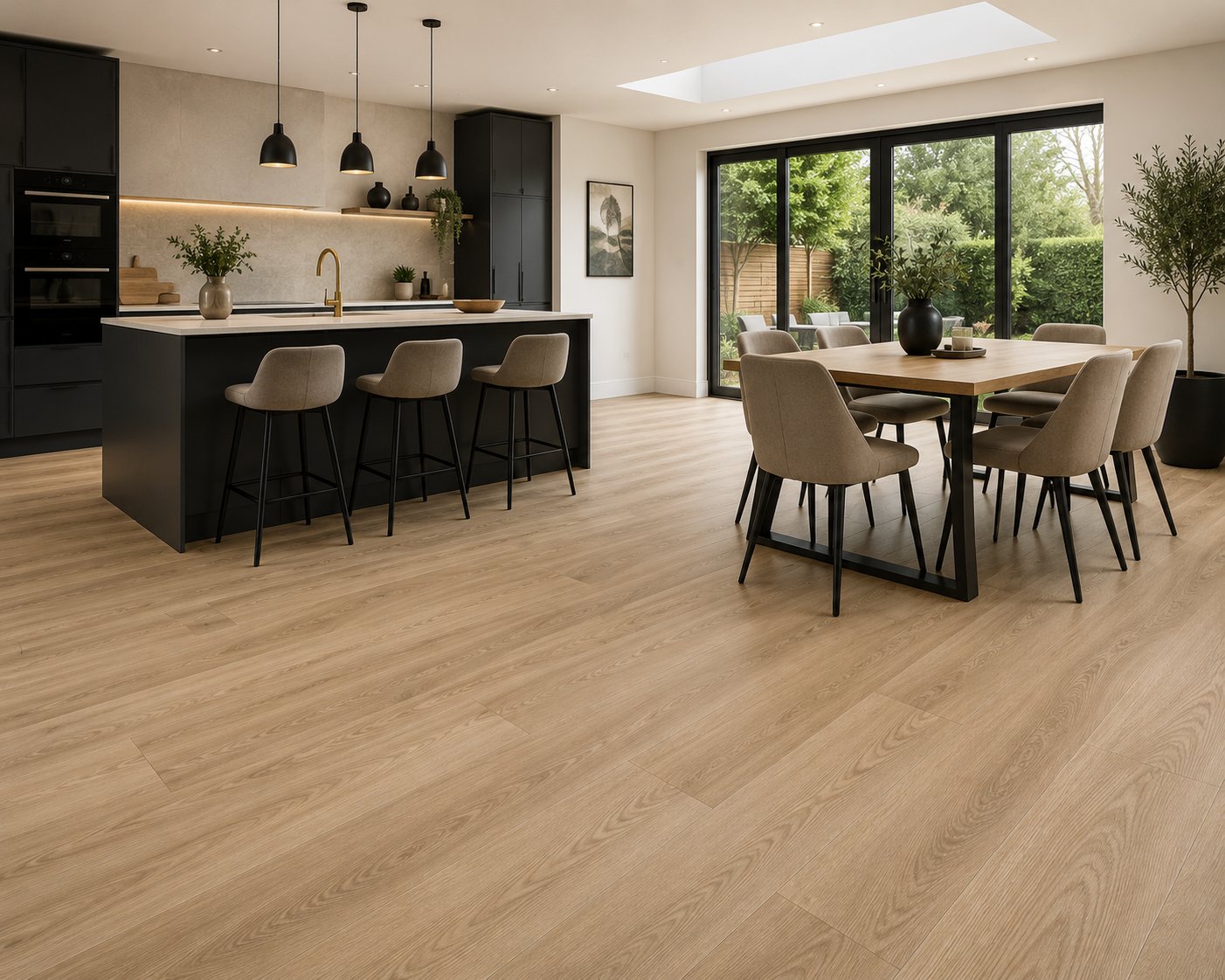
What Is LVT Flooring?
LVT explained for first-time buyers: how luxury vinyl tile is built, click versus glue-down fitting, wear layers, and which rooms it suits best in a home.
LVT stands for luxury vinyl tile. It is a layered vinyl floor supplied as individual planks or tiles rather than a roll, printed to look like wood or stone and finished with a clear protective layer on top. Because each piece is separate, it can be laid in straight planks, herringbone or tile patterns.
People choose it because it copes with water far better than laminate, feels warmer than ceramic tile and can be cleaned with a damp mop. It is used in kitchens, bathrooms, hallways and whole ground floors, as well as shops and offices.
How an LVT plank is built
Under the surface there is a backing layer for stability, a printed design layer that gives the look, and a clear wear layer on top. The wear layer is what actually takes the scuffs and footfall, so its thickness tells you more about how the floor will last than the overall plank thickness does.
Domestic rooms are fine with a lighter wear layer; hallways, family kitchens and commercial floors benefit from a heavier one. Product data sheets give the figure, and we can explain it for the range you like.
Click LVT and glue-down LVT
Click LVT locks together and floats over the subfloor, usually on a thin underlay. It is quicker to lay and suits many homes. Glue-down LVT is bonded to a smooth, level base with adhesive. It is more stable in large rooms, in conservatories that heat up in sun, and over underfloor heating, and it is the usual choice for commercial work and herringbone patterns.
Either way, the base decides the finish. LVT is thin enough to show dips and ridges beneath it, so a survey often recommends a latex screed or plywood overlay before fitting.
Where LVT works well and where it does not
- Good fit: kitchens, bathrooms, utility rooms, hallways, open plan ground floors
- Good fit: homes with pets and children, thanks to wipe-clean surfaces
- Think twice: bedrooms where you want softness underfoot, where carpet may suit better
- Think twice: rooms with badly uneven floors, unless preparation is included
Frequently asked questions
- Is LVT waterproof?
- The surface copes very well with spills and splashes, which is why it suits kitchens and bathrooms. Standing water should still be wiped up, and joints need fitting correctly.
- Is LVT the same as laminate?
- No. Laminate is a fibreboard core with a printed layer, while LVT is vinyl throughout, so LVT handles moisture much better.
- Can LVT go over underfloor heating?
- Yes, many LVT products are suitable, usually glue-down, with the heating run at the temperature the maker allows.
- Why does my LVT quote include floor preparation?
- Because LVT shows any unevenness underneath. Levelling the base first is what gives a flat, lasting finish.
Keep reading
LVT or laminate? Compare water resistance, feel underfoot, durability and guide costs to pick the right floor for your room.
Click LVT or glue-down LVT? Compare stability, feel, subfloor needs and cost before choosing your fitting method.
How LVT wear layer thickness and AC/commercial use class ratings relate to durability, and which specification suits which room.
Herringbone or straight plank LVT? Compare visual impact, waste, fitting time and cost for your layout.
See how we survey, prepare and fit LVT across Kent.
Talk it through with a fitter, not a call centre
See LVT samples in the showroom or at home, then book a free survey so we can check the subfloor and quote properly.