Why a New Floor Sounds Hollow Underfoot
A hollow or drummy noise underfoot means the covering is not in full contact with the base. Here is what causes the void and how it is closed.
Straight answer: hollowness is air. Wherever a covering is not touching the base beneath it, footsteps set that pocket vibrating and you hear a drum rather than a solid tap. The sound tells you where the void is, not necessarily how serious it is.
Some hollowness is expected. Every floating floor sits on an underlay rather than being stuck down, so it will always sound livelier than a bonded one, especially in a big empty room with hard walls.
What is not expected is a bonded floor that drums, or a floating floor with distinct hollow patches while the rest of the room sounds normal. Those point at the base underneath, and that is where any honest diagnosis has to start.
Normal resonance versus a genuine void
Tap across the whole room with a knuckle or a coin and listen for change. A consistent note everywhere, even a lively one, usually just means the floor floats. A note that drops away in patches means the covering has lost contact in those spots.
- Even sound across the room, no movement underfoot — resonance, not a defect
- Distinct patches that drum while neighbours sound dull — a void beneath
- Sound plus a slight give when weight lands on it — the covering is bridging a dip
- Sound plus a creak — two surfaces rubbing where they should be held apart or together
What creates the void in the first place
On bonded floors the usual answer is that the adhesive never made full contact. Dust on the base, a spread that skinned over before the covering went down, or a base with hollows in it all leave the covering resting on high points with air in between.
On floating floors, unevenness in the base does the same thing. The covering is rigid enough to span a dip rather than follow it, so the dip becomes a sealed pocket of air with a springboard over the top.
- Base not vacuumed and primed properly before adhesive
- Adhesive left open too long in a warm room
- Dips, trowel ridges or old adhesive residue left in the base
- Underlay bunched, doubled over or laid across a hollow
How flat the base actually has to be
Manufacturers set tolerances rather than demanding perfection, and most hard coverings expect a base that is flat within a few millimetres across a couple of metres. The number matters less than the principle: any dip deeper than the covering can follow becomes a hollow you will hear later.
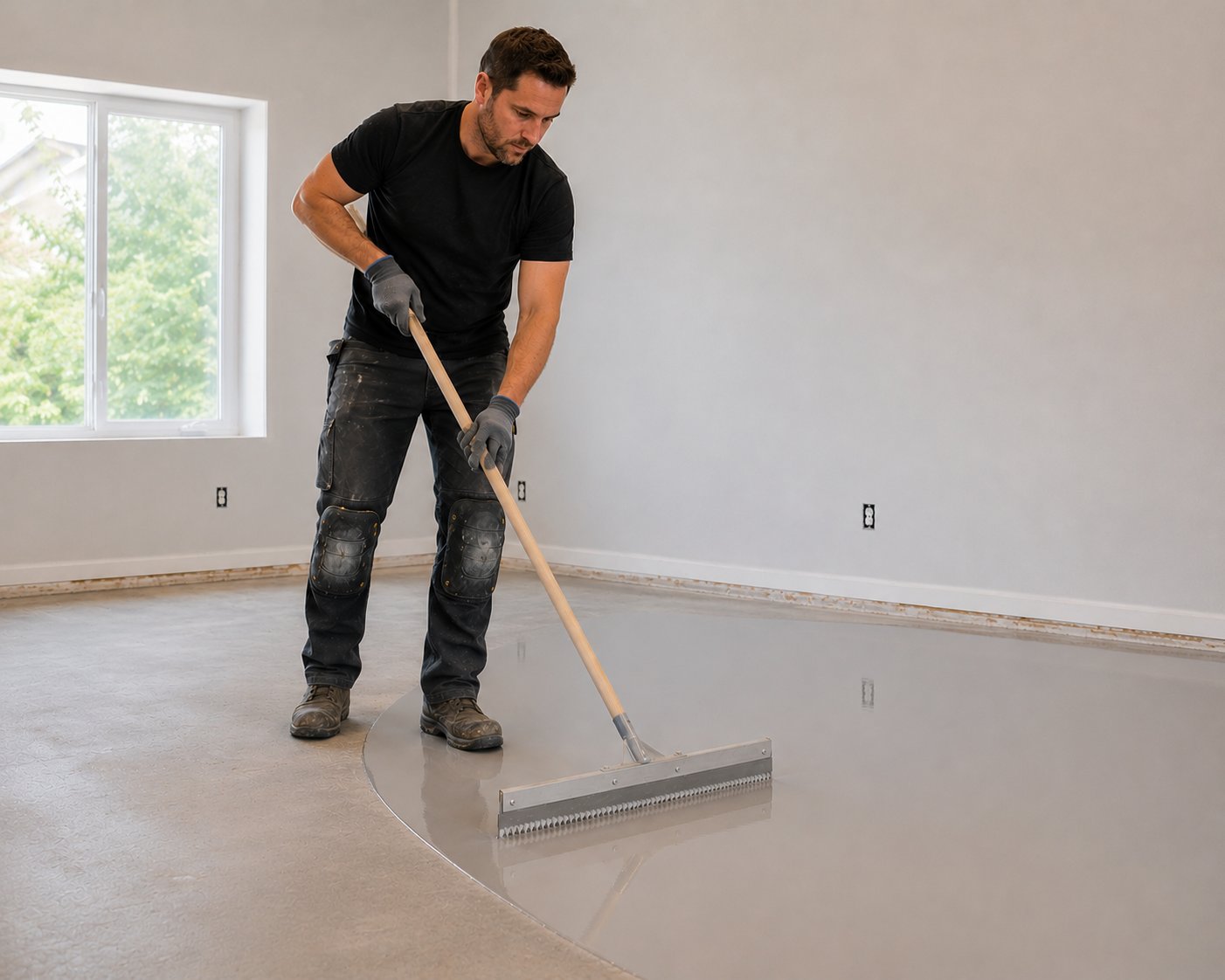
This is why proper preparation is not an optional extra. Smoothing compound, patching or an overlay board costs less than lifting a finished floor to correct the same problem afterwards.
Table: hollow sound by floor type
| Floor type | Likely reason for hollowness | Typical remedy |
|---|---|---|
| Bonded vinyl or tile | Partial adhesive contact | Lift the area, clean back, re-bond |
| Floating click floor | Dip in the base underneath | Lift, level the dip, relay |
| Timber base with overlay | Boards or ply not fixed down tightly | Screw down, then reinstate covering |
| Whole room, no patches | Normal floating resonance | No repair needed |
The tests we run before recommending anything
We sound out the room to map the hollow areas, put a straight edge across them to measure the dip, check whether the covering moves as well as sounds, and where it is safe to do so lift a small area at the edge of the worst patch to see the base for ourselves. Guessing at a void without looking under the covering is how the wrong repair gets sold.
Why hollow patches matter in commercial buildings
In an office, shop or care setting a hollow area takes concentrated wheeled and foot traffic that a domestic room never sees. A void under a bonded floor in a busy walkway breaks down faster than the same void in a spare bedroom, so we treat hollowness in commercial spaces as something to correct rather than tolerate.
What repair usually involves
- Small bonded patch — lift, clean the base back, re-adhere and roller down
- Dip under a floating floor — lift the boards, fill and smooth, relay
- Loose timber base — refix the deck before the covering goes back
- Widespread voids — take the area up, prepare properly and relay in one go
Preventing it on the next floor
Every hollow floor traces back to preparation, so that is where prevention lives: a clean base, checked for flatness with a straight edge, corrected where it needs it, and a covering laid within the adhesive's working time. It is unglamorous work and it is the difference between a quiet floor and one you can hear from the next room.
Frequently asked questions
- Is a hollow sounding floor a fault?
- Not always. Floating floors naturally sound livelier than bonded ones. It becomes a fault when only some areas drum, or when a bonded floor drums at all.
- Will a hollow area get worse?
- Under regular traffic, usually yes, because every footstep flexes the covering over the void. In a lightly used corner it may stay the same for years.
- Can hollowness be fixed without lifting the floor?
- Sometimes on bonded floors an injection repair works for a small void. Anything caused by a dip in the base needs the covering lifted so the base can be corrected.
- Does thicker underlay stop the hollow sound?
- It can soften the note, but it does not remove a void caused by an uneven base. Levelling the base is the part that actually solves it.
Keep reading
What proper subfloor preparation involves before new flooring goes down, why it matters, and what our fitters check on survey day.
How latex self-levelling compound works, when it's needed, and how it differs from full sand-cement screed before new flooring.
Why timber floorboards squeak or feel uneven underfoot, and how we sort it before new flooring goes down.
Thin gaps opening between vinyl planks usually mean movement, temperature swing or a bond that never took. Here is how to tell which.
See how we survey, prepare and fit LVT across Kent.
See how we survey, prepare and fit laminate across Kent.
Talk it through with a fitter, not a call centre
If part of your floor drums when you walk on it, we can sound it out, measure the base beneath and tell you exactly what is needed. Get in touch for a survey.