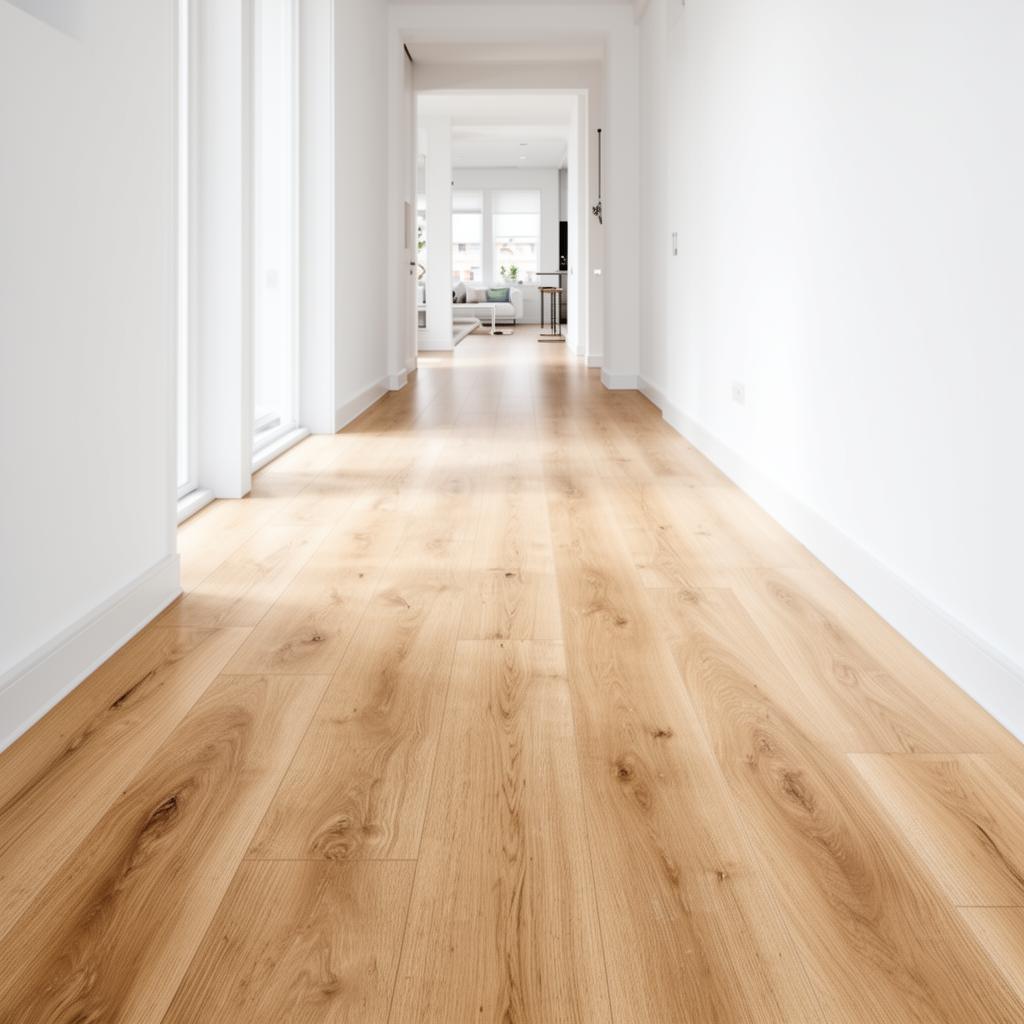
Laminate Floor Maintenance and Repair
How to clean laminate without damaging the joints, deal with chips, scratches and swollen boards, and replace a single plank in a floating floor.
Laminate is hard-wearing on the surface and vulnerable at the edges. The decorative layer resists scratching better than most people expect, but the core is compressed fibreboard, and once water reaches a joint that core swells and never goes back.
Almost everything in laminate maintenance therefore comes down to keeping water out of the joints and grit off the surface.
Cleaning laminate correctly
- Sweep or vacuum on a hard floor setting several times a week to remove grit
- Use a barely damp microfibre mop, never a sopping string mop or a bucket of water
- Use a cleaner made for laminate, or plain water, and avoid soap-based products that leave a film
- Never use steam, wax, polish or abrasive cream
- Dry any standing water immediately, especially near a dishwasher, sink or external door
Surface scratches and chips
Fine scratches often become far less visible once the floor is cleaned properly, because much of what looks like scratching is scuffing and residue. For genuine scratches, a colour-matched repair wax or filler pencil worked into the mark and buffed level is the practical fix.
Chips at a board edge are harder, because the exposed core is a different colour and will absorb moisture. Fill them with a hard wax repair kit rather than leaving them open, even if the colour match is imperfect.
Gaps opening between boards
Small seasonal gaps that appear in winter and close in summer are normal in a floating floor. Persistent gaps that keep widening usually mean the floor was fitted without an adequate expansion gap, or it is being held down at one point by a heavy unit, a screwed threshold or a skirting board pinched too tight.
The fix is to find the restraint and release it. Trimming the expansion gap at the perimeter and refitting the beading is a half day job and far cheaper than relaying the floor.
Swollen boards after water
| Symptom | Outcome |
|---|---|
| Damp surface, dried within hours | Usually no lasting damage |
| Slight lifting at one joint edge | May settle, monitor for a fortnight |
| Raised, roughened joint edges | Permanent, boards need replacing |
| Cupped or peaking boards across a run | Core has swollen, relay the affected area |
| Water under the floor from a leak | Lift, dry the subfloor fully, then reassess |
Replacing a single plank
In a floating click floor, the tidy method is to unclick from the nearest wall, working boards out in sequence, swap the damaged plank and reassemble. It is slow but leaves no visible repair.
Where that is impractical, the damaged board can be cut out with a plunge saw, the locking tongue removed from the replacement and the new board glued into place. Done carefully, it is invisible. Done in a hurry, the repair patch flexes and clicks underfoot.
This is the argument for keeping two or three spare boards from the original fitting. Laminate ranges change constantly, and a five year old decor is rarely still available.
Protecting the floor day to day
Felt pads on every furniture leg, replaced annually. A proper barrier mat at external doors. A tray under plant pots. Castors rated for hard floors on any office chair. Those four habits account for most of the difference between a laminate floor that looks tired at six years and one that still looks good at twelve.
When repair stops making sense
Repair is worth it where the damage is local and the rest of the floor is sound: a chipped board, a scratched plank, one water-swollen edge near a dishwasher. In those cases replacing a board or two costs very little and the floor carries on.
Repair stops making sense in three situations. Where the boards are widely gapped because the floor was fitted with no expansion allowance, because every repair will move again. Where the subfloor beneath is uneven or damp, since the same failures will recur. And where the decor is discontinued and no reasonable match exists, because a visibly different plank in the middle of a room looks worse than a tired but uniform floor.
At that point the honest advice is to price relaying the room and compare it against a series of repairs that will not hold.
Frequently asked questions
- Can laminate be sanded and refinished?
- No. The decorative layer is a printed image under a wear coat, and sanding removes it. Damaged boards are replaced, not refinished.
- Is water resistant laminate waterproof?
- No. It buys you more time to mop up a spill, but the core is still fibreboard and prolonged wetting will still swell it.
- Why does my laminate click when I walk on it?
- Usually a hollow beneath from an uneven subfloor, or a joint that has not fully engaged. Both are subfloor and fitting issues rather than product faults.
- Can I put laminate in a bathroom?
- We would not. Even water resistant grades struggle with the humidity and standing water in a bathroom, where LVT or vinyl belongs.
Keep reading
Why laminate boards separate over time and how we close the gaps or refit the floor correctly.
How to assess vinyl or laminate after a leak or flood, and when repair versus full replacement makes sense.
Laminate looks like wood but isn't — compare it against real engineered wood on feel, longevity and value.
See how we survey, prepare and fit laminate across Kent.
Talk it through with a fitter, not a call centre
Book a free measure from our Gillingham warehouse and we will bring samples of the options discussed here, check the subfloor and leave you with a written quote you can hold us to.