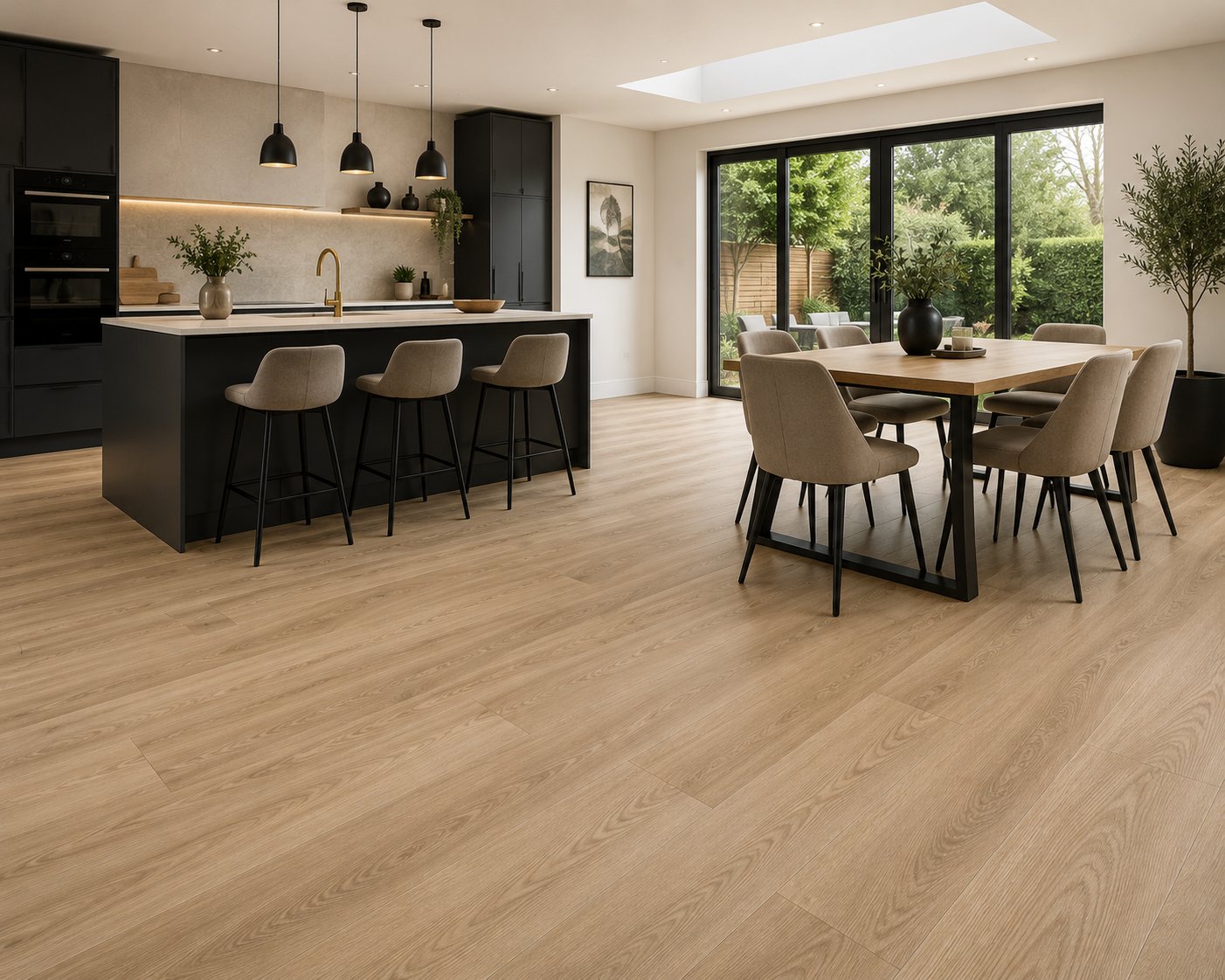
What Does LVT Flooring Cost, and Why?
What drives the price of LVT flooring — click vs glue-down, tile thickness, subfloor prep and fitting labour — with guide-only UK cost ranges.
LVT (luxury vinyl tile) quotes can vary widely, and it's not always clear why. Part of the answer is the product itself — wear layer thickness, plank size, rigid-core vs flexible — and part is the fitting method, since glue-down LVT takes longer to install than click LVT.
This breakdown separates product cost from fitting cost so you can see where your money is going and ask the right questions when comparing quotes.
LVT sits in an unusual position in the market: it can be bought as a budget product for well under carpet prices, or specified as a premium commercial-grade material costing several times as much, and the visual difference between the two isn't always obvious in a showroom sample. The wear layer, core construction and installation method behind the surface matter more than the pattern printed on it.
Click LVT vs glue-down LVT: cost implications
Click LVT (often rigid-core/SPC or WPC) floats over underlay and is generally quicker to fit, which usually keeps labour costs lower. Glue-down LVT bonds directly to a fully prepared subfloor, giving a lower profile and often better performance in commercial settings, but it takes longer to lay and demands a near-perfect subfloor, which adds labour and prep cost.
Guide-only cost bands
| LVT type | Guide price range per m² |
|---|---|
| Entry-level click LVT | £25–£40 |
| Mid-range rigid-core click LVT | £35–£55 |
| Premium glue-down LVT | £45–£75 |
| Commercial-grade LVT with heavy wear layer | £40–£65 |
What wear layer thickness does to price
Wear layer thickness is one of the biggest drivers of LVT price and durability, with thicker wear layers (typically 0.3mm–0.7mm) better suited to busy households or light commercial use. A thicker wear layer usually means a longer realistic lifespan, which can offset a higher upfront cost.
Subfloor prep costs specific to LVT
- Self-levelling compound where the subfloor has dips or unevenness
- Damp-proof membrane over solid floors with residual moisture
- Plywood overlay over uneven timber subfloors
- Removal of old adhesive residue from previous flooring
Where costs typically rise once a fitter arrives
LVT is unforgiving of an imperfect subfloor, so most on-the-day cost increases come from subfloor issues discovered once old flooring is lifted, rather than the LVT itself. This is why a proper survey — including checking under existing flooring where possible — reduces the chance of surprises.
Rigid core construction and why it affects price
SPC (stone polymer composite) and WPC (wood polymer composite) cores give click LVT its dimensional stability, letting it float over minor subfloor imperfections that would show through a thinner product. Denser SPC cores generally cost more than WPC but perform better under heavy furniture and rolling loads, which matters in kitchens and commercial areas.
Lifecycle cost versus the price on the sample board
A cheaper LVT with a thin wear layer might need replacing within a handful of years in a busy hallway, while a thicker commercial-grade product costing more upfront can outlast it several times over. When comparing quotes, it's worth weighing the expected lifespan against the initial outlay rather than judging purely on the headline per-m² figure.
Plank size and format as a cost factor
Larger-format planks and tiles generally cost more per m² to manufacture and can highlight subfloor imperfections more readily than smaller formats, which sometimes pushes up the standard required for subfloor prep. Herringbone or parquet-style LVT layouts also take noticeably longer to fit than a straight running pattern, and this labour difference should show up as a distinct line on the quote.
Frequently asked questions
- Is glue-down LVT always more expensive than click LVT?
- Generally yes, because glue-down installation takes longer and needs a more thoroughly prepared subfloor, though the product cost difference between click and glue-down tiles themselves can be smaller. The labour and prep gap is usually the bigger factor.
- Does LVT need special underlay?
- Click LVT typically uses a thin, dense underlay designed for rigid-core flooring rather than a thick carpet-style underlay, while glue-down LVT is bonded directly without underlay. Using the wrong underlay can affect warranty and performance.
- Why is commercial-grade LVT sometimes cheaper than premium residential LVT?
- Pricing reflects wear layer, design complexity and finish rather than the 'commercial' label alone, so a heavy-domestic residential product can sometimes cost more than a functional commercial one. It's worth comparing wear layer and warranty rather than the marketing tier.
- Can LVT be laid over old tiles or vinyl?
- Sometimes, if the existing surface is sound, flat and adhered properly, but this needs to be assessed at survey — loose, damaged or heavily textured surfaces usually need lifting or overlaying first. This is exactly the kind of detail a written quote accounts for.
Keep reading
A plain-English breakdown of what goes into a per-m² flooring price, with guide-only UK cost bands for materials, fitting and extras.
What subfloor preparation involves and what it typically costs — levelling compound, damp treatment, plywood overlay — guide-only UK ranges.
The real cost differences between buying flooring supply-only and using supply-and-fit, including risks, warranties and guide-only price bands.
How to choose LVT flooring: wear layer and rating, click or glue down, plank, tile or herringbone, underfloor heating, brands and what to check on samples.
See how we survey, prepare and fit LVT across Kent.
Talk it through with a fitter, not a call centre
Request a measured written quote from Kent Flooring Warehouse after a free, no-obligation site survey — call 07702 737267 to book a visit from our Gillingham-based team of in-house fitters.