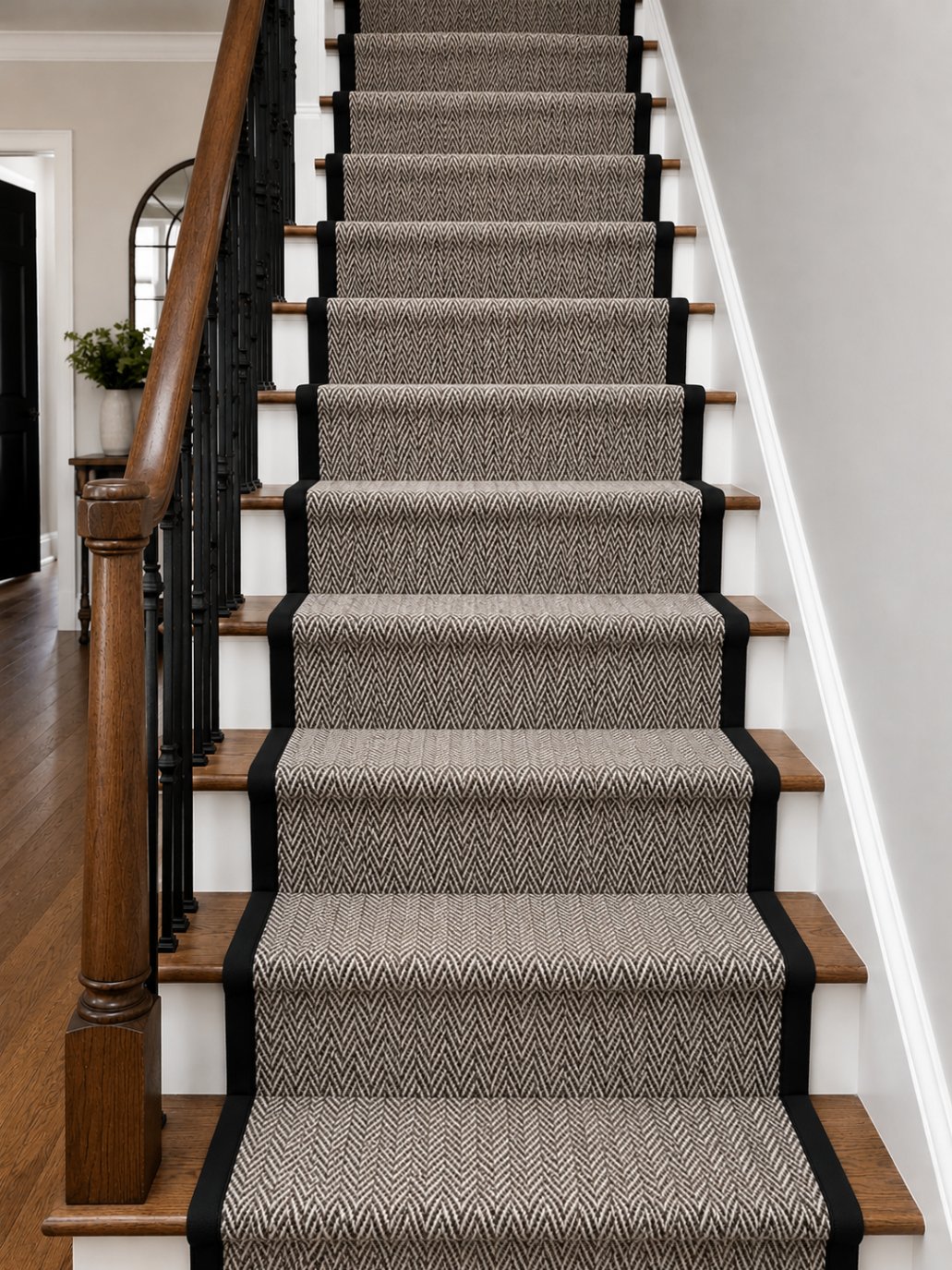
Stair nosing: choose and fit the right tread edge
Stair nosing selection and fitting for hard-floor stairs. Plan profiles, tread edges, fixing and transitions with a free survey and written quotation.
A stair nosing is the profile at the front edge of a tread. On hard-floor stairs it protects the covering edge and defines where the step finishes. The correct choice depends on the stair construction, tread shape and flooring system. We fit hard flooring on stairs with the nosing details considered alongside the treads and risers, rather than choosing an edge trim after the covering has been cut.
The stair flooring page covers the complete hard-floor staircase. Here, the focus is the edge itself: choosing a compatible profile, checking the existing nose, fixing it properly and connecting it to the surrounding covering. If the immediate problem is a worn or loose edge, our stair nosing advice guide explains why the cause needs attention before a replacement detail is selected.
Match the profile to the construction
Look at the shape of the existing front edge and the thickness of the proposed covering together. A rounded bullnose, a square tread and a worn edge need different consideration. The nosing should sit securely against the prepared stair rather than bridge a void or conceal movement. Photographs of the side profile are useful when starting an enquiry, but each step still needs checking.
Some nosings accept an LVT insert; others use a contrasting metal or vinyl finish. Decide whether a closely matched edge or a visible contrast suits the staircase. Appearance is only one part of the choice: the profile must work with the tread, covering thickness and manufacturer fixing detail. An ordinary room threshold should not be substituted for a stair-specific system.
Tread, riser and nosing form one detail
Agree how the horizontal tread meets the vertical riser and where the nosing sits in that junction. Glue-down LVT is the usual hard-floor stair option in our fitting approach, with the tread and riser pieces cut to suit each step. A click floor intended to float across a room should not be assumed suitable for that stair arrangement.
Winders and curved steps add individual shapes to the work, so counting steps alone does not describe every cut. Landings, top steps and the bottom connection to a hallway also need checking. The direction of the floor and the visual line of the edges should be planned across the whole flight rather than treating each nose as an unrelated accessory.
A loose edge needs assessment before covering
Movement, a damaged substrate or an unsuitable fixing can leave a nosing loose. Fitting another profile over the same fault does not address the underlying issue. Tell us when the movement appeared, whether the tread itself moves and what is known about the existing flooring. Avoid using the affected step where an insecure edge creates a hazard while arranging an assessment.
The base must support the fixing method specified for the selected nosing. Existing adhesive, worn timber and irregular edges may require preparation before the new detail is fitted. Our subfloor preparation service explains the wider assessment process. Necessary stair preparation and the proposed profile should be identified in the written quotation rather than left as an unspecified finishing allowance.
Plan access, quotation and aftercare
A staircase is an access route as well as a fitting area. Explain who uses it, what alternative access exists and whether the work includes landings or adjoining floors. The programme needs to allow for preparation and the chosen adhesive or fixing system before normal use. Do not arrange a return to heavy use solely around the time the last visible piece is fitted.
The number and shape of steps, chosen nosings, old-floor removal and edge preparation affect the cost. For a survey, send the staircase details and flooring specification if already selected. Afterwards, follow the profile and covering care instructions together. Check any new movement rather than treating it as ordinary wear; a secure edge and a tidy-looking edge are not automatically the same thing.
Frequently asked questions
- What does a stair nosing do?
- It protects the front edge of a tread and defines the step edge. On hard-floor stairs it must be compatible with the covering and securely fitted to the prepared stair.
- Can stair nosings match my LVT?
- Some profiles accept an LVT insert, while other options provide a contrasting edge. The selected profile, floor thickness and stair construction need checking together.
- Can a loose stair nosing simply be glued back?
- Assess the cause first. Movement, damage or an unsuitable fixing can require preparation or a different detail rather than another bond over the same problem.
- What affects stair nosing cost and fitting time?
- Step number and shape, the selected profile, existing edge condition, removal work and product fixing requirements all affect the quotation and programme.
Free measure, free written quote
Send the number and shape of your steps and any selected flooring details, then book a free survey for the stair edge and fitting scope.
Showroom and warehouse: Unit 9, Matilda Close, Gillingham Business Park, Gillingham, Kent, ME8 0PY