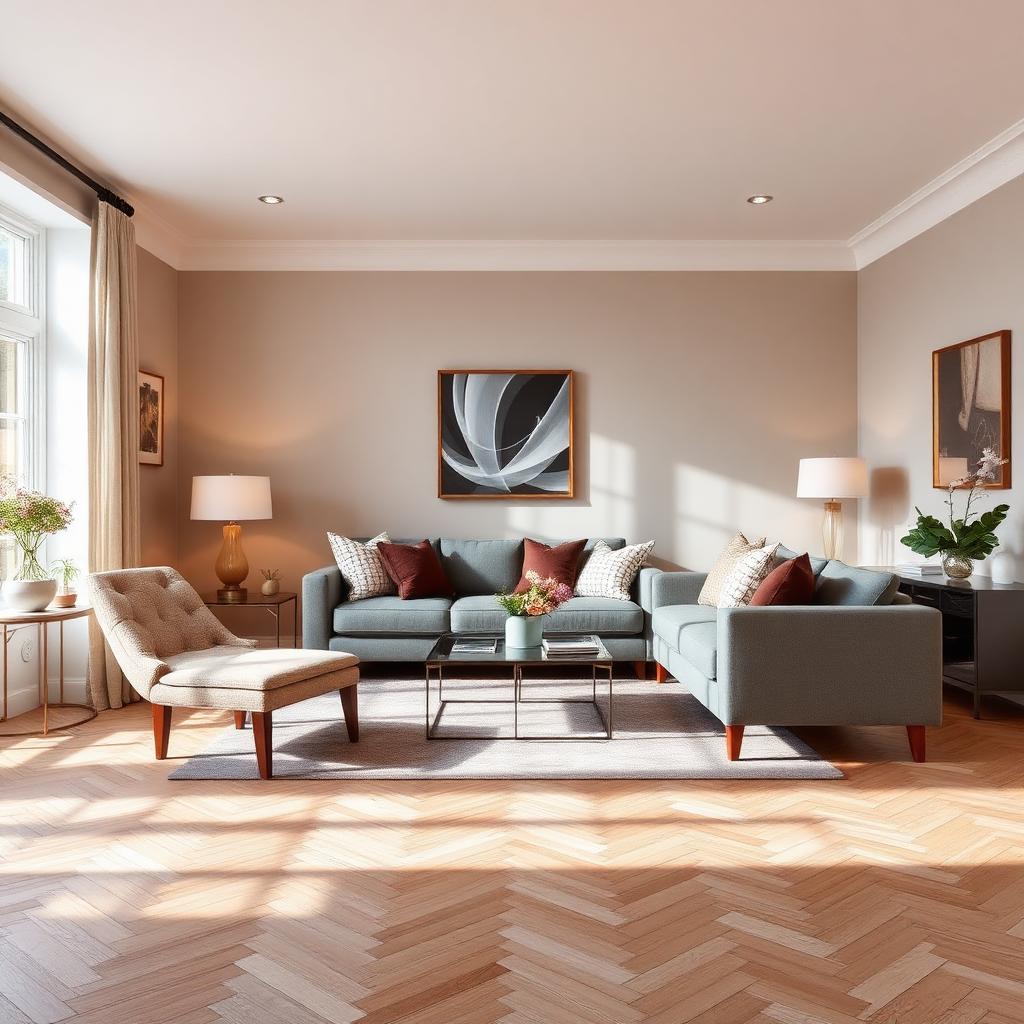
Best Flooring for a Living Room
Choosing between carpet, LVT, engineered wood and laminate in a lounge, covering warmth, acoustics, log burners, pets and how the room is actually used.
The living room is the room people agonise over most, because it has to be comfortable enough to sit on and tough enough to take daily use. It is also usually the largest single area in the house, so the decision carries the biggest share of the budget.
The right answer depends far more on how the room is used than on what is fashionable. A quiet adult lounge and a family room with a dog and two children are different problems.
Matching the floor to how the room is used
| Situation | Best choice | Why |
|---|---|---|
| Adult household, comfort led | Wool or 80/20 carpet | Warmth and quiet, low traffic means it lasts |
| Family with young children | LVT with a large rug | Spills wipe up, rug gives a soft play area |
| Dogs | Glue-down LVT or oiled engineered wood | Claw resistant and cleanable, oiled wood spot repairs |
| Open-plan lounge and kitchen | LVT throughout | One continuous floor, no awkward transition |
| Flat above another dwelling | Carpet, or LVT on acoustic underlay | Impact sound is the lease issue |
| Period property, restoration | Engineered or solid wood | Suits the building, refinishable |
The log burner question
If there is a wood burner or open fire, keep any resilient floor away from direct radiant heat and use a proper hearth extension. LVT can soften and mark under sustained radiant heat, and carpet in front of an open fire is an obvious spark risk.
The usual solution is a stone or tiled hearth extending the recommended distance in front of the appliance, with the main floor finishing neatly against it under a matching trim.
Acoustics in a large room
A big lounge with a hard floor, plastered walls and minimal soft furnishing will echo. It is not a defect, it is physics, and it surprises people who have gone from carpet to LVT in the same room.
A large rug, lined curtains and upholstered furniture bring it back under control. If the room is genuinely echoey, plan the rug into the budget rather than treating it as an afterthought.
Subfloor issues that shape the choice
- Suspended timber floors in older Kent housing often need a plywood overlay before LVT
- Solid concrete floors from the 1960s and 70s frequently need latex levelling
- A cold, uninsulated ground floor feels much colder under LVT than under carpet
- Any damp reading on a solid floor must be resolved before a resilient or wood floor goes down
Continuity with the rest of the house
Where the lounge opens onto a hallway with a hard floor, running the same floor through both makes a modest house feel considerably larger, and it removes a threshold that would otherwise sit in a doorway you walk through fifty times a day.
Where the lounge is a separate, closed room, there is no reason it has to match. Carpet in the lounge and LVT in the hall is a perfectly coherent combination as long as the door bar finishes match throughout.
Budget guidance for a typical lounge
A 20 square metre lounge in mid-range carpet with a good underlay is generally £560 to £840 installed. The same room in click LVT is usually £1,050 to £1,350 including basic preparation, and in engineered wood £1,450 to £1,900.
Those figures assume a sound subfloor. If latex or plywood is needed, add £12 to £28 per square metre depending on the method.
Planning the transition into the hallway
The doorway between hall and lounge is where most living room floors look either deliberate or accidental. The rule that works is to change material on the door line, directly under the closed door, so each room reads as one complete floor from inside it.
Choose the trim to suit the height difference rather than the colour. A flat door bar works where the two floors finish level, a ramped or lipped profile where there is a few millimetres of difference, and a proper threshold where the gap is larger. Getting this right is what stops a transition catching a toe or lifting at a corner.
Keep the finish consistent through the house. Matching door bars in every opening is a small detail that makes a mixed-floor house look designed rather than assembled over several years.
Frequently asked questions
- Is LVT too cold for a living room?
- It is cooler underfoot than carpet, noticeably so on a ground floor slab. A large rug or underfloor heating solves it.
- What is the best floor with dogs?
- Glue-down LVT with a good wear layer, or an oiled engineered wood where scratches can be locally repaired.
- Should the lounge match the hallway?
- If they are open to each other, yes. If they are separated by a door, it is purely a design choice.
- Do I need to move all the furniture?
- The room needs to be clear for a hard floor. For carpet we can work in halves if necessary, though a clear room is faster and cheaper.
Keep reading
A three-way comparison of carpet, LVT and laminate on wear, water, comfort, noise, subfloor demands, fitting time and long-term cost, with the weaknesses left in.
Running one floor through kitchen, dining and living areas: expansion, zoning, transitions, levels between old and new, and where a single material stops working.
Claw scratches, accidents, spills and slips. Which floors cope with dogs, cats and young children, which fail early, and the detail that keeps them safe.
See how we survey, prepare and fit carpet across Kent.
See how we survey, prepare and fit LVT across Kent.
See how we survey, prepare and fit engineered wood across Kent.
Talk it through with a fitter, not a call centre
Book a free measure from our Gillingham warehouse and we will bring samples suited to the room discussed here, check the subfloor and leave you with a written quote.