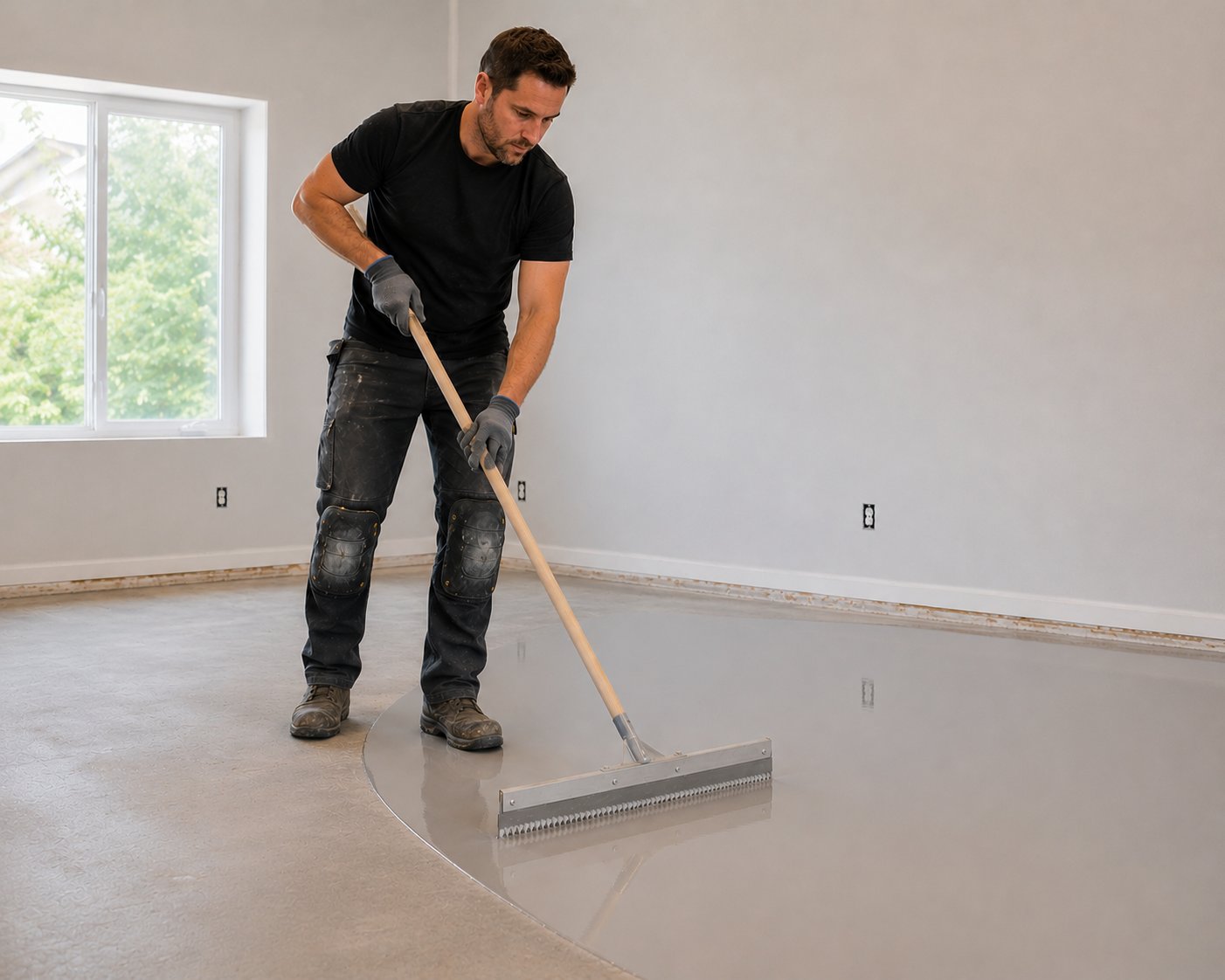
Moisture Testing Floors Before New Flooring Is Fitted
How moisture testing of floors works before new flooring goes down: meters, hygrometer and carbide tests on concrete, what readings mean and what happens next.
Moisture testing of floors means measuring how much water is still held in a concrete slab, screed or timber subfloor before a new floor covers it. Fitters use a quick electronic meter for a first check, then a hygrometer box or carbide test on concrete where the result matters, and only fit once the reading is within the flooring maker's limit.
Moisture trapped beneath a new floor is one of the most common causes of failure — adhesive breaking down, laminate boards swelling, LVT lifting at the edges. Moisture testing before fitting checks whether the subfloor is dry enough for the chosen flooring type, so problems are caught before they're sealed under a new surface rather than discovered months later.
It's a standard part of proper preparation, not an optional extra, particularly on ground floor concrete slabs and anywhere a new screed has recently been laid.
It's also worth testing after any water-related incident, even a fairly minor one — a leaking washing machine, an overflowing bath, or a small roof leak that's since been fixed. Surface staining can dry out and disappear from view long before the moisture trapped within the slab or screed has actually gone, and fitting straight over that hidden moisture simply seals the problem in.
Methods used to test moisture
- Electronic moisture meters, giving a quick relative reading across the surface
- Calcium carbide (speed) testing, a more precise method for higher-risk areas
- Hygrometer boxes left in place for a set period on concrete, following industry-standard test procedure
- Visual checks for staining, efflorescence (white powdery deposits) or a musty smell that hint at a longer-standing damp issue
How a hygrometer box test actually works
A small enclosed box or insulated hood is sealed to the floor over a probe and left for a set period, often around 72 hours, so the relative humidity of the air trapped against the slab can stabilise and be read accurately. It's slower than a surface meter reading but far more reliable, which is why it's the method used to make a final go/no-go decision on higher-risk jobs rather than a quick check alone.
Why concrete floors are checked more carefully
New concrete slabs and screeds can take many weeks or months to dry out fully, and the drying time depends on thickness, ambient conditions and ventilation. A slab that looks and feels dry to the touch can still register a moisture reading well above what's safe for adhesives or moisture-sensitive flooring.
What happens if a reading fails
If moisture is too high for the intended flooring, options include waiting longer for natural drying, improving ventilation, or applying a damp-proof membrane suitable for the situation. Which route makes sense depends on the cause and the flooring being fitted — this is assessed rather than assumed.
Which flooring types are most moisture-sensitive
| Flooring type | Moisture sensitivity |
|---|---|
| Laminate | High — swells and delaminates if damp |
| Engineered wood | High — can cup or gap |
| LVT / vinyl | Moderate — adhesive bond can fail |
| Carpet | Lower risk but underlay and gripper can be affected |
When testing happens in the job timeline
Moisture testing is carried out at survey stage wherever there's a reasonable risk factor — new build, recent leak, ground floor slab, or a room prone to damp — so any remedial work can be built into the quote rather than causing delays on fitting day.
Damp-proof membranes as a fallback, not a first resort
Where a slab genuinely can't be dried out in a sensible timeframe — a new-build on a tight completion schedule, for example — a liquid or sheet damp-proof membrane can be applied to isolate the flooring from the moisture below. It's treated as a considered fallback rather than a routine step, since it adds cost and doesn't address whatever is causing the moisture in the first place.
Frequently asked questions
- How is a concrete floor tested for moisture?
- A meter gives a quick surface reading, and where the result matters a hygrometer box is sealed to the slab for a set period, or a carbide test is taken, to measure moisture within the concrete.
- Does moisture testing apply to wooden floors too?
- Yes. Timber boards and joists are checked with a meter, particularly after leaks or in older properties, because damp timber moves and can damage the new floor.
- Do you test every floor for moisture?
- We assess risk at survey and test where there's a reasonable chance of an issue — ground floor concrete, recent screeding, or a history of damp — rather than testing every single floor as standard.
- What's a safe moisture reading?
- Safe thresholds vary by test method and flooring type, so there isn't one single number — your fitter will explain the relevant standard for your specific job and product.
- Can flooring be fitted while a slab is still drying?
- It depends on the flooring type and the reading. Some situations call for a suitable damp-proof membrane rather than waiting, but this needs assessing on a case-by-case basis rather than assumed as standard practice.
- Will a failed moisture test add cost to my job?
- It can, if remedial work such as a membrane or extended drying time is needed. We'd always explain this clearly and get your agreement before proceeding.
Keep reading
What proper subfloor preparation involves before new flooring goes down, why it matters, and what our fitters check on survey day.
Screed flooring before LVT, vinyl or laminate: how latex self-levelling compound works, when it's needed, and how it differs from sand-cement screed.
A guide to the main flooring adhesive types used for LVT, vinyl, wood and carpet, and why the right choice depends on the subfloor.
See how we survey, prepare and fit LVT across Kent.
See how we survey, prepare and fit laminate across Kent.
Talk it through with a fitter, not a call centre
Book a free, no-obligation survey with Kent Flooring Warehouse and our in-house fitting team will check your subfloor and confirm the right moisture testing before you commit to anything — call 07702 737267.