Flooring Adhesives: Choosing the Right Type
A guide to the main flooring adhesive types used for LVT, vinyl, wood and carpet, and why the right choice depends on the subfloor.
Not all flooring adhesive is interchangeable — the right choice depends on the flooring type, the subfloor material, and conditions like moisture or underfloor heating. Using the wrong adhesive is a common cause of bond failure, and it's rarely obvious until the floor has been down for a while and starts to lift or move.
Adhesive choice is part of the overall specification, decided alongside the subfloor assessment rather than as an afterthought once the flooring itself is chosen.
Adhesive also has a shelf life and needs storing correctly before use — kept too cold, too hot, or too long in a builder's van, some products separate or lose their working properties without any obvious change in appearance. Reputable fitters buy adhesive close to the fitting date rather than carrying old stock, precisely because a bond that looks fine going down can fail months later if the adhesive itself wasn't in good condition.
Main adhesive types used in flooring
| Adhesive type | Typical use |
|---|---|
| Acrylic/vinyl adhesive | LVT and sheet vinyl on standard interior subfloors |
| Pressure-sensitive adhesive | Click LVT that needs limited, repositionable bond |
| Polyurethane adhesive | Engineered wood, higher-moisture-tolerant applications |
| Epoxy adhesive | Heavy-duty commercial settings, high chemical/moisture resistance |
| Carpet adhesive (double-stick) | Fully bonded carpet installations, often in commercial settings |
Why subfloor type drives the choice
Adhesives are formulated for particular substrates — an adhesive that bonds well to concrete may not perform the same on plywood, and vice versa. Porosity, moisture tolerance and flexibility all need matching between the adhesive and both surfaces it's bonding.
Adhesives for underfloor heating and damp-prone areas
Where underfloor heating is present, a flexible adhesive rated for repeated temperature cycling is specified rather than a standard product, since ordinary adhesives can become brittle and fail under heat stress. Similarly, higher-moisture areas need adhesives with proven damp tolerance rather than assuming any adhesive will do.
Trowel notch size and coverage
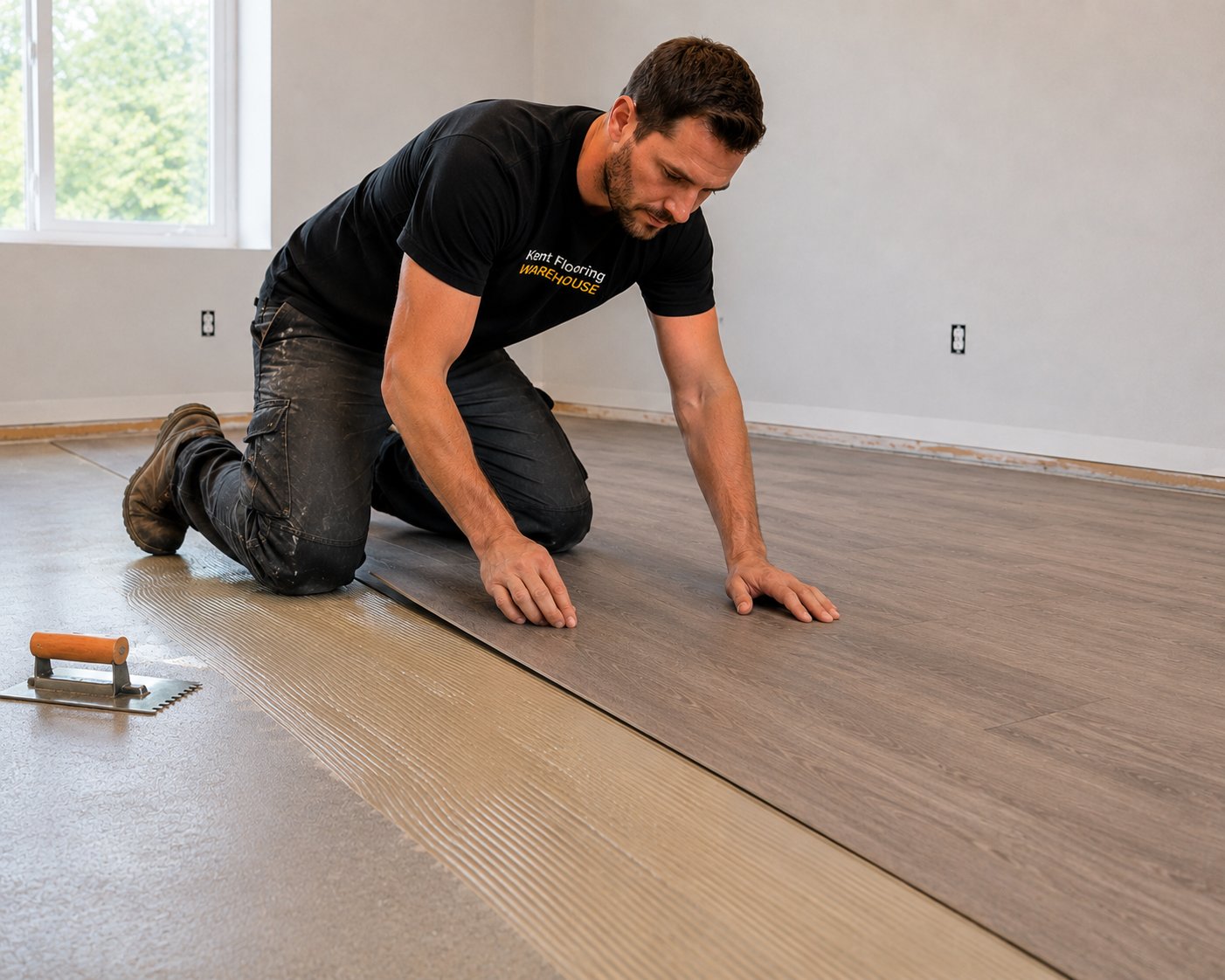
The trowel notch size used to spread adhesive affects how much is applied and how well the flooring beds down — too little adhesive risks poor bond, too much can cause ridging or squeeze-out. This is matched to the flooring manufacturer's recommendation, not just whatever trowel is to hand.
Coverage rates are usually quoted by manufacturers as a range in square metres per tub, but the actual figure achieved on site depends heavily on how porous and how flat the subfloor is — a slightly uneven substrate soaks up more adhesive in the low spots, which is one reason estimated coverage on paper doesn't always match what's used on the day.
Hard-set versus pressure-sensitive bonding
Some adhesives cure to a rigid, permanent bond, while pressure-sensitive types stay slightly tacky, allowing the flooring to be repositioned briefly or, in some cases, lifted again later without destroying the subfloor beneath. The choice affects more than just installation day — a hard-set adhesive under LVT makes future replacement more labour-intensive, whereas a pressure-sensitive system is often chosen deliberately in commercial settings where floors are expected to be changed periodically.
Open time and working conditions
Adhesives have a limited 'open time' — the window during which flooring can still be laid into it and bond properly. Room temperature, humidity and how much area is spread at once all affect this, which is why experienced fitters work in manageable sections rather than covering an entire room before laying begins.
Frequently asked questions
- Can any adhesive be used for click LVT?
- Click LVT is usually a floating floor and doesn't need full adhesive, though some products use a pressure-sensitive adhesive underlay or perimeter bonding depending on the manufacturer's instructions.
- Does adhesive choice affect warranty?
- Yes — most flooring manufacturers specify approved adhesive types, and using an unapproved product can affect your warranty even if the floor looks fine initially.
- Why did my old vinyl floor lift at the edges?
- This is commonly caused by moisture reaching the adhesive, an unsuitable adhesive for the subfloor, or insufficient coverage during application. It's usually preventable with correct specification and preparation.
- Is adhesive included in a standard flooring quote?
- Yes, adhesive is part of the fitting specification and priced accordingly — the correct type for your subfloor and flooring is included rather than substituted for a cheaper generic product.
Keep reading
How LVT wear layer thickness and AC/commercial use class ratings relate to durability, and which specification suits which room.
How moisture testing of floors works before new flooring goes down: meters, hygrometer and carbide tests on concrete, what readings mean and what happens next.
What seam welding is, why it's used on sheet vinyl in wet areas and commercial settings, and how it differs from a standard seam.
See how we survey, prepare and fit LVT across Kent.
See how we survey, prepare and fit vinyl across Kent.
Talk it through with a fitter, not a call centre
Book a free, no-obligation survey with Kent Flooring Warehouse and our in-house fitting team will check your subfloor and confirm the right adhesive specification before you commit to anything — call 07702 737267.