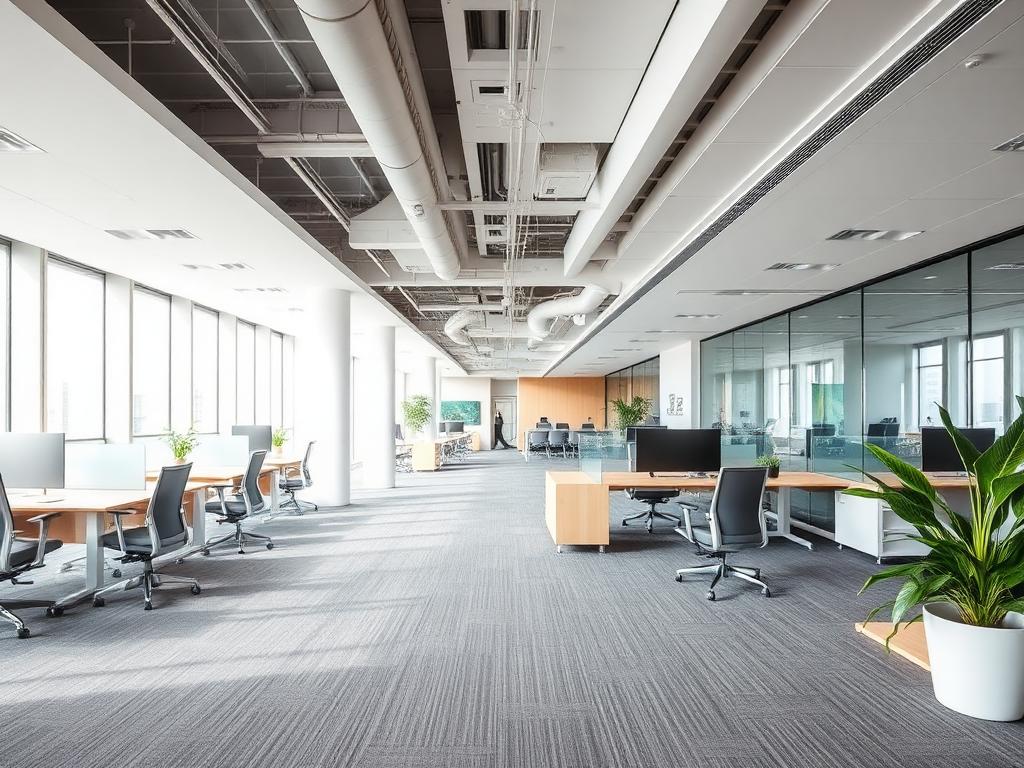
Carpet Tiles vs LVT for Offices
Specifying an office floor? Compare carpet tiles and LVT on noise, cable access, cleaning, downtime and what the subfloor allows.
This is the choice most office fit-outs actually come down to once broadloom has been ruled out: a modular carpet tile floor, or LVT laid plank by plank. Both are contract products we fit across commercial premises in Kent, and both will last if they are specified for the right zone and bonded to a base that was properly prepared.
They fail in different ways, which is the useful part. Carpet tiles lose their looks before they lose their structure, going flat and shaded in the walkways while the rest of the floor still looks new. LVT keeps its appearance far longer but shows every fault in the subfloor beneath it, and a lifting edge or an opening joint is immediately visible to everyone in the room.
So rather than picking a winner, most of the offices we quote end up with both: carpet tiles where people sit and where noise matters, LVT where people walk, eat, roll trolleys and spill things. Splitting the floor by zone usually costs less over the building's life than forcing one material to do a job it was never suited to.
Noise is the reason carpet tiles still win desk areas
An open-plan floor full of hard surfaces gets loud, and flooring is one of the few elements that can absorb sound rather than bounce it back. Carpet tiles take the edge off footfall and chair movement in a way no vinyl plank can, which is why they remain the default under desking even in buildings that have gone hard-floor everywhere else.
LVT does the opposite — footsteps, castor wheels and dropped objects all read clearly. In a walkway or a kitchen that is rarely a problem. Directly under a row of desks or in a meeting room with a hard ceiling, it can be.
Where a hard floor is wanted regardless, the answer sits in the build-up rather than the surface: an acoustic underlay or an acoustic-backed product, specified at survey against what the floor below actually needs. That matters far more in a converted flat or a tenanted upper storey than it does on a ground-floor unit.
Cable access, raised floors and reconfiguration
- Raised access floors point firmly at carpet tiles: single tiles lift for access to the void beneath and go back down without disturbing the rest of the floor.
- Frequent desk moves, flexible layouts and changing partition lines suit a modular floor for the same reason.
- Bonded LVT over a raised access floor is a commitment — reaching the void below means cutting into a finished, glued surface.
- Where cabling is fixed and routed in trunking or perimeter dado, that advantage disappears and the decision moves back to wear and cleaning.
Cleaning regime, spills and what each floor forgives
Carpet tiles absorb. Tea, coffee and print toner all leave a mark that spot cleaning may not fully lift, and the honest fix in a commercial setting is to swap the affected tile rather than keep scrubbing it — quick, cheap, and one of the real reasons facilities teams choose tiles in the first place, provided attic stock was kept from the original batch.
LVT repels. A spill wipes off a bonded vinyl floor, mopping is routine, and the surface takes a cleaning regime that would flatten carpet pile within a year. In a staff kitchen, a breakout area with a coffee machine or a treatment or consulting room, that is decisive.
The trade-off is what shows. LVT shows scuffing and black streaking from rubber wheels and shoe soles, particularly in a dark matt finish under bright lighting, and keeping it looking right means the right cleaning products rather than more effort. Carpet tiles hide day-to-day marking but gradually shade and flatten in the traffic lines.
Wear specification: what to actually check on the data sheet
Both categories are sold in domestic and contract grades, and the label on the box matters more than the material name. For LVT, the wear layer thickness is the number that decides whether a floor survives a commercial year — a domestic-grade wear layer put into a busy office will dull and wear through in the traffic lines long before anyone expects it to.
For carpet tiles, look for a contract construction: a dense, tufted pile with a solid tile backing that resists indentation from furniture feet and castor chairs. Domestic carpet in a commercial setting is a false economy, which is a point we make consistently across our commercial work.
| Consideration | Carpet tiles | LVT |
|---|---|---|
| Noise underfoot | Absorbs footfall and chair movement | Reflects it; may need acoustic underlay |
| Spills and wet cleaning | Absorbs; spot clean or swap the tile | Wipes clean; suits routine mopping |
| Cable void access | Individual tiles lift and relay | Bonded surface must be cut |
| What wears first | Pile flattens and shades in traffic lines | Wear layer dulls; scuffing shows |
| Key spec figure | Contract-grade pile and tile backing | Wear layer thickness for commercial use |
| Repair after damage | Replace the affected tiles | Patch individual planks |
Either way, the subfloor decides the result
This is the part that gets cut from budgets and then causes the callback. LVT is thin and semi-rigid, so it telegraphs what is underneath it: a trowel ridge left in a rushed levelling pour, a board joint in old timber, a dip across a screed bay. Bonded planks also need a base within a safe moisture range, because adhesive put down over a slab that is still drying is the usual reason a new floor starts lifting at the edges months later.
Carpet tiles are more forgiving of minor undulation, but they are not a way to avoid preparation. They are still bonded down, so they still need a sound, clean, dust-free base, and they will still sound hollow over levelling compound that delaminated from the slab because the primer was skipped.
We survey levels with a straightedge and test moisture before specifying either product, so preparation appears as its own line on the quote rather than as a surprise raised on fitting day. On concrete that usually means latex levelling; over timber it usually means plywood overlay.
Downtime in an occupied building
Carpet tiles suit a live building. They arrive in manageable boxes that can be stored on site and moved floor by floor, and they can be laid in sections out of hours or over a weekend, so an area can be handed back as it is finished.
LVT is less flexible on programme, because the honest timeline includes whatever the subfloor needs first. Levelling compound or overlay boarding has to be completed and given its curing time before planks go down, and that sequence cannot be compressed to suit a trading week — it is why we set out preparation as a separate stage when quoting commercial work.
Which is right for your office
Choose carpet tiles if the floor sits over a raised access void, if desks and partitions move, if the space needs to stay quiet, or if you want the ability to replace a stained tile in minutes rather than schedule a repair.
Choose LVT if the area gets wet, eaten in or wheeled across — entrances, kitchens, breakout spaces, corridors and client-facing circulation — and if you want a floor whose appearance holds up under routine mopping for years.
Where carpet tiles genuinely beat LVT: acoustics, cable access, phased installation in an occupied building, and the ease of a like-for-like repair. Where LVT genuinely beats carpet tiles: wet cleaning, spill resistance, appearance retention and the look of a continuous hard floor through a reception or circulation route. Most schemes are better for using each where it is stronger, and we are happy to mark that split on your plan at survey.
Frequently asked questions
- Can carpet tiles and LVT be used in the same office?
- Yes, and it is what we specify most often: carpet tiles under desking and in meeting rooms, LVT through entrances, kitchens and circulation. The junction is finished with an appropriate threshold trim so the two build-ups meet level and neither edge is left exposed.
- Will LVT be too noisy for an open-plan office?
- It is noisier underfoot than carpet, and how much that matters depends on the room's ceiling, layout and the storey it sits on. Where a hard floor is wanted anyway, an acoustic underlay or acoustic-backed product is specified at survey rather than added as an afterthought.
- Which lasts longer in a commercial setting?
- Specified correctly, LVT usually holds its appearance longer, because a contract wear layer resists the dulling that flattens carpet pile in traffic lines. Carpet tiles counter that with replaceability — you renew the worn tiles rather than the whole floor.
- Do we need subfloor preparation for carpet tiles too?
- Usually some. Carpet tiles tolerate minor undulation better than LVT, but they are bonded down and still need a sound, clean, dust-free base. Our survey confirms what is genuinely needed instead of applying preparation as a default cost.
- Should we keep spare tiles after the installation?
- We recommend it for any commercial carpet tile floor. Holding attic stock from the original batch means a damaged or stained tile can be swapped for an exact match later, which is difficult once a product's dye lot has moved on.
- Can either floor be fitted without closing the office?
- Carpet tiles phase well and can often be laid in sections or out of hours. LVT depends on the subfloor: if levelling or overlay boarding is needed, that work and its curing time have to be built into the programme first.
Keep reading
Quoted for levelling or boarding before a new floor? Here is how latex compound and plywood overlay differ and which your subfloor needs.
Fitting out an office or commercial unit? Compare carpet tiles and broadloom carpet on cost, downtime and wear.
How LVT wear layer thickness and AC/commercial use class ratings relate to durability, and which specification suits which room.
What to think about when specifying flooring for an office refurbishment — footfall zoning, acoustics, cabling and phased fitting.
Contract-grade or domestic carpet — understand construction, durability and where each is actually needed.
How carpet tiles are installed in offices and homes: preparing the floor, tackifier, setting out from the centre, pile direction, cutting in and replacing tiles.
See how we survey, prepare and fit commercial flooring across Kent.
See how we survey, prepare and fit LVT across Kent.
See how we survey, prepare and fit carpet across Kent.
Talk it through with a fitter, not a call centre
We survey commercial premises free of charge and will set out the zone-by-zone specification, preparation and programme in writing — call 07702 737267 or email sales@kentflooringwarehouse.com.