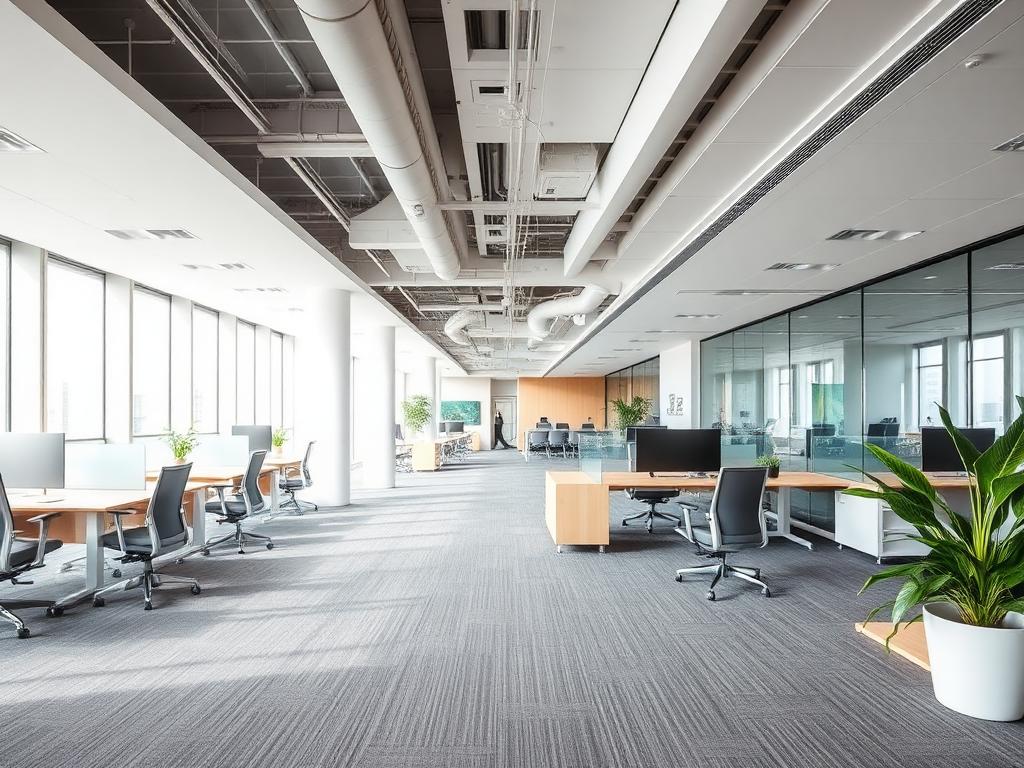
What Should You Consider for Office Flooring?
What to think about when specifying flooring for an office refurbishment — footfall zoning, acoustics, cabling and phased fitting.
Office flooring decisions are shaped by more than appearance. Footfall varies significantly across a typical office — heavy near entrances and communal areas, lighter in individual offices and meeting rooms — and the working pattern of the business dictates how and when fitting can actually happen.
This guide covers the practical specification and scheduling factors that come up most often in office refurbishment projects.
Because most office refurbishments happen alongside other trades — partitioning, electrics, decorating — flooring is rarely an isolated job, and its place in the overall programme affects both cost and the order in which work can proceed.
Zoning flooring by footfall and use
- Reception and entrance areas typically need the most durable, slip-resistant specification
- Open-plan work areas benefit from carpet tiles, which allow easy replacement of individual worn or damaged tiles
- Breakout and kitchen areas often suit hard flooring for easier cleaning around food and drink
Acoustic comfort in open-plan spaces
Open-plan offices can suffer from excessive noise reverberation, and flooring choice plays a role alongside other acoustic measures. Carpet tiles generally perform better acoustically than hard flooring, which is one reason they remain common in open-plan office areas despite the popularity of LVT elsewhere.
Working around cabling and raised access floors
Many offices run power and data cabling under raised access floors or in floor boxes, and flooring choice and installation sequencing need to accommodate this — including maintaining access for future cabling changes without needing to lift large areas of flooring.
Phasing to minimise business disruption
Refurbishing an occupied office often works best in phases, moving staff between zones as each area is completed, or scheduling fitting outside working hours where the business can't easily relocate desks and equipment temporarily.
Balancing durability with design
Office flooring specification is often as much about brand image and workplace feel as durability, but the two don't have to conflict — many commercial-grade carpet tiles and LVT ranges offer a wide choice of finishes without compromising on wear performance.
Sequencing flooring against other refurbishment trades
Flooring is usually one of the later trades on site, going in after ceiling and electrical work but before furniture and IT installation, since dust and debris from earlier trades can damage a finished floor. Getting this sequencing agreed upfront avoids costly protection measures or, worse, redoing damaged flooring.
Meeting room and focus pod acoustic needs
Meeting rooms and enclosed focus pods often benefit from a different acoustic approach to the open-plan floor, since sound reflecting off hard surfaces in a small enclosed space can make video calls and conversations harder to follow. Carpet or acoustic-backed flooring is commonly specified in these smaller rooms even where the wider office uses a harder finish.
Sustainability and take-back schemes for old flooring
Many businesses now want old carpet tiles or flooring diverted from landfill where possible as part of wider environmental commitments, and some manufacturers offer take-back or recycling schemes for their own products. It's worth raising this at the quoting stage if it matters to your organisation, since it can affect which products are specified and how removal is costed.
Frequently asked questions
- Should office flooring be fitted during or outside working hours?
- This depends on the scale of the project and whether the business can relocate staff temporarily; smaller zones can sometimes be fitted during the day, while larger areas are often better scheduled evenings, weekends or during planned office closures.
- Are carpet tiles better than broadloom carpet for offices?
- Carpet tiles are popular in offices because individual damaged or worn tiles can be replaced without redoing the whole floor, which suits high-traffic commercial use better than broadloom carpet in most office settings.
- How does raised access flooring affect a refurbishment?
- It needs to be factored into both the flooring choice and the fitting sequence, since access to cabling and floor boxes generally needs to be maintained for future IT and electrical changes.
- Can different flooring types be used in different zones of the same office?
- Yes, this is common practice — zoning flooring by footfall and use (entrance, open-plan, breakout, meeting rooms) generally gives a more practical and cost-effective result than a single uniform specification throughout.
Keep reading
How commercial flooring projects are costed — area, product spec, subfloor, phasing and out-of-hours work — with guide-only UK price bands.
Flooring considerations for retail and hospitality venues — footfall, brand image, slip resistance and out-of-hours fitting around trading.
Flooring considerations for schools and nurseries — durability, slip resistance, acoustics and fitting around term-time schedules.
Specifying an office floor? Compare carpet tiles and LVT on noise, cable access, cleaning, downtime and what the subfloor allows.
What a commercial flooring contractor does from survey to handover: paperwork, out of hours programmes, subfloor work and the questions worth asking first.
How carpet tiles are installed in offices and homes: preparing the floor, tackifier, setting out from the centre, pile direction, cutting in and replacing tiles.
See how we survey, prepare and fit commercial flooring across Kent.
Talk it through with a fitter, not a call centre
Request a measured written quote from Kent Flooring Warehouse after a free, no-obligation site survey — call 07702 737267 to book a visit from our Gillingham-based team of in-house fitters.