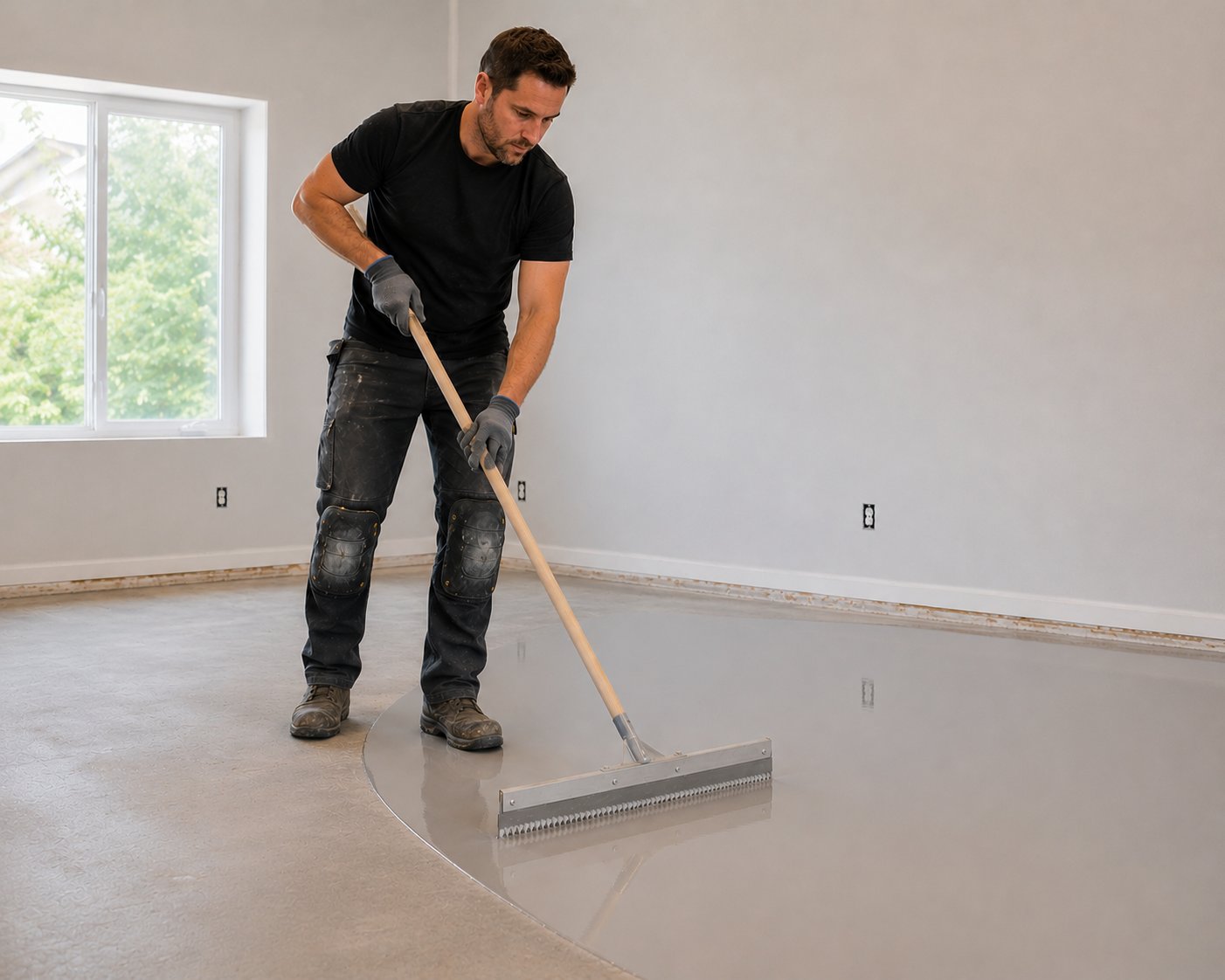
Latex Screed vs Plywood Overlay
Quoted for levelling or boarding before a new floor? Here is how latex compound and plywood overlay differ and which your subfloor needs.
These two are often presented as rival ways of spending the same money on preparation. In practice they are not really competitors at all, because what you have underneath usually picks one for you: latex self-levelling compound belongs on sound concrete and old hard screed, plywood overlay belongs over timber floorboards.
Both exist to solve the same problem from different directions. LVT, sheet vinyl and laminate need a flat, rigid, continuous base, and neither an undulating slab nor a set of moving floorboards provides one. Latex flows out to a smooth finish over a hard base; plywood bridges board joints and stiffens a floor that flexes.
The comparison is still worth making, because the choice affects cost, floor height, timescale and what happens at your doors. It also affects what you should push back on: preparation quoted on the wrong method for your subfloor is a warning sign, and it is the reason we check levels and moisture at survey before either line goes on a quote.
The subfloor makes the decision before cost does
On a solid concrete or screeded floor that is structurally sound but uneven, latex is the straightforward answer and generally the less costly one. It is a finishing layer, typically poured from a couple of millimetres up to around 10mm, and it cures in hours rather than days. Deeper than that and a fibre-reinforced or deep-fill product is used instead, because standard compound poured too thick can crack or shrink unpredictably.
On a suspended timber floor, latex is not the answer. Replacing boards with screed is not practical without significant structural work, so flooring-grade plywood is fixed across the existing timber instead — commonly 6mm to 12mm, screwed rather than nailed at close centres so it cannot work loose.
The two are not interchangeable, and that single point resolves most of the confusion we hear. Anyone quoting latex over floorboards, or boarding over a concrete slab that simply needs a skim, is solving the wrong problem.
Side by side
| Point of comparison | Latex self-levelling | Plywood overlay |
|---|---|---|
| Suits | Sound concrete and old hard screed | Timber floorboards and suspended timber |
| Typical build-up | 2–10mm | 6–12mm board thickness |
| Ready for flooring | Hours, product dependent | Same day once fixed down |
| Solves | Dips, ridges, general unevenness | Board joints, gaps, flex and squeak |
| Moisture caveat | Slab must be within a safe moisture range first | Flooring-grade ply; cheap ply swells if wetted |
| Effect on doors | Minimal height gain | Raises the floor; doors may need trimming |
What each method genuinely fixes, and what it hides
Latex deals with the shape of a hard floor. Poured over a primed, swept base it leaves a surface that should feel almost like glass underfoot — no trowel marks, no ridges, no hollow patches. What it cannot deal with is moisture: laid over a damp slab it traps the problem instead of solving it, which is why moisture testing comes before levelling is agreed rather than after.
Plywood deals with movement. It stops board joints telegraphing through thin vinyl as ridge lines, takes the flex out of springy boards so LVT joints are not stressed, and quietens loose boards that would otherwise squeak under a bonded floor. What it can hide is a joist problem, and a bouncy floor sometimes points to undersized or damaged joists rather than tired boards — that gets flagged rather than boarded over.
Faults we find where the wrong call was made
- Levelling compound poured onto a dusty, unprimed slab, delaminating later and sounding hollow underfoot although the surface looks flat
- Standard latex pushed well beyond its rated depth, then cracking across the surface
- Levelling carried out over damp concrete without the moisture being dealt with first
- A rushed pour left with trowel ridges that read straight through thin LVT once it is fitted
- Shuttering-grade ply used instead of flooring grade, its rough face and inner voids telegraphing through the new floor
- Sheets cut square and gapped at pipes and architraves instead of scribed, leaving shadow lines through the finished floor
Cost drivers rather than a headline figure
Both are priced per square metre and both appear as a distinct line on your quote rather than being folded invisibly into the flooring price. What moves the number is the work involved, not the method name.
For latex, the driver is depth and how much making good the existing surface needs beforehand — a light skim over a mostly flat slab costs less than levelling a floor with real dips across several rooms. For plywood, the driver is board thickness, area and how much preparation the existing boards need before sheets can go down, since more fixing and scribing means more time on site.
Living with the difference: height, doors and disruption
Plywood adds its own thickness to your floor, commonly 6–12mm, which is usually manageable but occasionally means trimming doors to clear the new level and checking where floors meet between rooms. Worth mentioning to your fitter in advance if a door is already tight in its frame.
Latex adds very little height, but it does need the room prepared for a pour. Doorways are often dammed with timber battens so the liquid does not run into the hallway, and pipework and floor-mounted fittings need protecting or working around. Radiators and kitchen units usually stay put, so the compound is worked carefully around pedestal legs and skirting.
Which is right for your floor
If your subfloor is concrete or hard screed and the problem is that it is uneven, latex levelling is the right method and there is no advantage in boarding over it. If your subfloor is timber boards and the problem is joints, gaps or flex, plywood overlay is the right method and latex is not a substitute.
Where plywood wins even though latex is cheaper: it is the only sensible route on suspended timber, it goes down and is ready the same day, and it fixes squeak and movement that no levelling compound can touch. Where latex wins: on concrete it adds almost no height, needs no door trimming and gives the flattest possible base for thin LVT or sheet vinyl.
Carpet changes the calculation again. Underlay and carpet are far more forgiving of minor unevenness and board movement, so neither method is needed as often — which is exactly the kind of cost we would rather take off a quote than leave on it. Our survey checks levels with a straightedge and tests moisture so you get an honest answer either way.
Frequently asked questions
- Can latex screed be poured over floorboards?
- It is not the standard approach. Timber boards move and flex, and a rigid compound over them is liable to crack, so plywood overlay is used on timber subfloors instead. Latex is for sound concrete and old hard screed.
- Is plywood overlay cheaper than latex levelling?
- The comparison rarely arises, because the subfloor decides the method. Both are priced per square metre, and the cost turns on depth or board thickness, the area involved and how much preparation the existing surface needs first.
- Does either method solve a damp subfloor?
- No. Both are preparation methods, not damp treatments. If moisture testing returns a reading above the safe threshold, that has to be addressed before any levelling, boarding or new flooring goes ahead.
- How soon can flooring be fitted afterwards?
- Plywood overlay is generally ready once it is fixed down. Latex cures in hours rather than days, but the time varies by product and depth, and a fresh sand-cement screed underneath it is a different matter again and may need weeks.
- Will preparation be on my quote as a separate item?
- Yes. Levelling and overlay are set out as their own lines so you can see what is being charged for preparation and what is being charged for the floor itself.
- How do I know which one my floor needs?
- Our survey establishes what the subfloor is, checks levels with a straightedge and tests moisture, then specifies the method that suits it — rather than adding preparation as a default cost on every job.
Keep reading
Specifying an office floor? Compare carpet tiles and LVT on noise, cable access, cleaning, downtime and what the subfloor allows.
What proper subfloor preparation involves before new flooring goes down, why it matters, and what our fitters check on survey day.
Screed flooring before LVT, vinyl or laminate: how latex self-levelling compound works, when it's needed, and how it differs from sand-cement screed.
Why plywood overlay boarding is used over timber subfloors before fitting vinyl or LVT, and how it differs from screeding.
How moisture testing of floors works before new flooring goes down: meters, hygrometer and carbide tests on concrete, what readings mean and what happens next.
What subfloor preparation involves and what it typically costs — levelling compound, damp treatment, plywood overlay — guide-only UK ranges.
See how we survey, prepare and fit LVT across Kent.
See how we survey, prepare and fit vinyl across Kent.
See how we survey, prepare and fit commercial flooring across Kent.
Talk it through with a fitter, not a call centre
We check levels and moisture at survey and quote preparation as its own line, so you know exactly what your subfloor needs — call 07702 737267 or email sales@kentflooringwarehouse.com.